
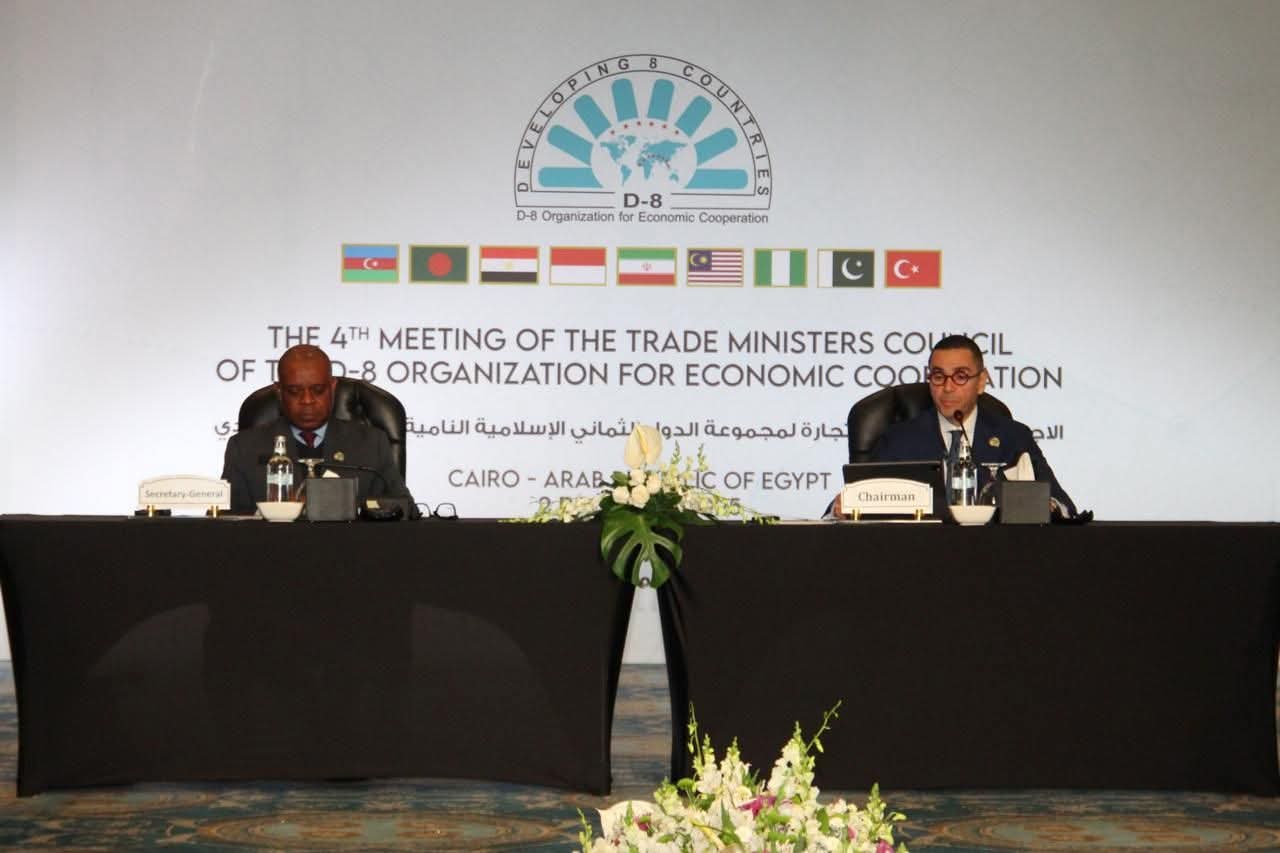
Minister El Khatib expressed pride in hosting the session, affirming that the meeting reflected the member states' commitment to boosting economic and trade cooperation, exploring new opportunities for development, and achieving prosperity for the region's people.
The Minister stressed the necessity for D-8 nations to unite
in addressing global shifts in international trade and value chains. He noted
that these changes demand more flexible policies to enhance trade integration
and sustainable growth within the group.
Highlighting the D-8's diversity in heritage, culture, and
rich resources, El Khatib remarked that uniting under the organization's
umbrella offers a unique opportunity to leverage collective potential, open new
horizons for trade and investment, and improve living standards.
El Khatib stated that intra-D-8 trade reached approximately
$150 billion in 2024. He emphasized the importance of joint efforts to
significantly increase this figure to reflect the true potential of member
states.
During its chairmanship, Egypt focused on key priorities,
including deepening trade integration, boosting investment, supporting
sustainable development, leveraging technology and innovation, building
capacity, improving infrastructure, and strengthening institutional frameworks.
The Minister indicated that Egypt worked to ensure the D-8
Preferential Trade Agreement (PTA) becomes a vital platform for economic
cooperation. Key to this is the full activation of the agreement,
implementation of the Trade Facilitation Strategy, agreeing on a binding
timetable, and operationalizing the Dispute Settlement Mechanism.
El Khatib confirmed Egypt's commitment to soon completing
the ratification procedures for the PTA and notifying the Secretariat. He also
stressed the importance of launching the working group for the Comprehensive
Economic Partnership Agreement (CEPA) to expand the agreement's scope. The
ultimate goal, he noted, is to elevate intra-D-8 trade to $500 billion by 2030,
aligning with the established roadmap.
The Minister highlighted the need to support Small and
Medium Enterprises (SMEs) and empower youth. He emphasized the importance of
proceeding with the establishment of a Regional Seed Bank and exploring the creation
of a Strategic Commodity Reserve to bolster food security among member states.
El Khatib concluded by stressing that expanding cooperation frameworks requires organizing trade forums and delegation visits to promote investment and facilitate direct contact between the private sectors of member states, thus opening new avenues for sustainable economic growth.