
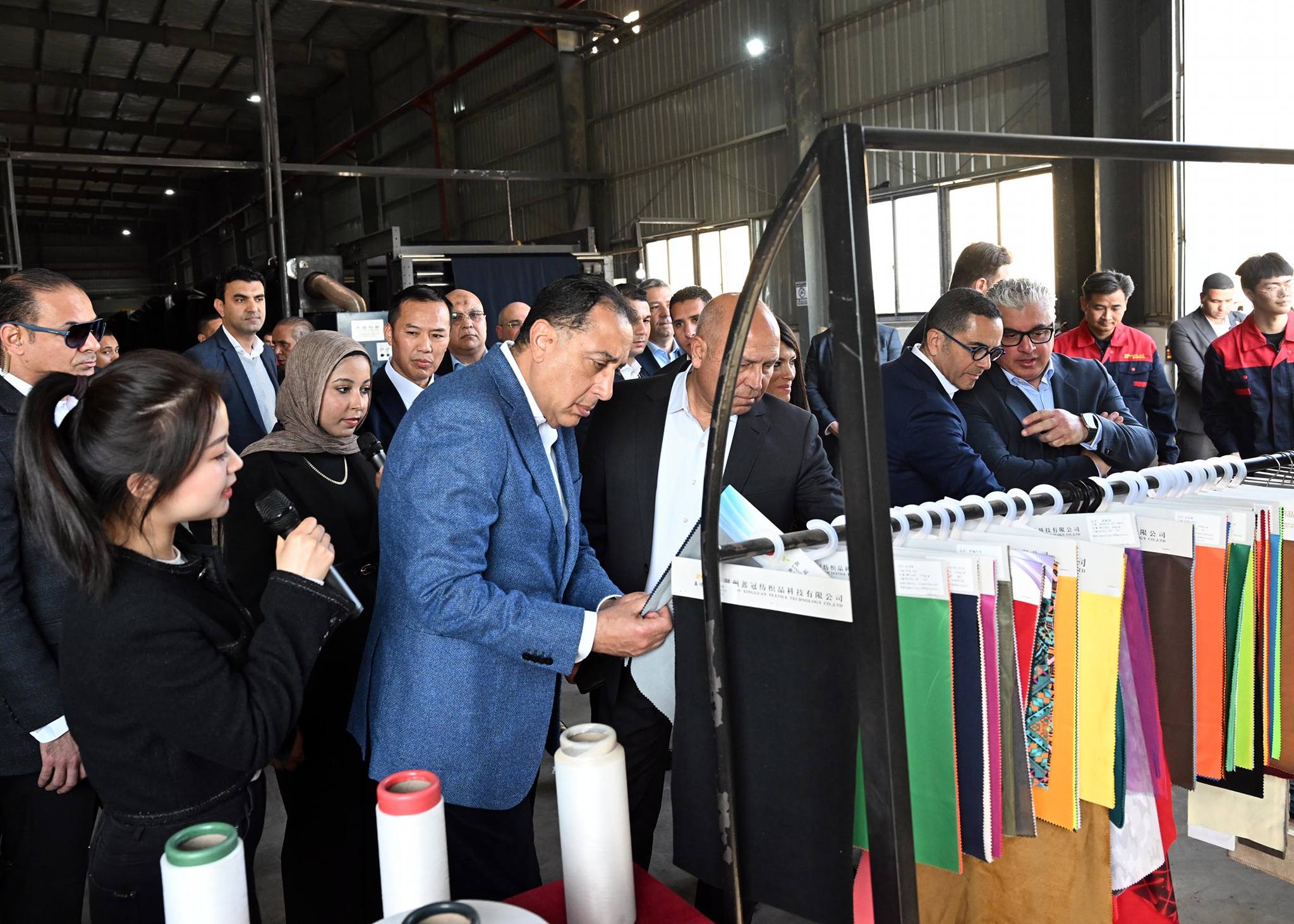
The inauguration was attended by several ministers, the Governor of Suez, the Chairman of the General Authority for the SCZone, senior officials of the Authority, representatives of industrial developers, and heads of the companies executing the projects. The ceremony took place during the Prime Minister’s tour of the SCZone to launch several new industrial and logistics projects.
The move comes as part of the state’s efforts to strengthen
the textiles sector and encourage industries capable of competing in local and
regional markets.
The Prime Minister said the opening of the project reflects
the government’s commitment to deepening local manufacturing in the textiles
sector and enhancing the integration of local raw materials with modern
technology. He noted that the state places great importance on developing this
vital sector, increasing the value of Egyptian products, and supporting
exports.
Walid Gamal El-Din, Chairman of the General Authority for
the SCZone, said the Shin Jin Complex represents an additional step in the
economic zone’s series of successes in attracting quality investments in the
textile industry. He added that it also adds value by transforming yarns and
fabrics into finished products ready for export, while strengthening supply
chains and logistics services related to the sector.
Gamal El-Din emphasized that the Authority continues to
attract projects capable of deepening local manufacturing and expanding the
presence of Egyptian textiles in regional and international markets. He said
this enhances the competitiveness of the national industry and reduces reliance
on imports, in line with the state’s comprehensive industrial development
plans.
The Prime Minister inspected the components of the Shin Jin
Complex while listening to a presentation by Gao Duo, Director of the complex.
She explained that the project spans 20,000 square meters, with investments of
20 million US dollars, and a production capacity of 60 million meters of fabric
and 10,000 tons of yarn annually. She noted that 70 percent of production is
exported.
She added that the project aims to provide 390 direct and
indirect job opportunities, supporting labor-intensive projects and enhancing
the integration between foreign investment and local raw materials. She
explained that the Shin Jin project specializes in producing yarns from various
synthetic fibers, manufacturing multiple types of woven fabrics, and carrying
out dyeing, bleaching, printing, and final finishing of textiles. The project
also includes spinning, weaving, embroidery, and knitting operations, all of
which increase the added value of Egyptian products and enhance their
competitiveness in global markets.