
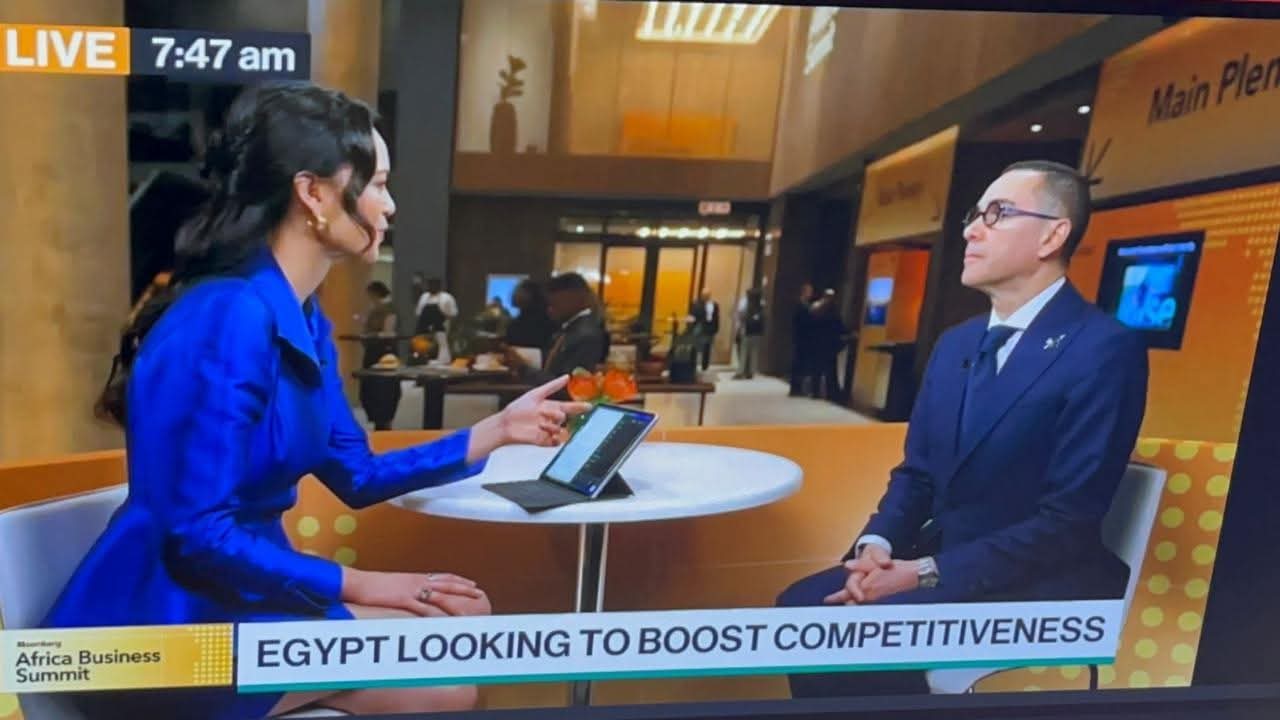
He acknowledged recent economic challenges but stressed that the government is actively working to restore FDI inflows. He highlighted significant deals, including a recent agreement with Qatari partners, and referenced the landmark Ras El Hekma deal signed last year as a model for attracting major investments.
El-Khatib stated that the current governmental focus is to
leverage the massive infrastructure investments completed over the past decade.
He emphasized that sustained political, fiscal, and commercial reforms over the
last year are key drivers for investment, noting that predictability and
long-term policies are what enable Egypt to attract capital.
Discussing the massive development project with Emirati
partners, the Minister confirmed that the initial sales phase for the Ras El
Hekma area has already begun. The project spans $173$ million square meters, is
expected to accommodate nearly $2$ million residents, and will feature a
private airport, an industrial zone, and educational facilities. He stated the
project is set to become a benchmark on the Mediterranean coast, positioning
Egypt on the regional investment map.
Engineer El-Khatib detailed the government's restructuring
of state asset management through the Sovereign Fund of Egypt (SFE) and a newly
established asset management and regulation unit. The SFE is tasked with
managing and enhancing the value of strategic state-owned assets, while the new
unit works to classify and evaluate state-owned enterprises (SOEs) to determine
if they should be transferred to the SFE or prepared for divestiture.
The Minister pointed out that Egypt is increasingly
attracting investments in mobile phone and electric vehicle manufacturing. He
cited the country's strategic geographical location, linking Europe, Africa,
and the Middle East and competitive wages as major advantages now that the
infrastructure is complete.
He acknowledged that the Red Sea disturbances and subsequent
rerouting of ships away from the Suez Canal have negatively impacted canal
revenues. However, he credited government-led reforms with compensating for a
significant portion of this impact, noting that remittances from Egyptians
abroad and foreign exchange reserves have risen, while inflation has decreased
and tax revenues have increased.
Furthermore, El-Khatib asserted that commercial policies aimed at reducing customs time and costs are focused on improving the balance of payments. He projected that Egypt's trade deficit will reach its lowest level since 2010 by the end of the current year.