
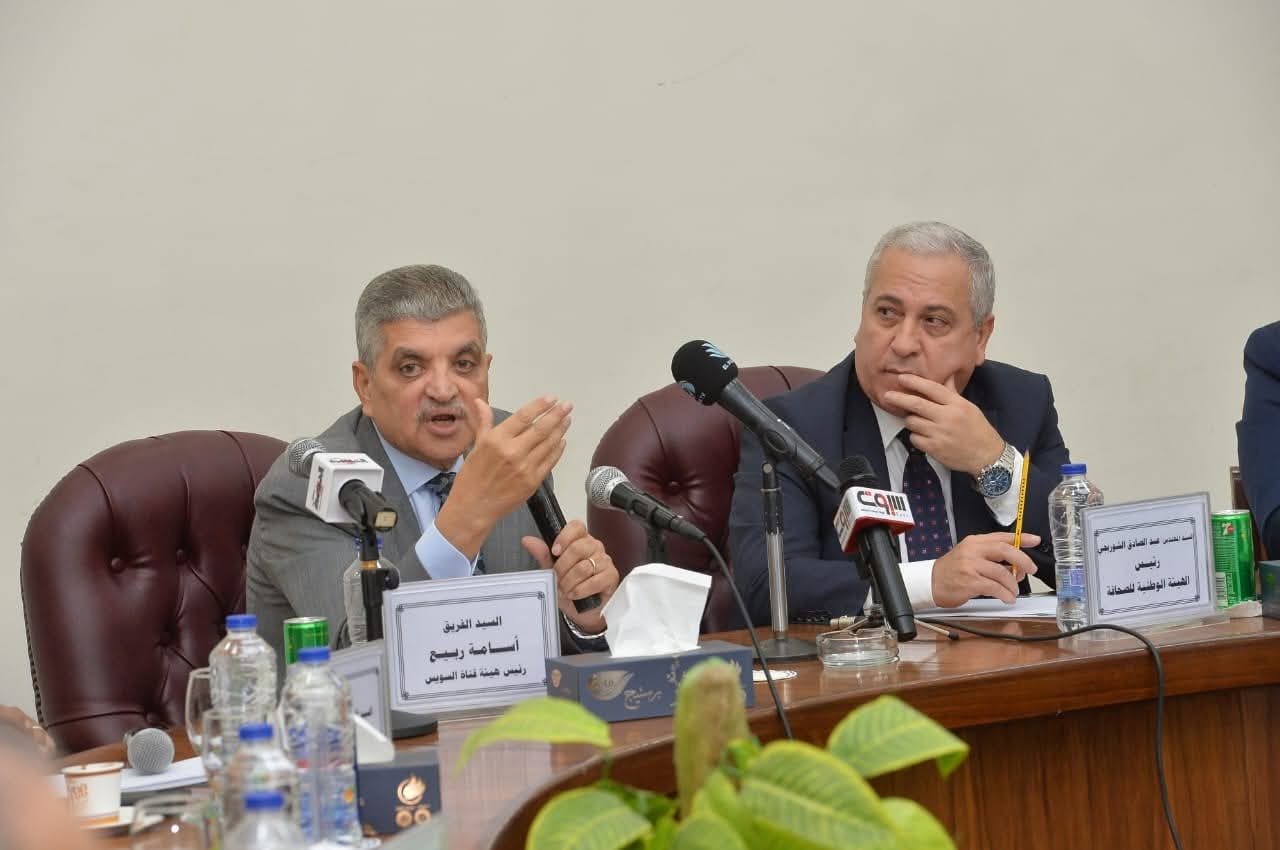
NPA chairman Abdel-Sadek El-Shorbagy welcomed Rabie, praising him as a sincere national figure who has earned local and international respect for his crisis management skills while leading the vital global waterway.
El-Shorbagy pledged the full support of Egypt's national
press to the SCA, assuring Rabie they would document achievements, counter rumours
with facts, and address defamation campaigns through public awareness. The NPA
chairman also commended the SCA's ongoing efforts to modernize its fleet to
maintain its competitiveness.
Rabie, in turn, expressed appreciation for the press's vital
role in promoting awareness. He affirmed the Suez Canal's status as the world's
most important shipping lane, stating that it has successfully navigated major
historical challenges thanks to the will, patience, and professionalism of
Egyptians.
Rabie highlighted the SCA's successful handling of the
global COVID-19 pandemic, noting the swift implementation of precautionary
measures and the use of expert pilots for vessels, particularly those from East
Asia. Despite the global crisis, the SCA achieved gains by offering incentives
and discounts, while other shipping routes incurred heavy losses.
He then addressed the highly complex 2021 grounding of the
mega-ship Ever Given, stating that traditional methods could not have resolved
the crisis. Rabie credited a young SCA engineer with proposing the
unconventional, successful salvage plan, which was executed without damage to
the vessel in a record six days—compared to traditional estimates of three to
six months. He noted the international praise received, even amidst defamation
campaigns that mocked the equipment used, and added that the SCA was later
consulted by major countries facing similar grounding incidents.
Rabie affirmed that the Ever Given crisis conclusively
proved that there is "no alternative to the Suez Canal," citing the
long queue of waiting ships and shipping lines that canceled voyages to await
the canal's reopening rather than seeking a new route. He also mentioned
President Abdel Fattah El-Sisi's close, round-the-clock monitoring of the
situation.
The SCA successfully navigated the Russian-Ukrainian crisis
and is now facing the "major crisis" of the Red Sea shipping tensions,
which has caused a significant decline in traffic and revenue due to shipping
lines rerouting.
Rabie said the Canal held firm during this latest difficult
period and took proactive measures, including intensifying contact with global
companies and providing additional services such as maintenance, ship repair,
marine ambulance, anti-pollution, and refueling services to offset the revenue
drop. He noted that daily transits had fallen from approximately 75 before the
crisis to only 30 at its lowest point.
He reported a significant turnaround, with navigation
indicators improving and the situation getting much better. Since September,
traffic has seen an 18.2% increase in net tonnage due to carefully studied
incentives and discounts.
Rabie dismissed the Cape of Good Hope as an unsustainable,
non-competitive route due to increased fuel consumption, higher carbon
emissions, longer transit times, and cargo damage. He labeled any discussion of
other alternative routes as unrealistic projects doomed to fail.
Rabie also emphasized the Canal's ongoing large-scale
development projects—including increasing dual-lane areas and establishing new
services—to maintain its global competitiveness. He highlighted the
construction of the New Suez Canal, its proven long-term benefits, and various
investment projects, including fish farms, factories, bridges, and aiming to
declare the Canal a "Green Suez Canal" by 2030.
Rabie announced that total SCA revenues from 2019 through
2024 reached approximately $40 billion, despite the chain of global crises.
Key revenue figures presented: 2019: $5.8 billion
2020: $5.6 billion
2021: $6.3 billion
2022: $7.9 billion
2023: $10.2 billion (Highest in Canal history)
2024 (Projected): Approximately $4 billion (affected by Red
Sea tensions)
Transiting ships increased from 18,880 in 2019 to 26,434 in 2023, before declining to 13,213 in 2024 due to the regional geopolitical situation.