
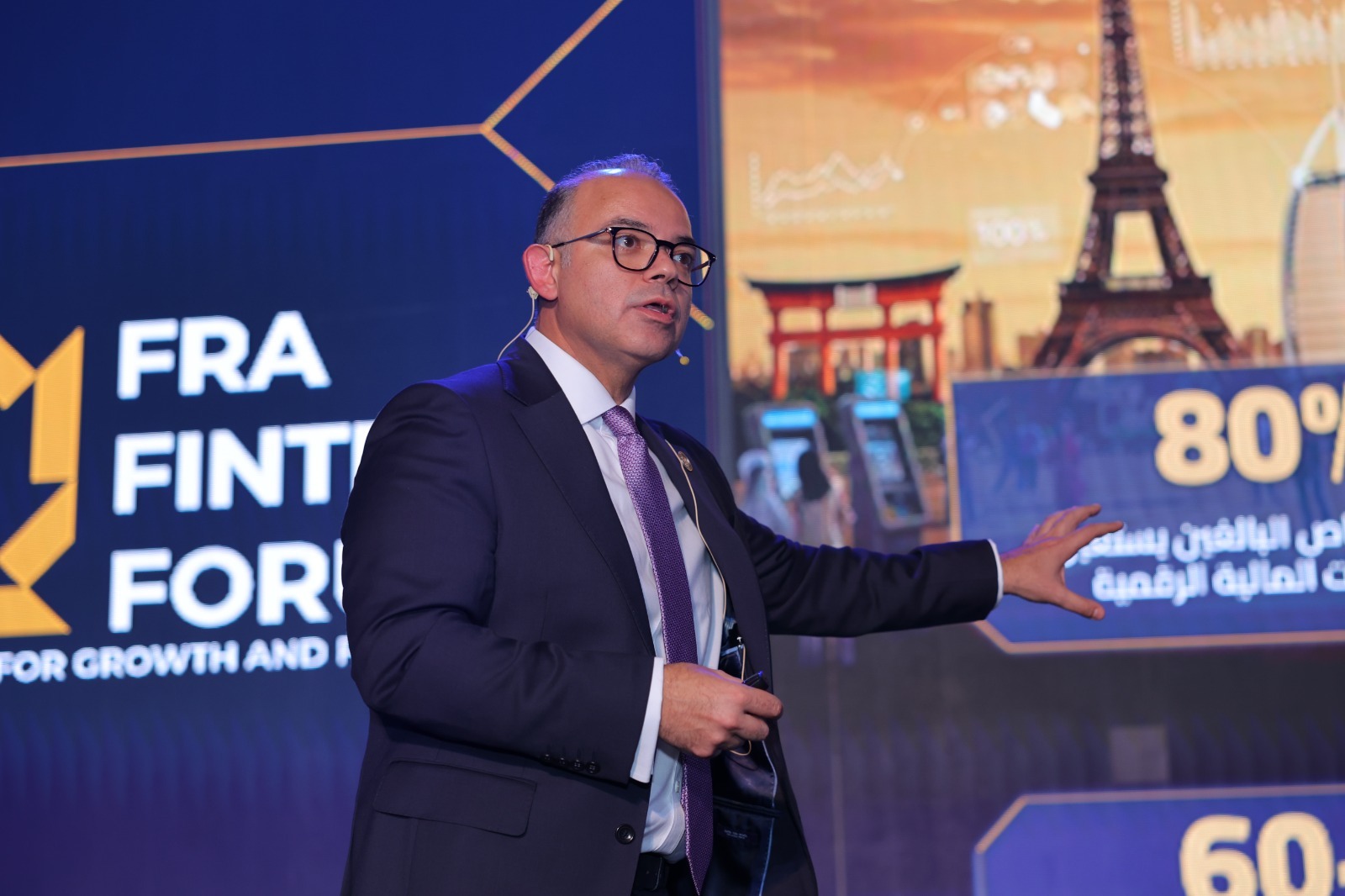
Farid emphasized that digitization is critical for global
economic advancement, noting that nearly two-thirds of consumers globally now
use digital applications daily, with 80% of adults engaging with digital
financial services. This global trend has prompted over 60 countries to launch
digital finance regulatory platforms, making Egypt's participation essential.
Egypt's robust presence in this digital landscape is
underpinned by a large youth demographic — smartphone users with an average age
under 24 — reflecting high digital service penetration. This has been
consistently underscored by President Abdel Fattah El-Sisi, Farid said.
The core objective of digitizing non-banking financial
transactions is to maximize benefits for citizens and clients, Farid stated. He
detailed the legislative journey, which began with FRA Resolution No. 122 of
2014 on electronic distribution of insurance policies, followed by Resolution
No. 316 of 2014 for non-banking financial sector technological infrastructure,
and Resolution No. 1005 of 2013 for brokerage firms' tech and information
security.
Recent efforts to digitize non-banking financial
transactions have accelerated following FRA executive decisions implementing
Law No. 5 of 2022. This law established the regulatory framework for technology
use in non-banking financial activities. Subsequent measures included
Resolution No. 69 for digitizing and linking insurance company databases with
the FRA's, and Resolution No. 58 for regulating establishment and licensing
rules.
Further, the FRA issued Resolution No. 139 of 2023 on
technological infrastructure and security for FinTech use in non-banking
financial activities. This was followed by Resolution No. 140 of 2023, a
groundbreaking decision detailing requirements for digital identity, contracts,
registries, and compliance for FinTech use, including electronic client
identification. Resolution No. 141 of 2023 established an outsourcing registry
for FinTech, allowing specialized firms to provide electronic client
identification and contract services.
Additionally, Resolution No. 57 was issued to regulate
Robo-advisors, and Resolution No. 268 allows startups with 15 million EGP
capital to conduct non-banking financing activities using technology.
Farid commented on the rapid pace of artificial intelligence
development, stressing the importance of enhancing institutional capabilities.
He noted that technological advancements carry inherent risks, necessitating
heightened preparedness for a resilient non-banking financial sector capable of
leveraging new tech while managing risks efficiently.
He explained that internal changes within the FRA were
paramount. The authority has forged strategic partnerships to bolster its technological
infrastructure, including a digital professionals platform and a central
registry for digital contracts and electronic signatures.
These efforts have seen 70 non-banking financial sector
companies begin digitizing services, with 24 already operational and 46
fulfilling requirements. Seven companies offer outsourcing, with four
registered in the FRA's FinTech registry. This has led to roughly 120,000
digital verification operations (60% in capital markets) and 80,000 digital
contracts issued to date.
Farid underscored the FRA's commitment to supporting company
growth through intangible asset valuation standards and rules for Special
Purpose Acquisition Companies (SPACs). This led to the formation of the first
venture capital SPAC, now listed on the Egyptian Exchange. Startup valuation
standards have also been issued.
To further support technology-driven startups, the FRA Board
issued Resolution No. 163 of 2024, establishing a Regulatory Sandbox for
Technological Applications. This sandbox allows FinTech providers to test
innovative applications, including business models.
The Regulatory Sandbox aims to support market entry for
smart digital solution startups, enhance regulatory understanding of FinTech,
improve regulatory practices for sustainable financial growth, and boost
innovation in the non-banking financial sector by fostering a conducive
environment for financing, investment, and insurance solutions.
Farid added that the FRA is adapting to rapid technological
advancements by ensuring an interactive environment among FinTech solution
providers, financial institutions, research centers, universities, business
incubators, accelerators, investors, and global tech companies.
He clarified that the Sandbox will help the FRA achieve its
vision of promoting innovation in non-banking financial services, ensuring
consumer benefits from emerging technologies while maintaining regulatory
standards. The sandbox is expected to help startups gain investor confidence
and attract capital, fostering sustainable growth.
Farid announced the launch of the Regulatory Sandbox's
official website: https://frasandbox.com/.
The platform provides information on activities, services, and updates on its
efforts to facilitate innovative FinTech applications, reinforcing FRA's
support for digital tech startups.
Development partners collaborating with the Sandbox include
regulatory bodies, academic institutions, startups, incubators, accelerators,
financial institutions, technology providers, consumers, and investors.
Eligibility criteria for joining the Sandbox include an
original innovation within Egypt's non-banking financial sector, readiness for
application, market efficiency improvement, increased consumer benefits and
protection, and a feasible business plan.
The application process involves submission, review,
approval, testing, and a final evaluation. Outcomes can include market entry,
an extended testing period, or rejection.
The FRA Chairman also highlighted services on the FRA
Sandbox platform, including the Regulatory Sandbox, innovation programs and
hackathons, regulatory guidance, and a FinTech ecosystem marketplace.
Farid announced the launch of the first hackathon through
the Regulatory Sandbox in partnership with Mercatura Forum. The competition
will have national (August), continental (September), and global (October)
stages. Details and application procedures will be announced on the platform on
August 1, with a total prize pool of $300,000. Insurtech hackathons will also
be announced on September 1 in partnership with AUC Vlab.
Finally, Farid outlined future plans, describing them as ambitious goals for national economic growth. These include issuing regulatory rules for digital platforms for investing in real estate investment funds (to be followed by stocks and fixed-income instruments), simplifying participation in venture capital firms and funds, streamlining procedures for handling unpaid documents, and opening the door to all legal forms of investment funds, which will require legislative amendments.