
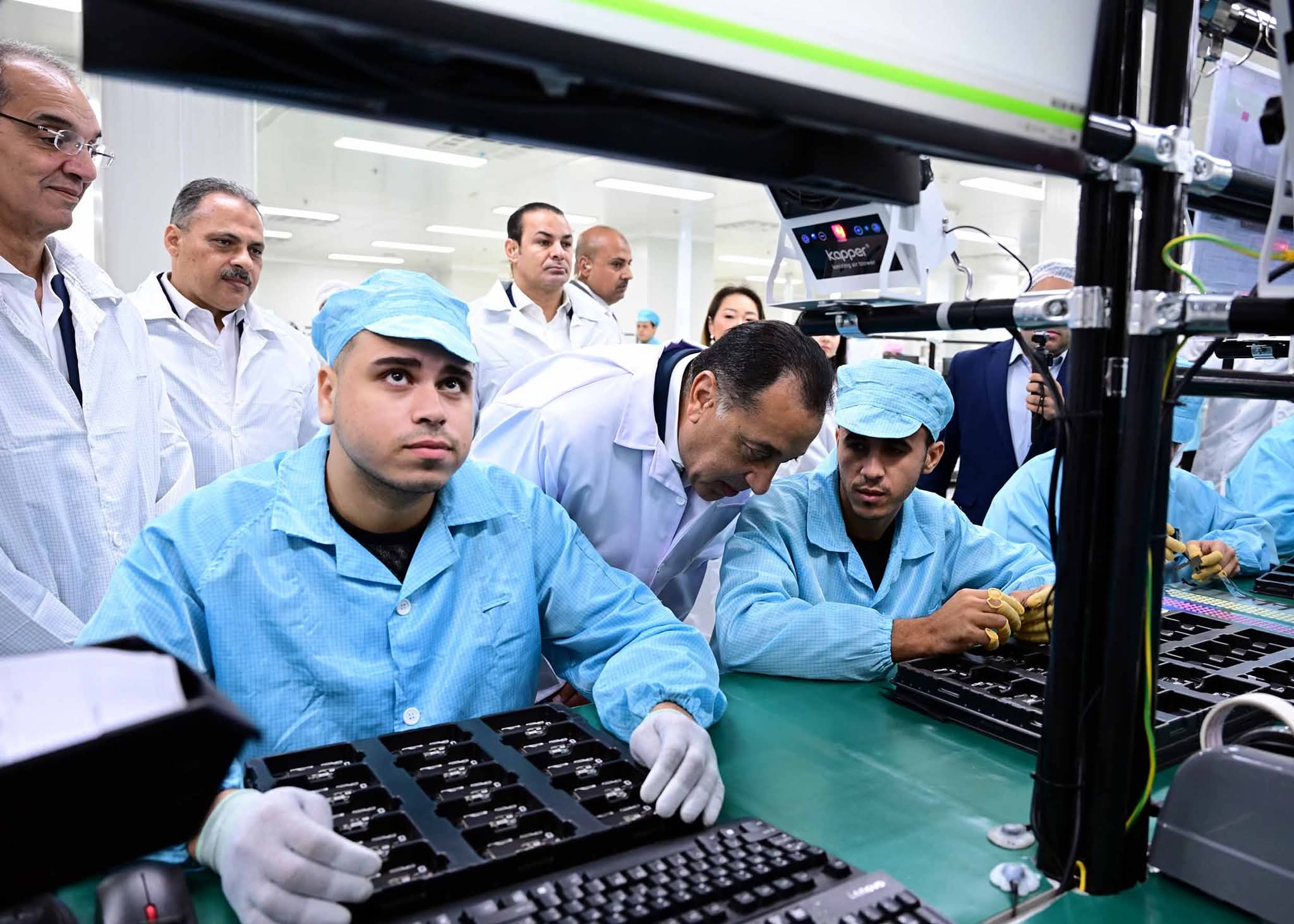
Madbouly was joined at the opening by Minister of Communications and Information Technology Engineer Dr. Amr Talaat, Sharqia Governor Engineer Hazem El Ashmouny and Lay Ren, OPPO president for the Middle East and North Africa. Also in attendance were Engineer Ahmed El Zaher, CEO of the Information Technology Industry Development Agency (ITIDA), and Noah Ma, GM of OPPO Egypt.
The Prime Minister stressed his
participation underscored the goals of the presidential initiative Egypt
Manufactures Electronics (EME), which seeks to position the electronics
industry as a major driver of Egyptian economic growth. The initiative aims to
double exports, reduce electronic and electrical imports, create hundreds of
thousands of jobs and attract foreign investment.
Madbouly noted that the EME initiative
had already achieved remarkable growth, with increased exports, a rise in
electronics design workers, the establishment of new local companies and
international branches, and the first-time founding of factories for mobile
phones, tablets and fiber-optic cables in Egypt.
Minister Talaat said the OPPO
factory, backed by a $50 million investment and providing 2,000 jobs,
highlighted the successful cooperation between the government and the private
sector in advancing the EME initiative. He added that the Communication
Ministry provides incentives to encourage global companies to expand
production, meet local demand and export abroad, which strengthens Egypt's role
as a regional electronics hub. Talaat pointed out that regulatory measures had
boosted investor confidence, drawing 15 brands for mobile phone and accessories
manufacturing with a maximum annual capacity of about 20 million units and
total investments of about $200 million.
In his speech, Ren affirmed that
local manufacturing is a core pillar of OPPO's commitment to the Egyptian
market and aligns closely with the EME initiative. Guided by the vision
"Technology for Mankind, Kindness for the World," he said the factory
demonstrates confidence in the Egyptian market's potential, will introduce the
latest innovations to local consumers, create local jobs and contribute to
national development. Ren added that products are manufactured locally to the
same high quality standards as the company's China headquarters, stressing a
commitment to making Egypt a regional centre for smart technology and
high-quality manufacturing.
Before touring the facility,
Madbouly was informed the factory spans 24,000 square metres and employs about 2,000
Egyptian staff — including engineers, technicians and quality specialists — who
are trained according to international standards. Current production is about 400,000
units monthly, or about 5 million units annually, with a local added value
exceeding 42 percent.
Ma explained the factory currently
has 17 production lines and plans to increase this to 20 by the first quarter
of 2026, boosting total capacity to about 500,000 units per month. The factory
has already begun supplying devices, including the Reno12, Reno13, Reno14, A5
Pro and A6 Pro series, to the Egyptian market.
As a key part of OPPO's regional
strategy, the company plans to begin exporting products to Arab markets by the
end of next year. Future phases include launching new production lines for
wearables such as smartwatches, fitness bands and smart earphones.
During his tour, Madbouly
inspected various production and quality control stages, from board
manufacturing and component assembly to final packaging.
He spoke with young employees,
including a woman from Sharqia governorate who had transitioned from aviation
hospitality to electronics after specialised training. Employees confirmed they
receive health, insurance and financial benefits from the company.
Madbouly concluded by expressing pride in the competence of the Egyptian engineers, technicians and workers, stating they are producing high-quality electronic products that rival their counterparts in developed countries.