
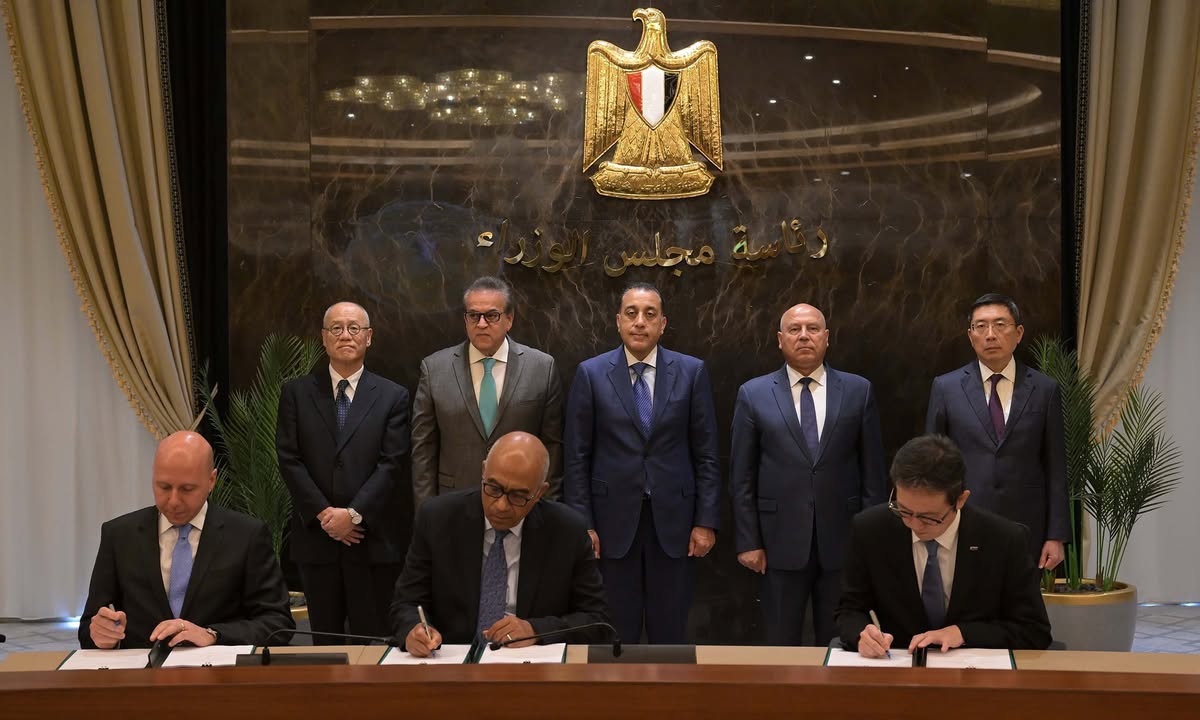
The signing ceremony was attended by Dr. Khaled Abdel Ghaffar, Deputy Prime Minister for Human Development, Minister of Health and Population, Lieutenant General Engineer Kamel Al Wazir, Deputy Prime Minister for Industrial Development, Minister of Industry and Transport, Walid Gamal El Din, Chairman of the SCZone, Dr. Hisham Steit, Chairman of the Egyptian Unified Procurement, Medical Supply and Technology Management Authority, Fumio Iwai, Ambassador of Japan to Egypt, and Dominic Goh, Singapore's Ambassador to Cairo.
The agreement was signed by Dr. Osama Abdel Basset,
Chairman of the Egyptian Medical Investments Company, Dr. Ahmed Samy, Chairman
of Interpharm for Medical Industries, and Sato Masafumi, CEO of Japan's JMS.
This agreement aligns with the Egyptian state's
strategic direction to promote local industry and localize medical technology
industries, including medical products, supplies, and devices. It represents an
implementation of the previous announcement of the launch of a project to
manufacture blood collection bags locally. A joint cooperation agreement was
signed between the ECMI, affiliated with the Egyptian Authority for Unified
Procurement, the Japanese company JMS, a global leader in the manufacture of
high-quality blood collection bags and other medical supplies; and Interpharm,
a company specializing in import, export, and medical industries and the
exclusive agent of the Japanese company JMS.
Dr. Moustafa Madbouly stressed that this promising
project is one of the pillars of an integrated national project targeted by the
Egyptian state, with the support of President Abdel Fattah El-Sisi, to transfer
advanced technology and localize industries in strategic and vital sectors,
most notably the pharmaceutical and medical industries, which impact the lives
of citizens and are linked to their health.
He appreciated the agreement concluded today to
implement a project to produce blood collection bags locally, through a
partnership that integrates the public and private sectors to advance Egypt's
medical industry in all its branches. This partnership aims to meet the needs
of the local market and open up export opportunities to neighboring markets.
This is in light of the potential to achieve a real breakthrough and build an
integrated medical industrial base.
Dr. Hisham Steit said that the project aims to ensure
the quality and safety of blood transfusions in accordance with international
standards, improve patient health services, and develop the medical industry
through the transfer of advanced technology and the localization of expertise.
It aims to meet 100% of the Egyptian market's annual blood bag needs, while
increasing exports to the Middle East and North Africa markets. The project
targets the production of 7 million bags by the seventh year, 3 million of
which will be for local consumption and 4 million for export. This will
contribute to boosting Egypt's exports of medical products and increasing
foreign currency earnings.
Steit added that the factory will be located in the SCZone
in Ain Sokhna, covering an area of 7,000 square meters, including sterile
production areas and advanced warehouses. This will benefit from the government
incentives and logistical facilities offered by the zone, making it an ideal
manufacturing base for regional and international markets.
He noted that this massive investment alliance consists
of the (ECMI), Interpharm Medical Industries, and the Japanese company JMS,
with investments totaling EGP 1.4 billion.
This project reflects Egypt's commitment to achieving self-sufficiency in the medical sector, enhancing cooperation between the public and private sectors, as well as attracting foreign direct investment in pharmaceutical manufacturing. This comes amid the growing national and international need for high-quality blood products to meet the needs of surgical operations, accidents, and diseases such as leukemia, kidney disease, organ transplantation, and others.