
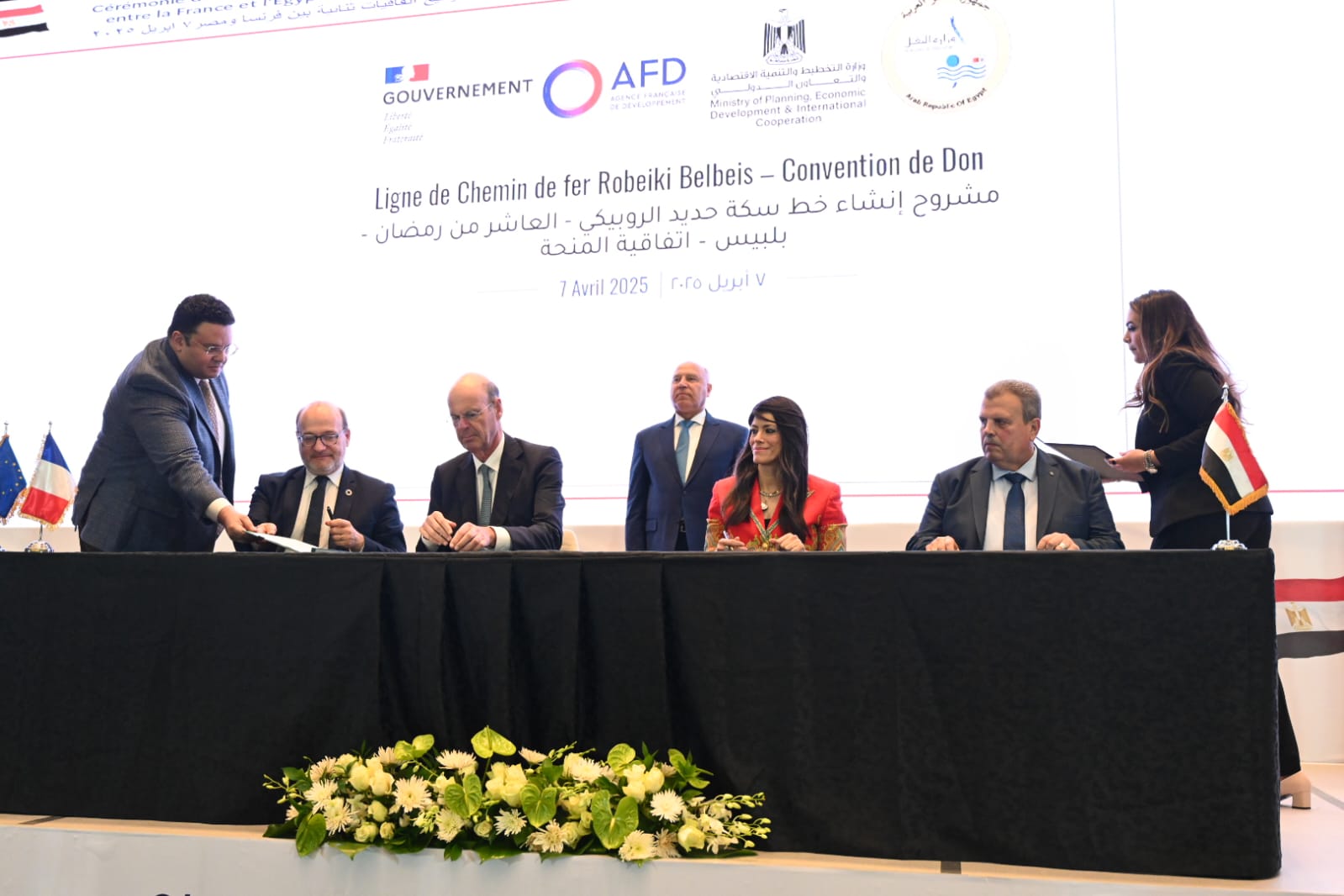
The signing ceremony was witnessed by Lieutenant General Kamel El-Wazir, the Minister of Transportation and Acting Minister of Industry, and Dr. Rania Al-Mashat, the Minister of Planning and Economic Development and International Cooperation. The agreement was signed by Mr. Éric Lombard, the French Minister of Economy, Finance, Industrial and Digital Sovereignty; Engineer Mohamed Amer, Chairman of the Egyptian National Railways Authority; and Mr. Rémy Rioux, Director-General of the French Development Agency (AFD).
The credit facility provided by AFD amounts to €70 million,
part of the project's total cost of €215 million. This total includes a foreign
component of €105 million (€70 million from AFD and the remainder from the
European Bank for Reconstruction and Development - EBRD) and a local component
equivalent to approximately €110 million.
Lieutenant General El-Wazir emphasized the strategic
importance of the 63.5-kilometer project, which will connect Rubiki and Belbeis
via the 10th of Ramadan City and its dry port. The line will include seven
stations: Rubiki, Industrial Zone 1, Industrial Zone 2, Kilometer 14, the 10th
of Ramadan interchange station with the Light Rail Transit (LRT) connecting
Cairo to the New Administrative Capital, the 10th of Ramadan dry port, and
Belbeis.
The project includes the construction of an approximately
18.5 km line linking the Cairo/Rubiki/Suez railway to the dry port and
logistics zone in 10th of Ramadan City. Works on stations and bridges are
currently underway. Additionally, a roughly 45 km line will connect the dry
port and logistics zone to the Benha/Zagazig/Ismailia/Port Said railway line at
Belbeis station.
Minister El-Wazir stated that the project will integrate the
dry port and logistics zone in 10th of Ramadan City with the national railway
network. This will facilitate the connection of the dry port to seaports on
both the Red Sea (Sokhna and Adabiya) and the Mediterranean Sea (Port Said,
Damietta, Alexandria, and Dekheila). This integration is expected to
significantly boost the movement of goods between these ports and the major
industrial hub of 10th of Ramadan City. The city is considered the largest
industrial stronghold in Egypt and the Middle East, hosting approximately 2,996
factories with total investments of EGP 84 billion and an annual production
value of EGP 162 billion, providing 500,000 job opportunities. Furthermore,
1,028 factories are currently under construction in the city, with an estimated
investment of EGP 3 billion, an expected annual production value of EGP 8
billion, and the potential to create 87,000 additional jobs.
The railway line will serve both passengers and freight,
easing the commute for workers in the 10th of Ramadan industrial zone.
Approximately 90% of the zone's workforce currently travels from Belbeis using
private and less safe transportation. The project is also expected to reduce
traffic congestion caused by freight trucks and worker transport buses, lower
fuel consumption and carbon emissions, minimize accidents and road maintenance
costs, and contribute to the integration of the railway network with seaports,
dry ports, and logistics zones. This will enhance economic returns for all
these projects, facilitate the transportation of goods, especially containers
from seaports to the 10th of Ramadan dry port, maximize indirect transit,
eliminate port congestion, and reduce inflation caused by importers facing
financial penalties. Additionally, the line will serve passengers in Sharqia
Governorate (Belbeis City), providing a connection to the New Administrative
Capital and Greater Cairo via the LRT interchange.
Minister El-Wazir highlighted that the project is a key
component of the NWFE+ program (Sustainable Transport pillar), funded by a
consortium of international banks and institutions, including the French
Development Agency, the European Bank for Reconstruction and Development, and
the European Investment Bank. He noted that Egyptian national companies and an
Egyptian consultant are currently executing the station and bridge works, with
bridge construction reaching 80% completion and overpass construction at 65%.
The ceremony also witnessed the signing of a technical support grant agreement for the project.