
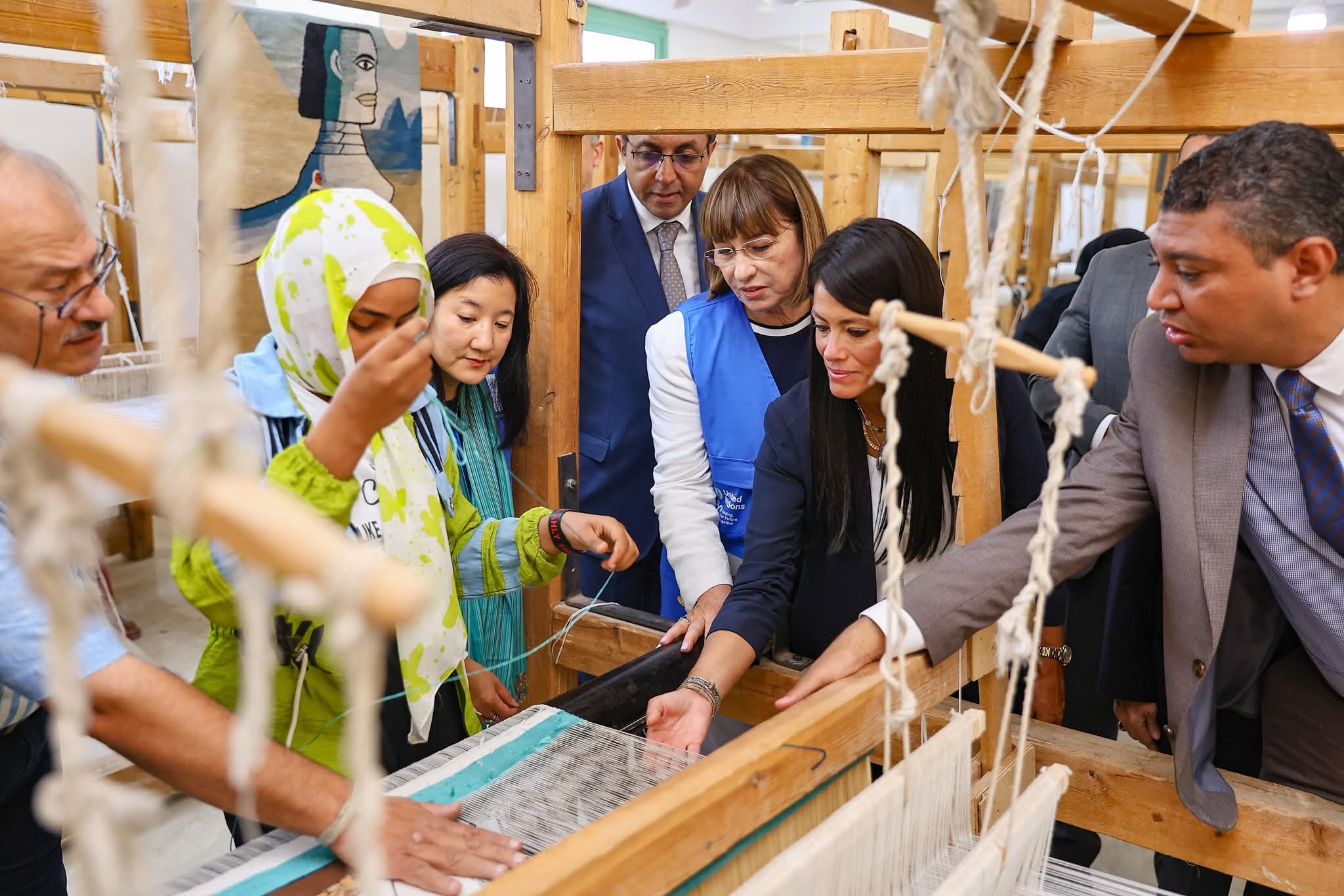
The event took place during the minister's visit to Qena to inspect several development projects, in a trip marking the 80th anniversary of the United Nations' founding. She was joined by Qena Governor Dr. Khaled Abdel Halim, Al-Nidaa Foundation Executive Director Dr. Heba Handousa, UN Resident Coordinator for Egypt Elena Panova, and UNDP Resident Representative for Egypt Chitose Noguchi.
The two-storey, 500-square-meter factory's ground floor will
be used for silkworm breeding and raw silk production, while the upper floor
will be for weaving textiles like "Farka" and carpets. The project
operates under the umbrella of the Egyptian Initiative for Integrated
Development, "Al-Nidaa," with supervision from the United Nations
Development Programme (UNDP) and the Ministry of Planning and Economic
Development, and funding from the Spanish Agency for Development.
Al-Mashat also inspected the silkworm breeding project at
the foundation’s farm, which includes a mulberry tree farm. She stressed that
the local silk industry primarily supports the socio-economic empowerment of
women by providing sustainable job opportunities that benefit families and
local communities.
This initiative, she said, helps achieve sustainable
development goals, especially poverty eradication and creating decent jobs for
women, which "strengthens social justice and provides a healthy and safe
environment where citizens have greater opportunities for growth and
development."
The Minister added that the silk industry is labor-intensive
and heavily relies on women, providing a source of income for rural and low-income
residents. This industry aligns with Egypt's 2030 Sustainable Agricultural
Development Strategy, which aims to develop the silk sector while preserving
heritage crafts, like natural silk carpet weaving.
UNDP Resident Representative for Egypt, Chitose Noguchi,
hailed the project.
"The establishment of the first silk factory in Qena is
a significant step that highlights the outstanding work of women who are
contributing to the revival of this industry, preserving heritage while
building modern industries," Noguchi said. "This achievement was made
possible thanks to our strong partnership with the Ministry of Planning, the
Al-Nidaa network, the Qena Governorate, and the generous support of Spanish
cooperation."
Noguchi added that together, the partners "are working
to create opportunities that enhance local value chains and provide jobs for
successive generations."
The Al-Nidaa initiative is a national effort that aims to boost the developmental impact of UN interventions and socio-economic development efforts in target communities. Launched in 2012, it provides sustainable jobs in Upper Egypt through four programs: basic services development, promoting small and medium-sized enterprises and entrepreneurship, a sustainable agricultural development program, and knowledge dissemination.