
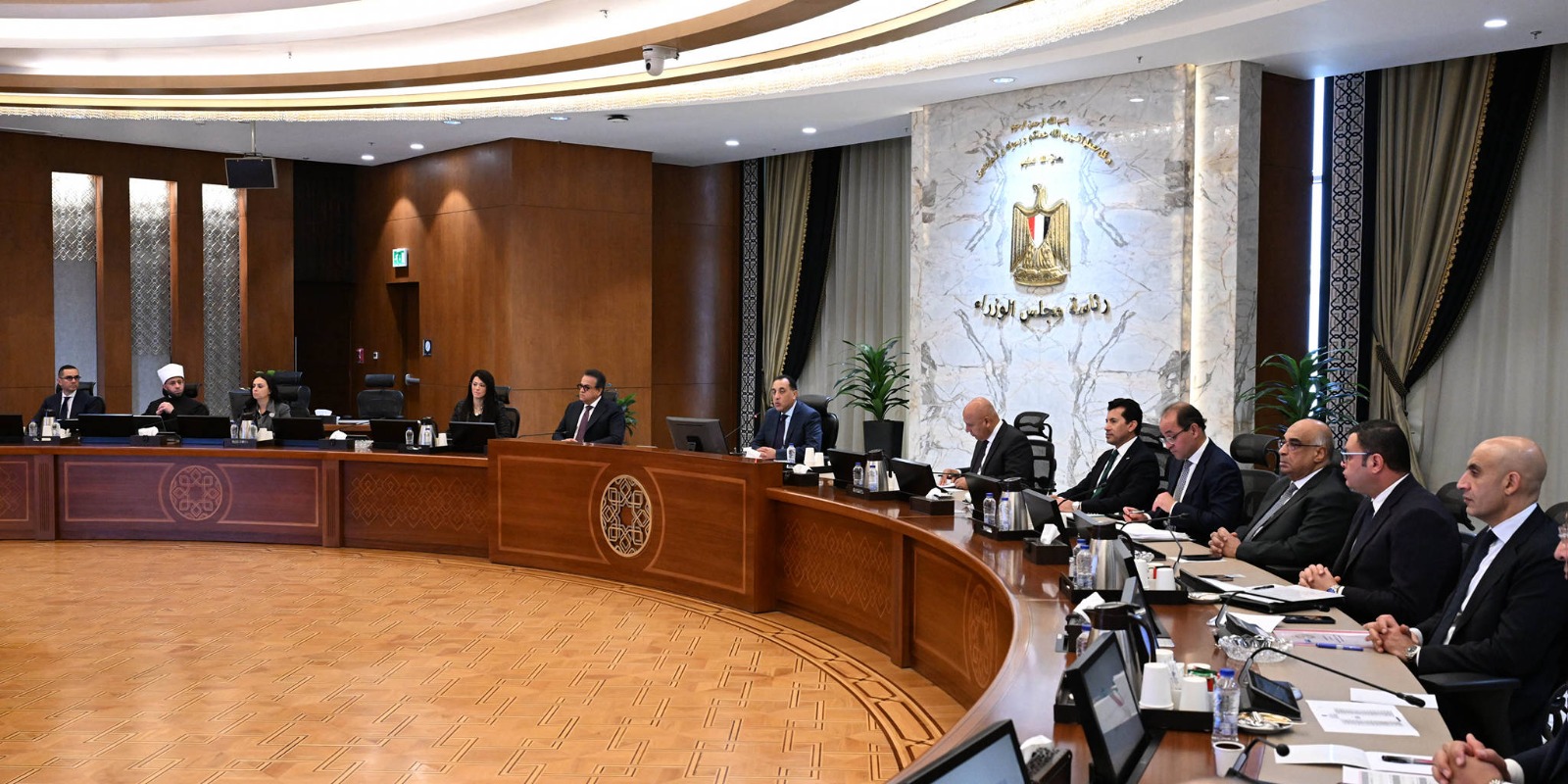
The meeting was attended by Khaled Abdel Ghaffar, Deputy Prime Minister for Human Development and Minister of Health and Population; Kamel Al Wazir, Deputy Prime Minister for Industrial Development and Minister of Industry and Transport; Rania Al Mashat, Minister of Planning, Economic Development and International Cooperation; Ashraf Sobhy, Minister of Youth and Sports; Ahmed Kouchouk, Minister of Finance; Maya Morsi, Minister of Social Solidarity; Adnan Fangary, Minister of Justice; Osama Al Azhari, Minister of Endowments; Sherif El Sherbiny, Minister of Housing, Utilities and Urban Communities; Hassan El Khatib, Minister of Investment and Foreign Trade; Mohamed Abdel Latif, Minister of Education and Technical Education; Major General Khairat Barakat, Head of the Central Agency for Public Mobilization and Statistics (CAPMAS); Raafat Hindi, Deputy Minister of Communications and Information Technology for Infrastructure; Abla Al Alfi, Deputy Minister of Health and Population and Supervisor General of the National Population Council; Nabil Habashy, Deputy Minister of Foreign Affairs and Migration for Egyptian Expatriates Affairs, along with officials from the concerned ministries and entities.
At the beginning of the meeting, Madbouly announced the launch
of the General Census of Population, Housing and Establishments 2027. The Prime
Minister stressed that the census comes at a critical time, given the
importance of census data as a fundamental basis for planning, sustainable
development and future policy formulation. He pointed to the introduction of a
new enumeration and assessment system that aligns with technological
advancements in this field.
Rania Al Mashat stated that Major General Khairat Barakat
had previously presented to the Cabinet the importance of the upcoming census.
She noted that Egypt is among the countries that began conducting population
censuses many years ago. She also confirmed close coordination among all
entities concerned with this file.
During the meeting, Barakat reviewed the methodology for
conducting the upcoming census, its objectives, and the rules governing its
implementation. He explained that, in line with the recommendations of the
United Nations Statistical Commission, CAPMAS intends to conduct the General
Census of Population, Housing and Establishments 2027 using a new methodology.
The approach is based on integrating comprehensive field enumeration with the
matching of digital administrative records held by state institutions, while
ensuring consistency with international statistical principles. He noted that
the 2027 census represents a transitional phase toward the full implementation
of a register based census starting with Egypt Census 2037.
The 2027 census, according to Barakat, aims to align with
the state’s digital transformation strategy and to provide a real time snapshot
of population, buildings and establishments, along with their characteristics
and distribution across various classifications. He added that the census seeks
to deliver updated, high quality data consistent with state digital registries,
while accelerating the frequency of data dissemination to meet the needs of
ministries, government entities and data users nationwide.
The Head of CAPMAS also reviewed coordination efforts with
concerned entities in preparation for the census. He highlighted cooperation
with the Ministry of Planning, Economic Development and International
Cooperation to secure the required financial allocations and technical support.
He also referred to coordination with the Ministry of Communications and
Information Technology regarding technical specifications for systems,
applications, data centers, and security and operational plans for census
activities and field surveys.
Regarding implementation rules, Barakat explained that they
include technical standards related to data security in cooperation with
specialized experts, as well as statistical standards ensuring compliance with
the fundamental principles of official statistics adopted by the United Nations
General Assembly, while taking into account the data needs of state
institutions and international recommendations.
Barakat stressed that census data form the foundation for
planning and sustainable development at the national, ministerial and
governorate levels. He noted that the data help identify marginalized groups
and underserved areas, enabling the state to develop targeted policies to
improve social and economic conditions. He added that census results also
assist in identifying economic sectors requiring support or development and in
improving resource allocation and investment direction.
The Head of CAPMAS added that census data underpin the
planning and design of major national projects, including the Decent Life
initiative, which aims to improve living conditions for more than 60 million
citizens in rural Egypt. He noted that the data support national strategies
such as the Population and Development Strategy and serve as a cornerstone for
housing policy formulation. He added that census data help forecast future
needs in health, education and housing sectors and provide the basis for
legislation such as the Real Estate National ID Law and the Old Rent Law.
Ministers and officials presented a number of remarks to
ensure that the census fully meets requirements and achieves its objectives.
They affirmed full cooperation with those responsible for its implementation.
Madbouly concluded by emphasizing that the census represents
a key opportunity to meet the data needs of ministries and government entities,
improve public services, and target areas requiring intensified support, in
line with the state’s development goals.