
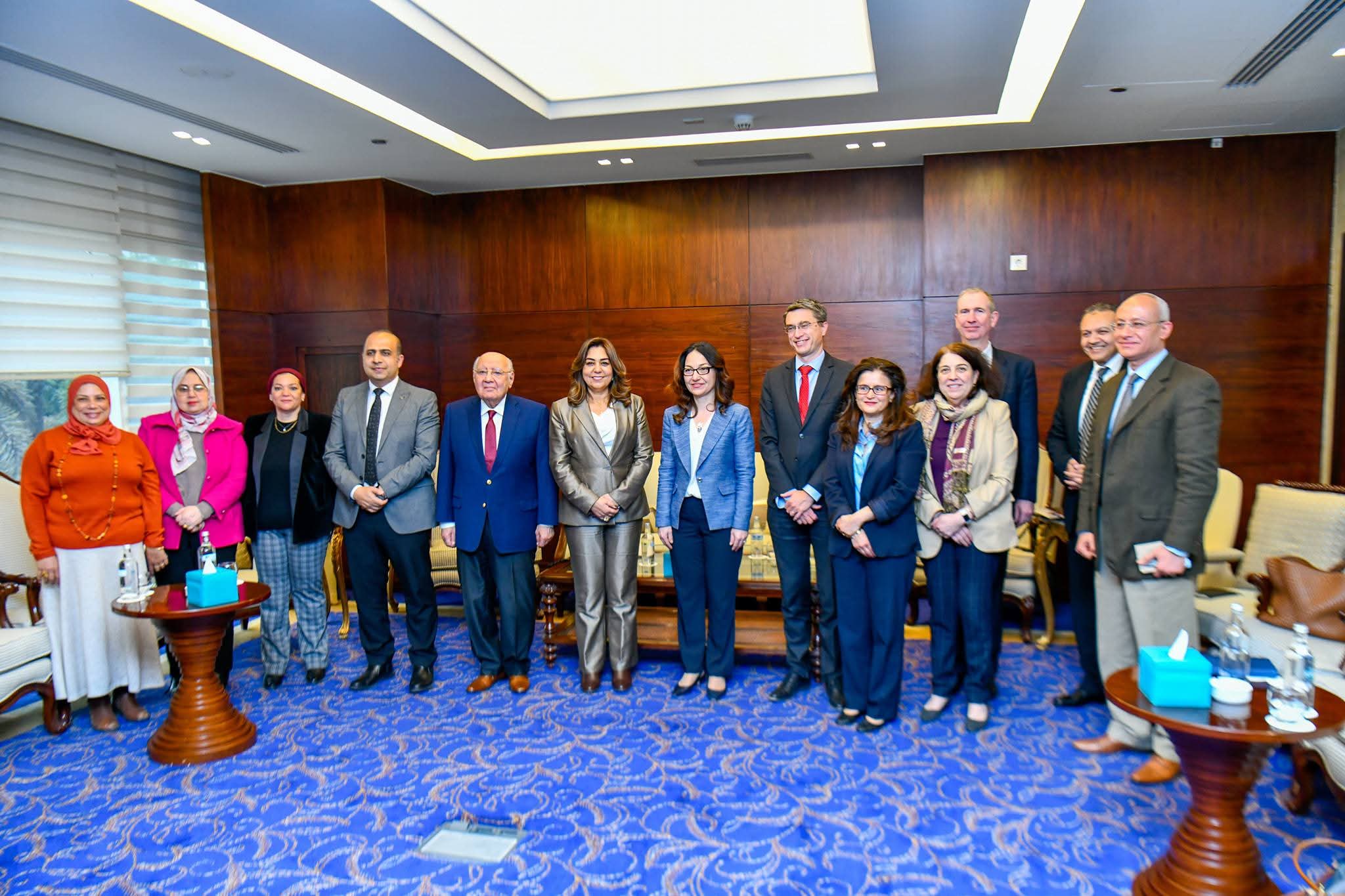
The meeting was attended by several World Bank leaders, including Galina Andronova Venslit, Vice President of the Bank; Stefan Gimbert, Director of the Egypt, Yemen, and Djibouti Department; Maria Seraf, Director of Environment for the Middle East and North Africa; along with representatives from the Ministry of Environment and relevant bodies such as the Waste Management Regulatory Authority and Ambassador Raouf Saad, Advisor to the Minister for Multilateral Cooperation.
At the beginning of the meeting, the Minister praised the ongoing cooperation with the World Bank in the Greater Cairo Air Pollution and Climate Change Management Project, stressed that it is a pioneering initiative in Egypt to address air pollution challenges, reduce its sources, and link it to climate change mitigation efforts. She highlighted achievements made through executive projects such as the Integrated Solid Waste Management City in 10th of Ramadan and the electric bus project to promote sustainable transport.
The Minister also directed the need to develop laboratories in central administrations across governorates to ensure accurate sample analysis and reduce pressure on the central laboratory in Cairo. She emphasized her keenness to enhance private sector participation in environmental work. She explained that the waste management project in 10th of Ramadan represents a replicable model to ease the burden on the state and open new horizons for investment, commending the World Bank’s support in the safe closure of the Abu Zaabal landfill to protect citizens’ health.
Regarding the blue economy, the Minister proposed cooperation in implementing a pilot model of a smart real-time monitoring system in one of Egypt’s nature reserves, which would help make urgent decisions to preserve natural resources and replicate the experience across other reserves, with civil society engagement in monitoring and observation.
The project was described as the largest of its kind for the World Bank in the region in the field of waste management, highlighting its importance in serving citizens and enhancing private sector participation. World Bank representatives commended the tangible achievements already made and expressed their aspiration to provide technical support to Egypt in advancing the blue economy.
Key issues discussed during the meeting are establishment of
120 air pollution monitoring stations, reduction of open burning by 50% over
three years, rehabilitation of the Abu Zaabal landfill, and development of
sustainable transport projects.
Future cooperation plans include providing technical support to Egypt in the field of the blue economy, with a focus on assessing coral reef degradation and leveraging the country’s rich biodiversity and water resources.