
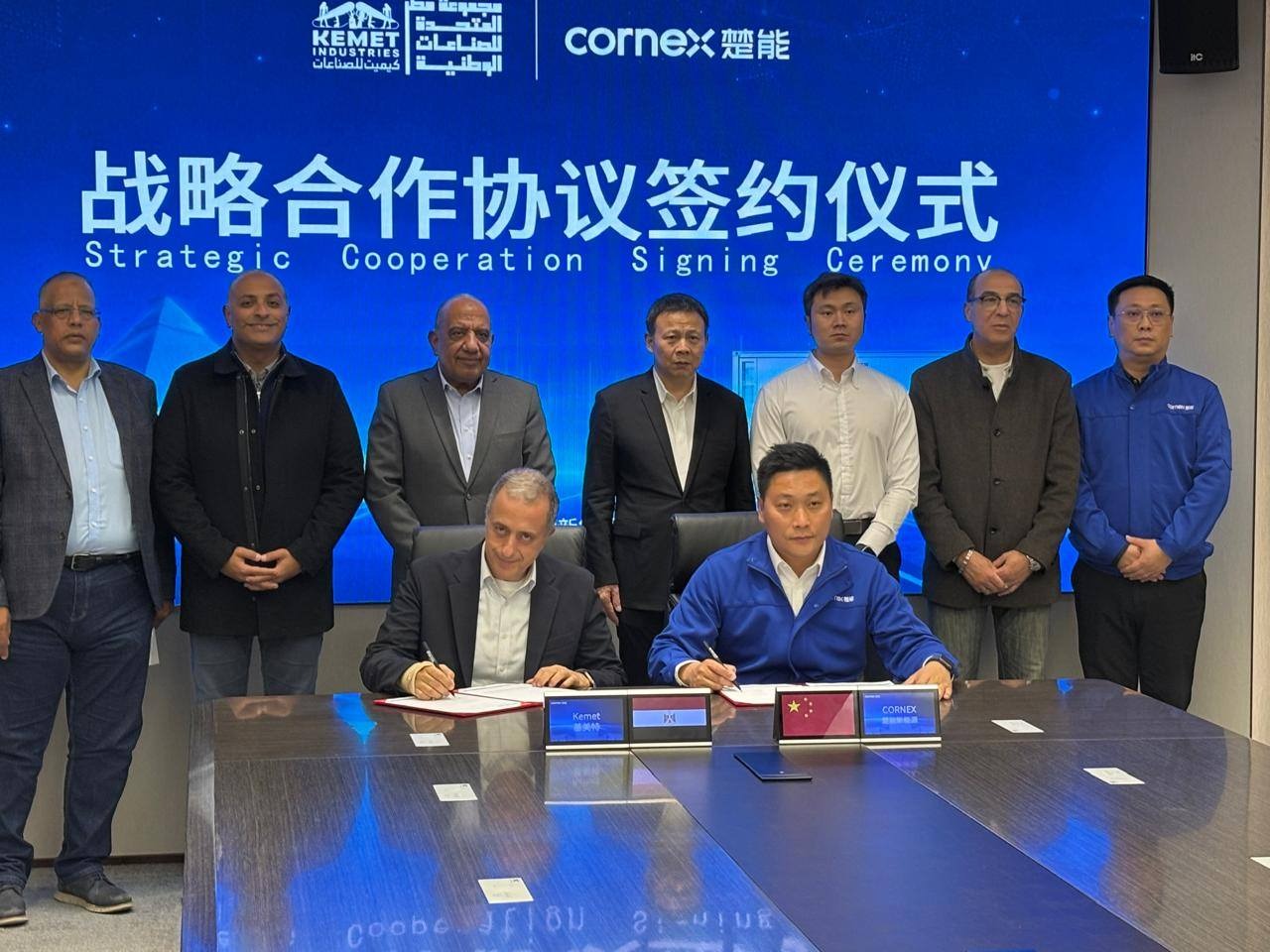
The meeting reviewed the advantages of the Egyptian market and the work program of the electricity and energy sector, in light of the state’s focus on energy transition and increasing reliance on renewable energy within the energy mix. The discussions addressed the need to expand the use of battery-based electricity storage technologies, alongside ongoing projects to establish standalone storage stations and stations connected to solar and wind energy projects. The importance of energy storage batteries in securing the national grid and ensuring the stability and continuity of electricity supply was also highlighted.
The meeting discussed the state’s plan to support industry,
transfer and localize technology, expand the manufacture of electrical
equipment and supplies, and promote the substitution of locally manufactured
products. The talks explored avenues for cooperation and mechanisms for joint
work in manufacturing electrical equipment for renewable energy, as well as
transferring and localizing the technologies owned by the Chinese company,
particularly in the manufacturing of energy storage battery cells.
Following the meeting, Dr. Esmat witnessed the signing
ceremony of a strategic cooperation agreement between the Egyptian company
Kemet and the Chinese Cornex Group to localize the manufacturing of energy
storage battery cells and establish an integrated battery manufacturing plant
relying on locally sourced raw materials and industrial inputs.
The agreement was signed by EngineerAhmed El Abd, Chairman
of Kemet, and Dai Deming, Chairman of Cornex Group. It provides for the
establishment of a factory to produce electrical energy storage battery cells,
along with the transfer and localization of Cornex’s manufacturing technology,
starting from raw materials and the necessary processing industries through to
battery production. The project will rely on locally sourced materials and will
have an annual production capacity of 5,000 megawatt hours, with total
investments estimated at 200 million dollars.
Dr. Esmat also conducted a field visit to Cornex’s factories
in Wuhan, China. During the visit, he inspected the reference factory and
production lines that will be replicated in Egypt using the same design,
mechanisms, and technology, with the Egyptian factory set to be identical to
the Wuhan facility.
During the tour, Dr. Esmat received a detailed briefing on
the technology used, the operation of the production lines, production
capacity, space requirements, and other technical specifications of the Chinese
company’s products.
The field tour included visits to facilities for receiving
industrial inputs, final product testing laboratories, and locations for
shipping products to ports and factories. Dr. Esmat was accompanied by EngineerAdel
El Hariri, member of the Studies and Planning Department at the Egyptian
Electricity Transmission Company, along with officials from both the Egyptian
and Chinese companies.
Dr. Esmat stated that a clear plan is in place for
technology transfer and industrial localization. He explained that the Ministry
of Electricity and Renewable Energy supports all types and models of
partnerships, particularly those involving the use of locally manufactured
equipment, especially energy storage batteries. He noted that the agreement is
distinguished by covering manufacturing from the cell stage through to final
battery production, ensuring effective technology transfer, and that this
factory represents the model to be established in Egypt. He praised the role of
the private sector in the electrical equipment manufacturing industry,
particularly companies working to localize new industries and modern
technologies, such as this factory.
Dr. Esmat added that a comprehensive work strategy is being
implemented to localize industry and transfer modern technology across all
fields and sectors, while providing all forms of support within this framework.
He stressed that the sector remains open to all companies operating in
renewable energy to participate within the state’s energy transition plan. He
noted that the electricity and energy sector has made significant progress
toward positioning Egypt as a regional hub for energy and electrical equipment
manufacturing. He also confirmed that priority is given to locally manufactured
products in implementing national energy strategy projects, pointing to the
requirements and regulations being developed to increase the local component
ratio in renewable energy projects to 60 percent.