
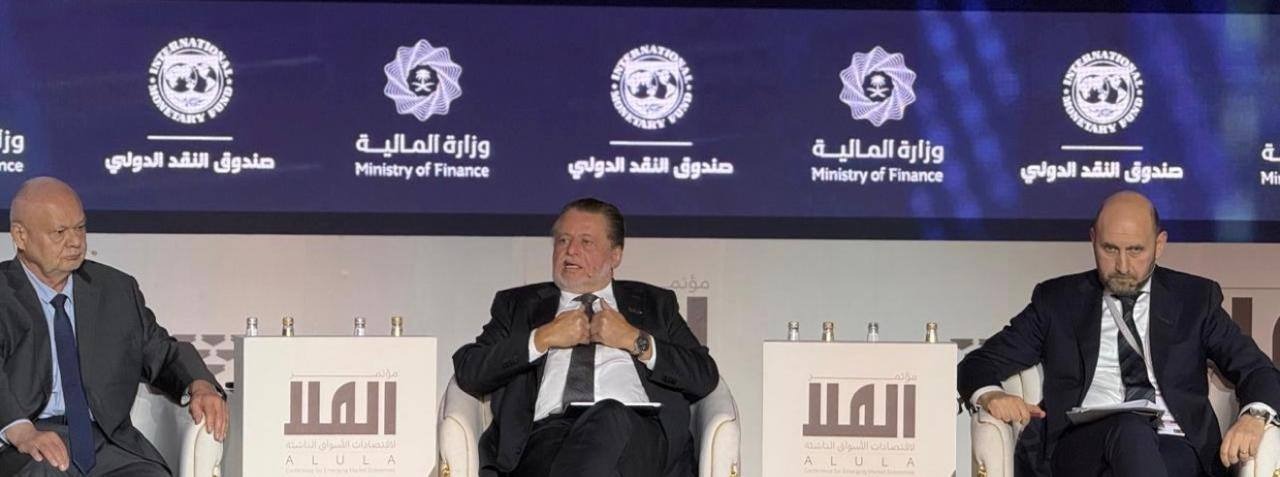
The conference was attended by Saudi Finance Minister Mohammed bin Abdullah Al-Jadaan, IMF Managing Director Kristalina Georgieva, along with high-level participation from central bank governors, finance ministers, senior officials from international financial institutions, and a select group of experts from around the world.
This year’s conference, held under the theme "Aligning
Economic Policies to Support Emerging Market Economies Amid Global Trade
Challenges and Monetary Transformations," highlighted the rapid changes
occurring in the global economy and the challenges and opportunities these
present for emerging market economies, particularly in international trade,
monetary and financial systems, and macroeconomic policies.
The Governor participated in two sessions. The first, titled
"Monetary Policy Amid Structural Transformations in the Global
Economy," saw him review Egypt’s economic reform program launched in March
2024, which includes transitioning to inflation targeting with a fully flexible
exchange rate system. He emphasized that this shift represents a fundamental
change in Egypt’s monetary policy, focusing the Central Bank’s role on
establishing a strong framework rather than managing a fixed exchange rate.
He stressed that the Governor’s role is not to favor a
currency’s rise or fall, but to provide a robust system allowing the exchange
rate to respond to supply and demand. He added that Egypt’s measures
successfully reduced inflation from around 40% to nearly 12%, boosting
confidence in the Egyptian economy.
He also emphasized the importance of considering global
variables when formulating monetary policy, building precautionary reserves
during prosperous times, and strengthening communication between central banks,
particularly between emerging and developed economies. He called for scenario
analyses, contingency planning for the banking sector, and urged multilateral
financial institutions to provide emergency facilities that can be activated
immediately during crises.
The Governor also highlighted the Central Bank of Egypt’s
efforts in establishing the Center for Data Science and Advanced Analytics,
developing real-time forecasting tools and proactive indicators to bridge gaps
in traditional macroeconomic indicators. This initiative aims to accelerate
decision-making and provide forward-looking insights to support monetary
policy.
At the conclusion of the session, he noted that Egypt’s
economic indicators continue to improve, particularly with Suez Canal revenues
recovering and the tourism sector achieving record numbers in visitor arrivals
and spending. Private sector activity has also strengthened, with the
Purchasing Managers’ Index (PMI) rising above 50 points, reflecting expansion
and growth.
He added that the Egyptian economy currently enjoys
promising opportunities and positive prospects that outweigh potential risks,
regardless of external shocks affecting other countries.
In a related session on Monday titled "Strengthening
Global Financial Safety Nets," the Governor highlighted the vital role of
these networks in enhancing countries’ preparedness for future crises and
ensuring stable economic expectations. He noted that the quality of
international reserve assets is as important as their size, and that tools such
as stress tests and scenario analyses help determine reserve levels aligned
with each country’s specific risks and needs.
He pointed out that Egypt’s net international reserves
reached a record $52.6 billion in January 2026, covering 6.3 months of imports
and approximately 158% of short-term external debt. He emphasized that the
Central Bank ensures that reserve growth is accompanied by improvements in
quality, including enhancing asset and liability structures and extending
external debt maturities.
On the sidelines of the conference, the Governor held a
series of bilateral meetings with senior officials from international financial
institutions and his counterparts from other central banks to exchange views on
global risks, enhance crisis preparedness, and explore joint coordination in
fiscal and monetary policies.