
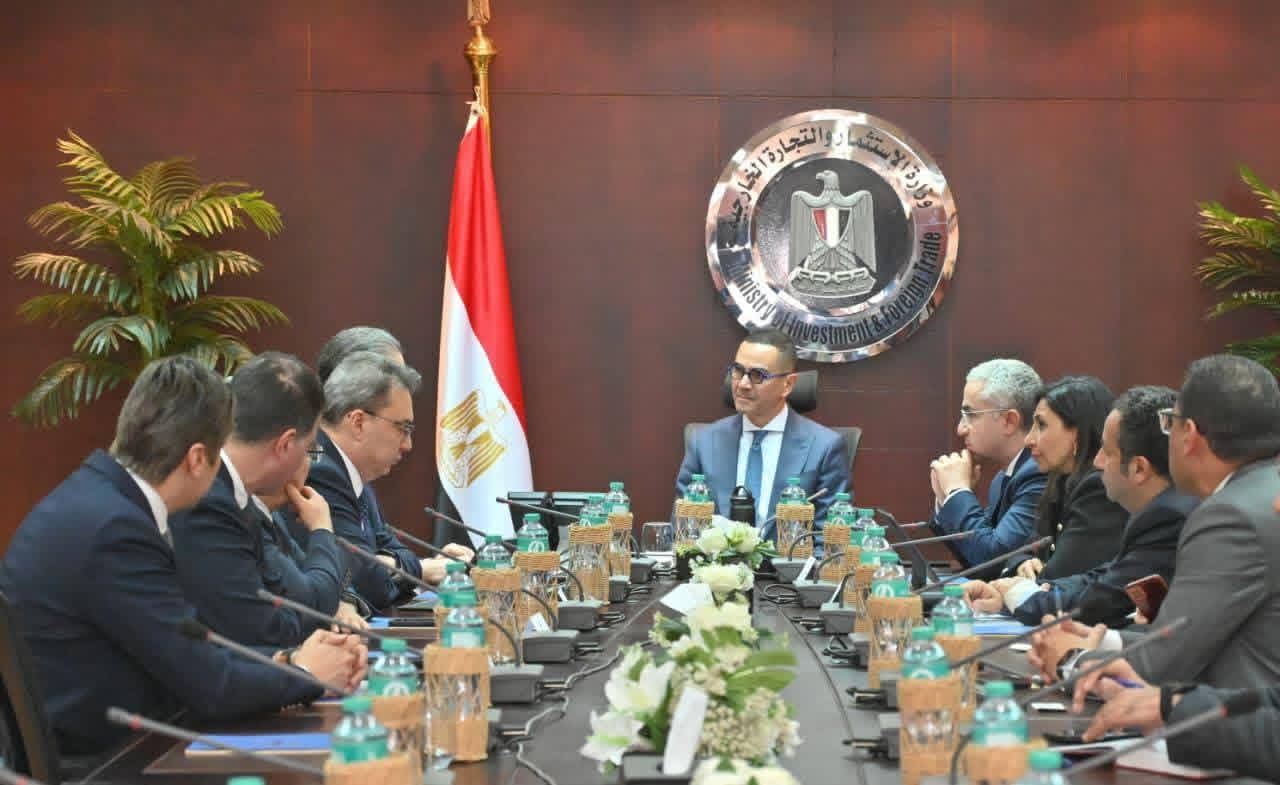
The meeting also explored prospects for existing and future partnerships in the building materials sector and several other industrial fields.
The meeting included Burak Sevilengül, CEO of Eczacıbaşı
Holding, and Hasan Pehlivan, CEO of Eczacıbaşı Building Products, along with
their accompanying delegation.
Engineer Mohamed El-Gousky, CEO of the General Authority for
Investment and Free Zones, and Ghada Nour, Assistant Minister for Investment, Promotion,
and Government Offerings, attended the meeting.
The group reviewed its experience operating in the Egyptian
market. Egypt serves as a hub for manufacturing and exporting to several
markets, including Turkey, the European Union, and the Gulf Cooperation Council
countries. Products are manufactured locally under production partnerships,
following the group’s quality standards and brand. This enhances Egypt’s export
capabilities and supports regional value chains.
El-Khatib outlined Egypt’s investment competitiveness. He
emphasized that production cost structure, availability of qualified labor, and
competitive energy prices are key factors attracting industrial investments. He
noted that Egypt continues to enjoy a clear regional advantage.
The minister stressed that the Egyptian government pursues a
clear policy to support the private sector as the main driver of economic
growth. Recent reforms focus on policy clarity in both monetary and fiscal
measures. This strengthens the business environment and boosts investor
confidence.
El-Khatib highlighted that fiscal policy has undergone a
major transformation in cooperation with the Ministry of Finance. The tax
system has been simplified, and business burdens reduced.
The minister added that the state has made significant
progress in digitizing government services. The time and cost of trade-related
procedures were cut by around 65% within one year. The goal is to exceed a 90%
reduction by removing non-tariff barriers. A unified digital platform now
offers more than 460 services and permits. This improves supply chain
efficiency and facilitates trade.
El-Khatib also presented the state’s vision for enhancing
integration between investment and trade. He emphasized moving away from
reliance on tariffs as the main tool. He outlined a clear plan to open up to
African markets, giving companies in Egypt access to markets with hundreds of
millions of consumers. Trade agreements and modern infrastructure will support
this expansion.
The minister noted that Egypt aims to strengthen its
position as a regional industrial and logistics hub serving the Middle East,
Africa, and Europe. He pointed out that economic relations with Turkey are
developing rapidly within a framework of industrial integration, enhancing the
shared interests of both countries.
Representatives of Eczacıbaşı praised the tangible
improvements in Egypt’s infrastructure and business climate in recent years.
They said the reform measures provide a strong investment incentive and a boost
for reassessing expansion opportunities in Egypt. Opportunities exist in
building materials and other sectors, including pharmaceuticals, consumer
goods, mining, and renewable energy, especially solar projects.
The meeting also reviewed the group’s supply and contract
manufacturing activities. Representatives said these operations grew
significantly over the past year, nearly tripling compared to previous years.
These activities have become a key component of export business and reflect
confidence in Egypt’s production capabilities.