
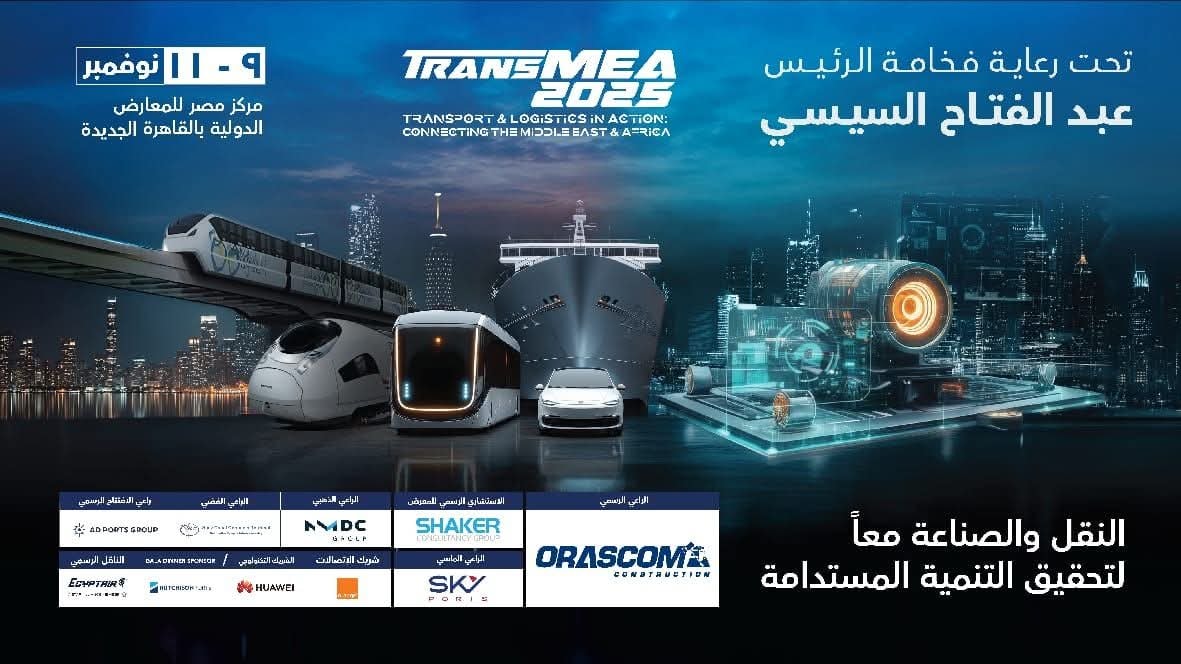
Held under the slogan "Industry and Transport Together for Sustainable Development," the event recognizes that industry and transport are cornerstones for building the New Republic and achieving Egypt's Vision 2030 goals. This aligns with the President's directives to transform Egypt into a regional hub for transport, logistics, transit trade, and industry. The exhibition is set to host over 500 global and local companies from 30 countries.
The exhibition is timely, coming amid an unprecedented
national renaissance in both local manufacturing and transport infrastructure.
Industry is a key focus for increasing growth, deepening
local manufacturing, achieving self-sufficiency, and boosting export
competitiveness.
The transport system, encompassing sustainable green
transport, railways, roads, ports, logistical zones, and river transport, is a major
artery supporting this development and facilitating trade and investment.
TransMEA will highlight opportunities, partnerships, export
strategies, and advanced technologies to improve product quality and stimulate
a greater local component.
The event will showcase several initiatives:
Linking manufacturers of components and final products.
Providing and equipping industrial land and connecting it
with logistics zones to streamline export operations.
Promoting the Ministry of Industry's Egypt Industrial
Digital Platform, which automatically handles the allocation of industrial
lands and units, licenses, and permits across governorates.
Featuring an outdoor exhibition of modern transport methods
and industry localization models.
Displaying achievements in developing national production
capabilities and fostering public-private partnerships to localize modern
technology and build a strong, sustainable industrial base.
A central feature is the Negative Industry Exhibition, a platform to match import needs with local manufacturing capabilities. This is designed to boost industrial integration, reduce reliance on imports, and enhance the competitiveness of Egyptian industry. It allows manufacturers and suppliers to exchange expertise and explore opportunities for locally sourcing production requirements, which supports industrial growth, saves hard currency, and reinforces supply chains across relevant state ministries. Previous editions successfully led to the local manufacturing of several production requirements.