
Madbouly highlighted the government's efforts to attract more local and foreign investment to establish new factories and expand existing ones, stressing that the state spares no effort in supporting serious industrial projects that achieve added value and contribute to creating more job opportunities.
For his part, Lieutenant General Engineer Kamel Al-Wazir,
Deputy Prime Minister for Industrial Development and Minister of Industry and
Transport, said the food industry sector is vital, especially dairy product
factories. He noted that Egypt has great competitiveness and its products are distinguished
by high quality, pointing to the tangible success of Egyptian goods in Arab,
African, and global markets.
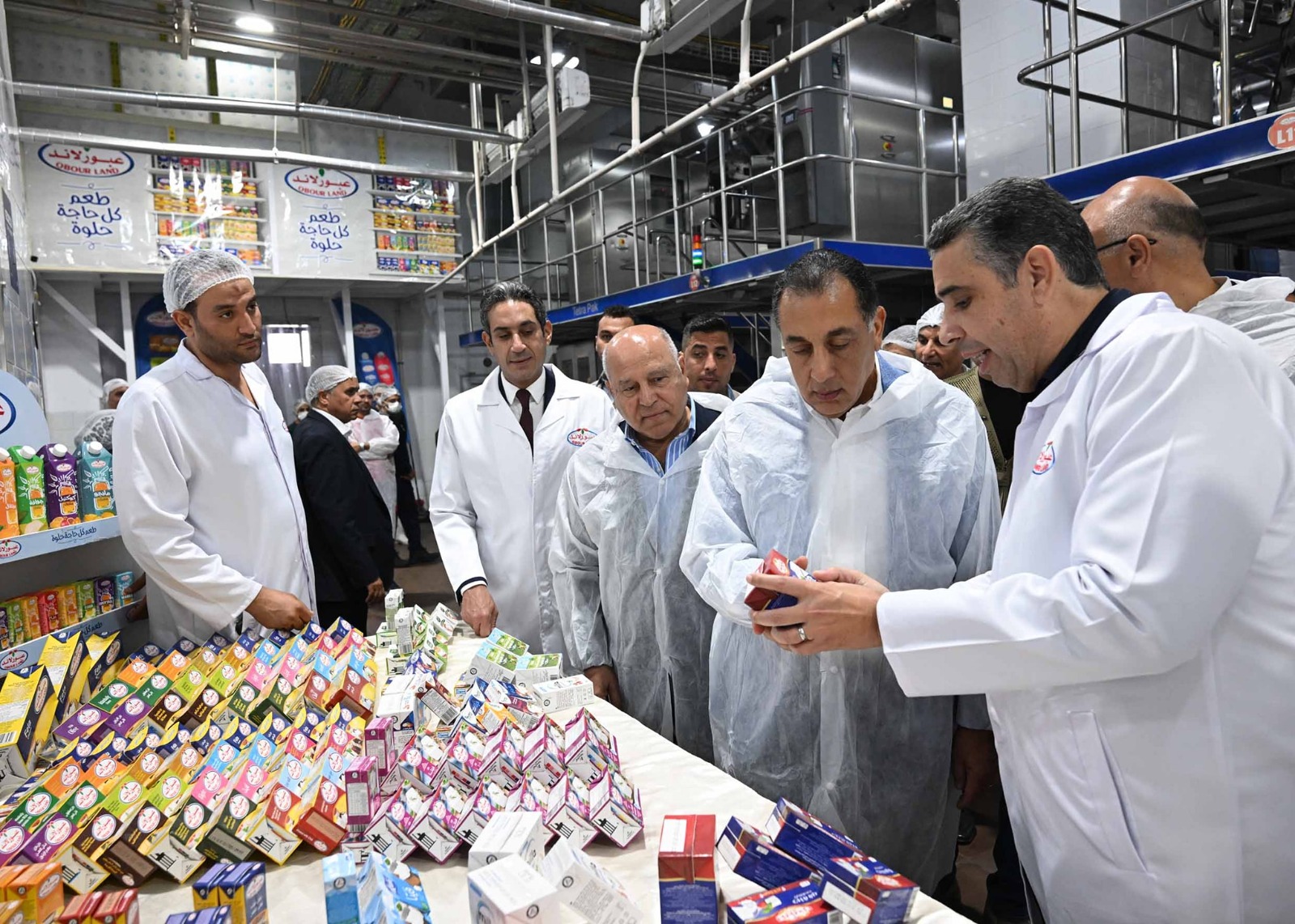
During his tour, Madbouly was briefed on the various
manufacturing stages and the integrated production line at the Obour Land 2
factory, which specializes in white cheese production. He observed the stages
of production, pasteurization, filtration, the addition of salt, the
concentrated milk stage, and the final transfer to the cheese-making process.
He also inspected the production hall, the Tetra Pak
machines, and the assembly, packaging, and printing equipment, in addition to
the company's product display for local and export markets.
Mohamed Hamed Sherif, Chairman of Obour Land Food
Industries, then gave Madbouly a presentation, noting that the company is a
leading firm in the food industry, specializing in dairy, cheese, and juices.
The factory is built on an area of 26,000 square meters. Sherif added that the
company was established in 1996, began production in 1998, and holds a market
share of about 40% of cheese products in the Egyptian market.
Sherif said Obour Land produces a variety of products,
including UHT milk (full-fat or skimmed) at a rate of 100 tonnes per day. The
company also produces natural and vegetable white cheese with an average
production of 450 tonnes per day and a maximum capacity of 750 tonnes per day.
He added that they produce fruit juices at a rate of 60
tonnes per day. Sherif noted that the factory for natural and vegetable
processed cheese helps meet local market needs, with the largest portion of its
output exported to Gulf Arab states and other countries.
The chairman also noted that Obour Land exports its products
to about 35 countries, including Russia, Azerbaijan, South Africa, Thailand,
Gulf Arab countries, and African nations such as Chad and Senegal. He
highlighted the high quality of the company’s products, which have obtained ISO
quality certifications, Egyptian and Emirati quality certificates, and are
included in the "White List" of the National Food Safety Authority.
He also underscored the company's commitment to occupational safety and health
standards.
He mentioned that the company employs about 2,600 workers
and has a huge distribution network covering all governorates of the republic
through "refrigerated vehicles" that transport and distribute
products to sales outlets and commercial markets, in addition to agents across
the country.
Ahmed Hussein, General Manager of Factories at Obour Land,
discussed the company's expansion plan, noting the completion of a new factory
and the installation of its machinery. He said trial operations would be
conducted this month, with production slated to begin in early November. This new
facility will primarily focus on producing processed cheese, which is currently
the most in-demand product for export.
Hussein also detailed plans to expand "Obour Farm," an affiliated farm that currently produces about 12 tonnes of milk daily from approximately 700 cows. The company aims to reach a production rate of 30 tonnes of milk per day to meet increasing demand, as the company's factories often run at full capacity, especially during peak seasons and for export orders.