
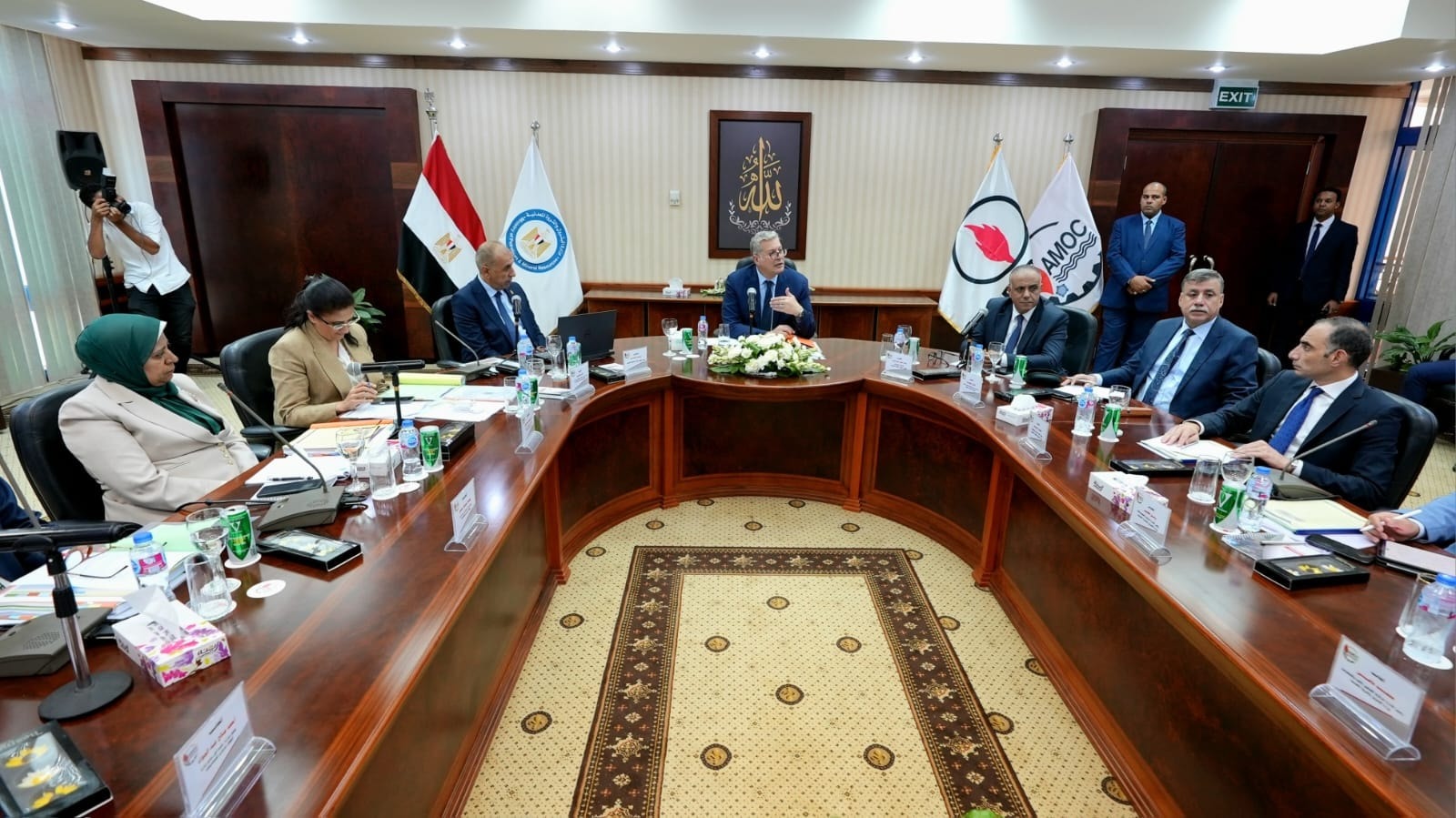
During the Ordinary General Assembly, which approved the company's results for the 2024-2025 fiscal year, Engineer Badawi outlined the six core axes of the Ministry's national strategy.
He underscored the crucial role played by the Alexandria
Mineral Oils Company (AMOC) in executing this plan by maximizing production
capacity, helping meet local market demand, reducing the import bill, and
boosting export opportunities for specialized products.
The Minister lauded AMOC's distinguished performance
indicators, which reflect its strength as a company listed on the Egyptian
Stock Exchange. He praised the integrated efforts of all company and sector
employees in securing the public's needs for petroleum products.
Engineer Magued El-Kordy, Chairman of AMOC, reviewed the key
performance indicators:
Production: Production of oils and waxes reached 172,000
tons, achieving 108% of the target. The company maintained a highly profitable
product mix—including solar, naphtha, and butane—totaling 442,000 tons, while
fuel oil production was 666,000 tons.
Local Supply: AMOC supplied the local market with 1.191
million tons of products, valued at EGP 33.66 billion.
Exports: The company successfully penetrated new export
markets, especially in Africa, exporting 70,000 tons valued at $65 million,
marking a 9% increase over the previous year.
Financial Growth: Financial indicators showed significant
growth:
Revenues rose to approximately EGP 38 billion, an 11%
increase from EGP 34 billion in the previous year.
Net Profit increased to about EGP 1.552 billion.
Total Investments reached EGP 5.6 billion, growing by 7.4%.
Shareholders' Equity rose to EGP 5.422 billion, a 9% growth
year-on-year.
For the fourth consecutive year, AMOC was included in Forbes'
ranking of top Egyptian companies based on profitability and market value. It
also joined the Egyptian Exchange's new (EGX35-LV) 2025 Index, which includes
over 35 companies with high liquidity and low price volatility.
The results also affirmed the company's commitment to
safety, occupational health, environmental sustainability practices, energy
rationalization, and the reduction of carbon emissions.
The Ordinary General Assembly approved a cash dividend
distribution of 80 piasters per share to shareholders.
The company also supported community development in various
governorates with approximately EGP 23 million dedicated to developing
infrastructure, education, health, and improving quality of life.
The Extraordinary General Assembly approved an amendment to the company's fiscal year, changing it to start in January and end in December, instead of running from July to June.