
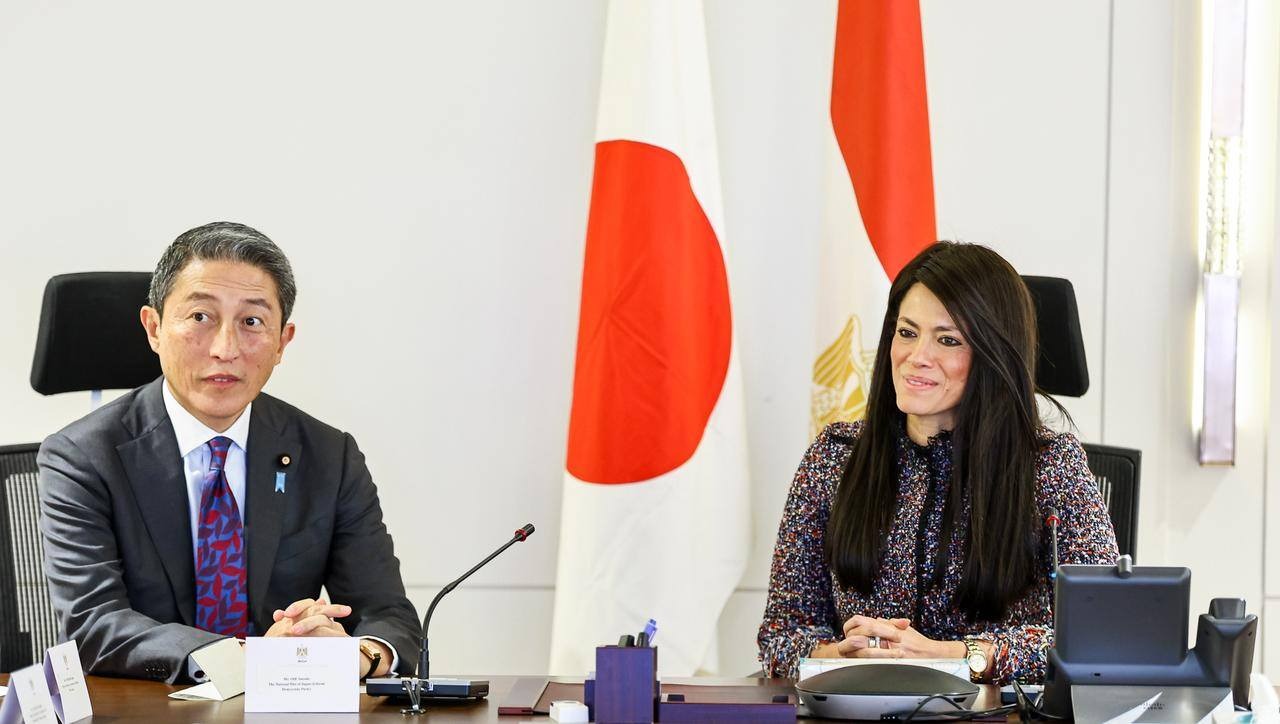
The delegation included prominent members of the House of Councilors representing various political parties, including Aoi Satoshi (Liberal Democratic Party), Dr. Yokoyama Shinichi (Komeito), and Uchikoshi Sakura (Constitutional Democratic Party), alongside senior researchers from the Standing Committees on Environment and Budget. The delegation was accompanied by H.E. Iwai Fumio, Japan’s Ambassador to Egypt.
Dr. Al-Mashat expressed the Egyptian people's profound
respect for Japanese culture and its model of discipline and productivity. She
noted that both nations recently celebrated over 70 years of diplomatic
relations, highlighted by a joint report with the Japan International
Cooperation Agency (JICA) documenting decades of successful development
projects.
The Minister emphasized that Egyptian-Japanese cooperation
spans critical sectors including education, health, sustainable transport, and
tourism. She specifically cited the Grand Egyptian Museum (GEM) as the world's
largest example of developmental cooperation in culture and heritage, noting
that its impact extends beyond construction to the preservation of global
"public goods."
Dr. Al-Mashat highlighted that the uniqueness of the
Japanese partnership lies in its focus on quality and sustainability.
"Our partnership with Japan is a model for development.
It focuses on technical support, institutional capacity building, and ensuring
the continuity of projects long after the financing periods end," the
Minister stated.
Addressing economic cooperation, Dr. Al-Mashat outlined
several key pillars of the current strategy:
Private Sector Growth: JICA programs are increasingly
providing financing targeted at both Japanese and non-Japanese private sector
entities operating in Egypt.
Budgetary Support: Japanese contributions support Egypt’s
structural reform programs, enhancing macroeconomic stability and employment
rates.
Universal Health Insurance: Egypt is drawing inspiration
from the Japanese model, working in a multilateral framework alongside the
World Bank and France to implement a comprehensive healthcare system.
Governance and Transparency: The Minister reaffirmed the
existence of a rigorous governance framework for Japanese grants and
concessional loans to ensure maximum efficiency and transparency.
Despite regional and global crises, Dr. Al-Mashat noted that
the Egyptian economy continues to show resilience, with growth rates exceeding
5% and a steady increase in foreign direct investment (FDI). She extended an
open invitation for further direct Japanese investment across various sectors.
The Japanese parliamentary members expressed their gratitude for the fruitful cooperation, specifically praising the Egyptian-Japanese Schools (EJS) as a tangible success story of Japanese development resources in Egypt. After conducting field visits to several projects, the delegation lauded the effective utilization of resources and expressed a commitment to long-term cooperation that fosters stability and prosperity globally.