
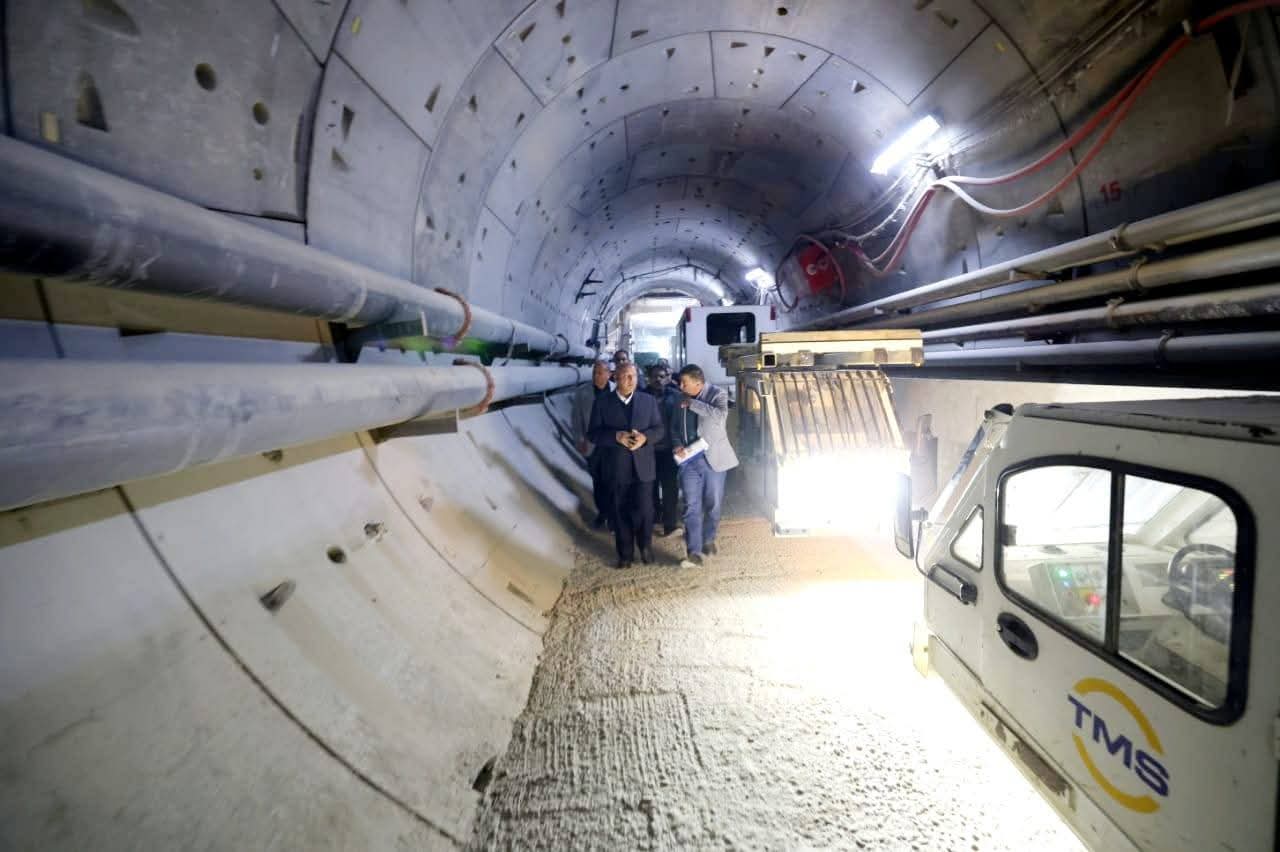
The tour, carried out under the directives of President Abdel Fattah El-Sisi, focused on the first phase of the line, which stretches from the Great Egyptian Museum (GEM) to the Fustat district. Al-Wazir was accompanied by senior officials from the National Authority for Tunnels (NAT) and heads of the national firms executing the project.
Al-Wazir visited several key stations along the route,
including Giza, Al-Ahram, and the GEM. He confirmed that restoration work in
the areas surrounding the Great Egyptian Museum has reached 100% completion
ahead of the museum's highly anticipated opening.
Deep beneath the Giza plateau, the Minister inspected the
progress of four massive Tunnel Boring Machines (TBMs). Two machines are
currently advancing toward the GEM and Al-Remaya, while two others are
operating in the Talbeya and Al-Matbaa districts.
"This project is a testament to Egyptian
engineering," Al-Wazir said, noting that five national companies are
carrying out the massive construction effort.
The new line is a cornerstone of Egypt’s strategy to expand green,
sustainable, and eco-friendly public transport. Once fully operational, Line 4
is expected to transport approximately 1.5 million passengers daily,
significantly easing the gridlock on Cairo’s major arteries.
A unique feature of the project is the interior design of
the GEM station. Wazir instructed the NAT to coordinate with the Ministries of
Tourism and Antiquities to ensure the station’s aesthetic reflects the
historical significance of the neighboring museum and the Giza Pyramids.
The Ministry detailed a four-phase expansion plan for the
line:
Phase 1: Spans 19 km from Hadayek El Ashgar to Fustat,
featuring 17 stations. It will intersect with Line 1 at Al-Malek Al-Saleh and
Line 2 at Giza.
Phase 2: Extends 26.9 km from Fustat to New Cairo,
intersecting with the planned Line 6 at Sayeda Aisha.
Phase 3: A 16.3 km stretch connecting Hadayek El Ashgar to
Al-Hosary Square in 6th of October City.
Phase 4: A 38.7 km final leg reaching the New Administrative
Capital’s airport, where it will link with the Light Rail Transit (LRT) system.
The second stage of Phase 1 is set to accelerate this month, with the first TBM scheduled to be lowered at the Fustat station in mid-January to begin drilling toward Al-Mesaha by March.