
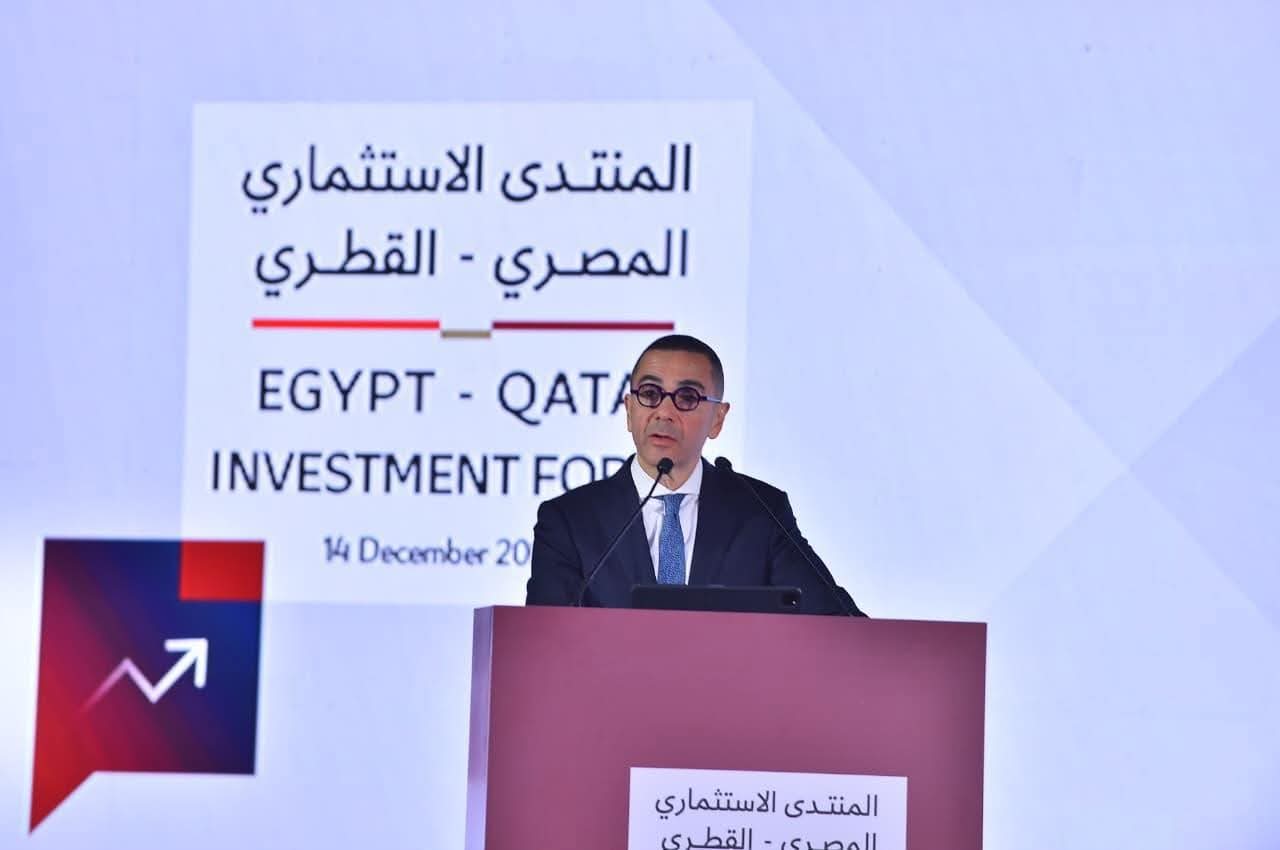
El-Khatib underscored that relations between Egypt and Qatar are based on strong foundations of trust and mutual cooperation, which is reflected in robust economic indicators. Qatari investments in Egypt currently stand at approximately $3.2 billion, distributed across more than 266 companies operating in diverse sectors including finance, industry, and tourism.
The Minister noted a significant positive momentum in
bilateral trade, which surged by nearly 80%, rising from about $80 million in
2023 to $143 million during the first ten months of 2025. This growth, he said,
confirms the expanding base of economic cooperation and the ability of
companies in both nations to leverage available opportunities.
He added that economic ties have recently received a strong
impetus, highlighted by President Abdel Fattah El-Sisi's visit to Doha and his
meeting with Emir Tamim bin Hamad Al Thani. That meeting resulted in an
agreement to boost investment cooperation and open new horizons, evident in the
announcement of a new Qatari investment package in Egypt. Key among these is a
major partnership for the development of the Alam ElRoum area on the North
Coast, focusing on integrated tourism and urban development.
El-Khatib affirmed Egypt's ambition to solidify its position
as an attractive investment destination in the coming years, citing clear
competitive advantages, notably its unique geographical location, the
availability of qualified human capital at a competitive cost, and a stable and
secure environment.
He outlined the country's economic strategy, noting that the
past decade focused on building a solid economic base through intensive
investments in infrastructure development, roads, ports, modern logistics zones,
and the establishment of a new generation of smart cities to create an
environment capable of absorbing growth and attracting major investments.
The current phase, El-Khatib continued, involves building on
this foundation through "clear structural and institutional reforms"
and adopting stable, long-term macroeconomic policies aimed at enhancing the stability
of the business environment and reducing burdens on investors. These efforts
are supported by comprehensive digital transformation of government services,
which has already improved macroeconomic indicators and reinforced certainty
and trust.
On the monetary front, El-Khatib highlighted that
disciplined policies contributed to lowering inflation to 12.3% in November
2025, while foreign reserves were bolstered to $50.2 billion and remittances
from Egyptians increased to $36.5 billion, supporting overall macroeconomic
stability.
Regarding fiscal policies, the government has engaged with
financiers through successive reform packages that have expanded the tax base
by approximately 35% without imposing new tax burdens. Efforts are also
underway to reduce non-tax financial burdens by comprehensively inventorying
fees imposed on investors and reviewing current company obligations, alongside
unified handling and digital transformation to reduce the actual cost of investment
and enhance transparency.
Furthermore, an open and flexible trade policy aims to
reduce the trade deficit by maximizing exports to $145 billion, simplifying
procedures, and cutting their cost by about 90%. This strategy involves
maximizing the use of trade agreements and protecting local industry to boost
the global competitiveness of the Egyptian economy.
Minister El-Khatib emphasized the government's ambitious
goal to see Egypt rank among the top 50 countries globally in investment and
trade competitiveness indices within the next two years. Implementation of this
transformation has already begun with the expansion of comprehensive digital
transformation, including the launch of the licensing platform and work on the
economic entities platform. This platform will completely re-engineer licensing
procedures and all associated fees and burdens, aiming for greater transparency
and predictable costs for investors.
The Minister presented promising and diverse investment
opportunities built on a vision of integration. He stressed that the
partnership should combine Qatari capital and investment expertise with Egypt's
production capabilities, infrastructure, geographic location, and competitive
advantages. Key sectors for cooperation include:
Industry: Opportunities for joint manufacturing and
deepening value chains, particularly in labor-intensive and intermediate
industries like auto components, glass, textiles and apparel, polyester, and
aluminum.
Tourism: Especially integrated tourism and urban development
projects.
Energy: Including new and renewable energy.
El-Khatib concluded that the forum marks a new stage in the
strategic cooperation between Egypt and Qatar. To support Qatari investors, a
specialized committee has been formed, comprising teams from various concerned
agencies, to facilitate investment and trade procedures, address challenges,
and provide necessary assistance.
He reiterated Egypt's commitment to advancing cooperation with Qatar to a deeper strategic level that achieves tangible results for the benefit of both nations, expressing hope that the forum would be a launchpad for a renewed path of fruitful partnerships.