
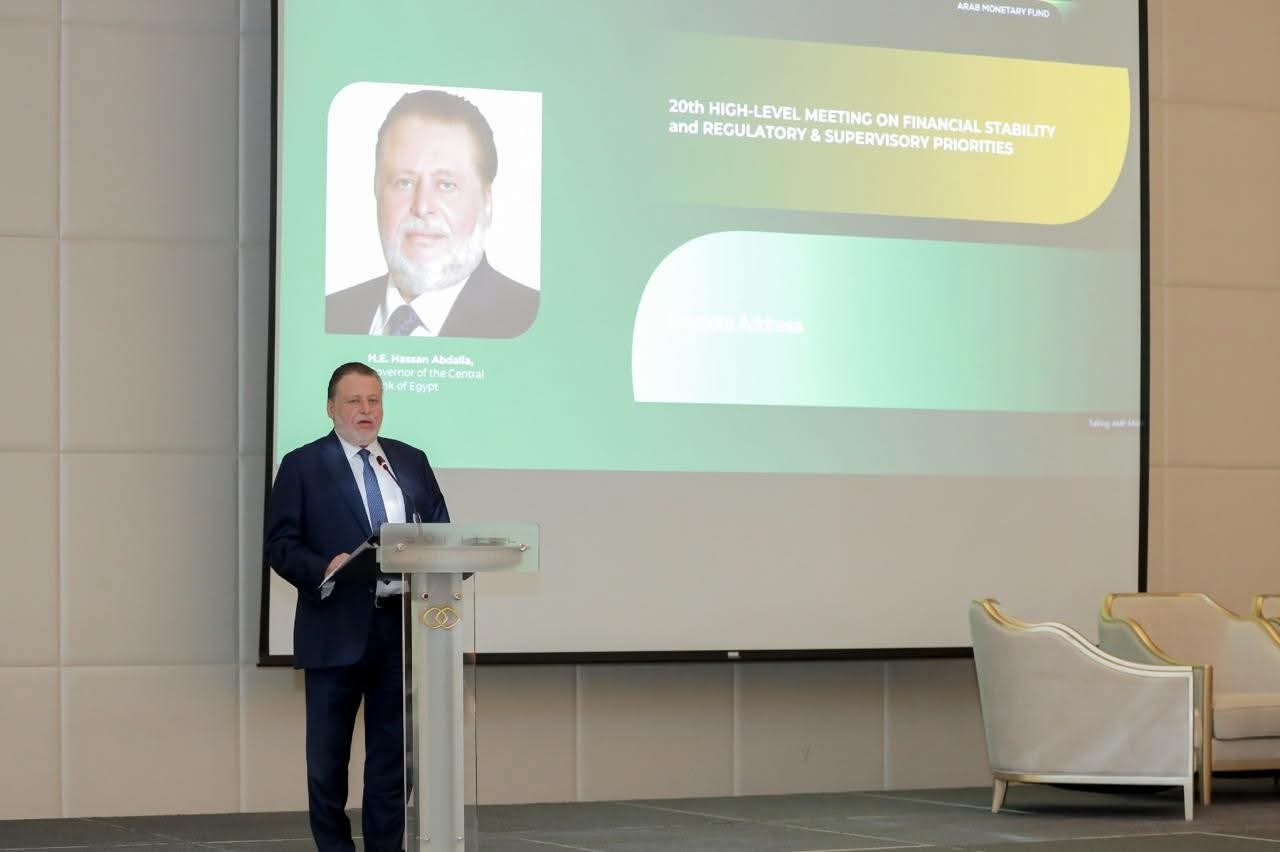
Abdallah made the remarks during his address at the 20th High-Level Annual Meeting on Financial Stability and Regulatory and Supervisory Priorities. The meeting was organized by the Arab Monetary Fund (AMF) in collaboration with the Financial Stability Institute (FSI) and the Basel Committee on Banking Supervision (BCBS) at the Bank for International Settlements (BIS) in the Emirati capital, Abu Dhabi.
The event was attended by Khaled Mohamed Balama, Governor of
the Central Bank of the UAE; Dr. Fahad bin Mohamed Al-Turki, Director General
and Chairman of the Board of the AMF; Fernando Restoy, Chairman of the FSI; and
Neil Winton, Secretary General of the BCBS. Numerous governors of Arab central
banks from Bahrain, Tunisia, Palestine, and Lebanon, among others, as well as a
large number of officials and experts, also attended.
In his speech, the CBE Governor underscored the importance
of the meeting's agenda, particularly topics related to financial stability and
regulatory and supervisory priorities in the Arab region. He described these as
a fundamental pillar for achieving development ambitions amid the complex
transitional phase of the global economy, marked by high inflation, liquidity
fluctuations, and rapid geopolitical shifts.
He added that the severity of these challenges is amplified
in the Arab region by rising public debt levels and the continuous volatility
of exchange and oil prices, which directly impact public finances, economic
activity, and investor expectations.
Abdallah explained that these challenges have necessitated a greater
role for central banks in safeguarding monetary stability, strengthening
economic resilience, and building more flexible financial systems to ensure
continued sustainable growth, absorb unexpected shocks, and maintain market
confidence.
The Governor highlighted the rapid growth of non-bank
financial institutions (NBFIs), whose share of global financial assets has
risen to nearly 50%. While this makes them a crucial market driver and an
engine for economic growth and financial inclusion, it also carries greater
risks that demand advanced and transparent regulatory frameworks.
He also pointed to the massive expansion of technological
innovation, particularly the use of digital assets and stablecoins, whose value
has doubled over the past three years, making them an influential component in
cross-border payments and transfers.
Abdallah further addressed the significant transformations
driven by Artificial Intelligence (AI), which offers opportunities to enhance
analysis and supervision capabilities, while noting associated risks such as
regulatory disparity, bias, and data protection. He also mentioned the
increasing cyber risks, necessitating a secure digital infrastructure and
sophisticated legislation.
The Governor also touched upon the global banking stress
witnessed in 2023, particularly following the failure of four banks. He noted
that this exposed the shortcomings of traditional liquidity standards in the
face of rapid digital withdrawals and instantaneous fund transfers via
electronic platforms.
He explained that these crises were the result of a combination of factors, including weak governance, insufficient risk management, unsustainable business models, and inadequate supervisory oversight. This calls for updating stress tests, enhancing operational readiness, and implementing proactive supervision capable of detecting risks early.