
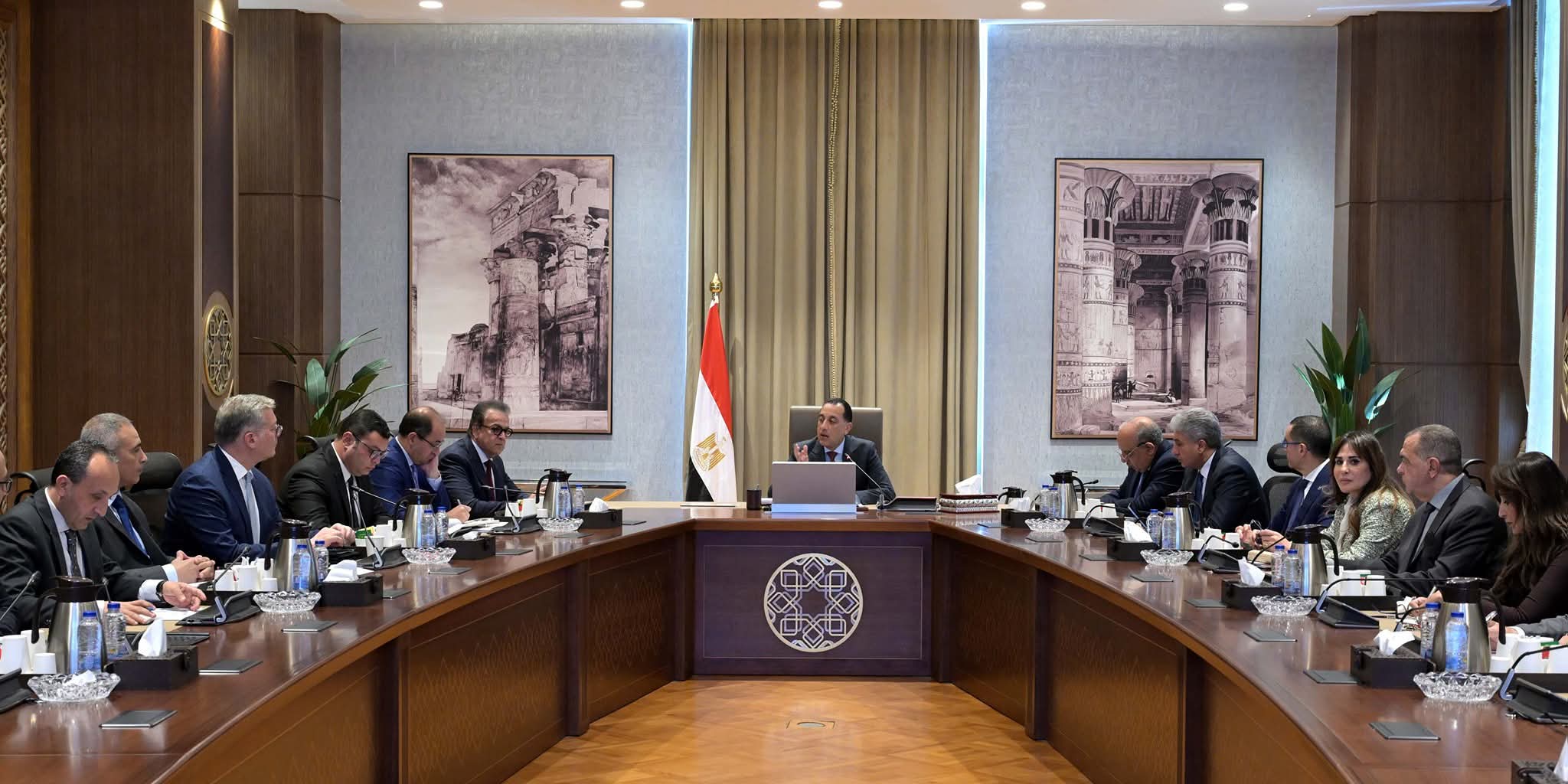
The meeting was attended by Dr. Khaled Abdel Ghaffar, Deputy
Prime Minister for Human Development and Minister of Health and Population;
Engineer Mahmoud Esmat, Minister of Electricity and Renewable Energy; Ahmed
Kouchouk, Minister of Finance; Sherif Fathy, Minister of Tourism and
Antiquities; Engineer Sherif El-Sherbiny, Minister of Housing, Utilities, and
Urban Communities; Engineer Hassan El Khatib, Minister of Investment and
Foreign Trade; Engineer Karim Badawi, Minister of Petroleum and Mineral
Resources; Sherif El-Kilany, Deputy Minister of Finance for Tax Policies; and
several other officials. Dr. Rania Al-Mashat, Minister of Planning, Economic
Development, and International Cooperation, participated via video conference.
Madbouly opened the meeting by highlighting the economic
reforms implemented by the Egyptian government in recent years. These reforms
included numerous investment incentives to improve the overall investment
climate. He noted the presence of several positive indicators and stressed the
government’s ongoing efforts to enhance the investment environment, motivate
investors, and encourage the private sector to increase its contribution to
economic activities. The goal is to create more job opportunities and boost
production and exports across various sectors.
He instructed the relevant ministries to prepare a new
package of facilitation measures and policies to increase private sector
investment during this phase. These efforts aim to support Egypt’s
comprehensive development and achieve the state’s investment objectives.
Madbouly emphasized that this issue enjoys the attention of
President Abdel Fattah El-Sisi. The President has issued directives to
incentivize the private sector to expand its contributions across multiple
sectors. Comprehensive health insurance is among the top priorities. Other
priority areas include the presidential “Decent Life” initiative to develop
rural villages and the renewable energy sector. Key sectors highlighted by the
government include industry, tourism, communications and information
technology, and agriculture.
He stressed the importance of offering further incentives to
attract additional investment. The goal is to encourage the private sector to
inject new investments and expand existing ones in priority sectors. The
tourism sector was specifically mentioned, with the government aiming to
attract 30 million tourists in the coming years. Incentives are essential to
achieving this target.
The Prime Minister also addressed the energy sector. Efforts
aim to increase the share of renewable and new energy in Egypt’s energy mix to
42 percent in the coming years. Government incentives are expected to
facilitate this target.
Madbouly highlighted the importance of raising export rates
across promising sectors, including the pharmaceutical industry. He also
emphasized the need to expand the number of governorates implementing
comprehensive health insurance. All these objectives are part of the
government’s priorities, and the administration is working diligently to
achieve them.
He confirmed that current economic indicators show positive
results. Real productive sectors are driving economic growth. Continuous
efforts are necessary to maintain achievements and to double positive outcomes
in the coming period.
He noted that the government is managing multiple important
files simultaneously. These include debt reduction and improving citizens’
quality of life and public services. All these efforts positively affect the
Egyptian people.
Madbouly emphasized the need to continue implementing
measures that attract more investments and create a stimulating environment
across sectors. The government seeks to maximize Egypt’s promising resources
and potentials.
He stressed the importance of fully applying the Investment
Law provisions and incentives for investors. The Prime Minister also
highlighted the need to activate stimulus packages approved by the government
for several sectors. Priority sectors will benefit first, and all exemptions
and facilitation measures included in these packages must be implemented.
Madbouly underlined the importance of continuing structural
reforms, particularly those announced recently and outlined in the national
strategy. These reforms aim to achieve targeted outcomes across multiple
sectors.
The Prime Minister highlighted efforts to attract more
investments to the petroleum sector. This will expand exploration and
extraction activities and increase production of petroleum products and natural
gas, meeting developmental and consumer demands.
He also emphasized maximizing investment opportunities in
new cities and increasing private sector participation in urban expansion
projects. These projects aim to align urban development with the state’s
broader development plans.
During the meeting, ministers reviewed ongoing efforts in
their respective sectors to boost operations and attract both domestic and
foreign investments. They confirmed that new packages of facilitation measures
will be announced soon to further attract investments from the local and
international private sector.