
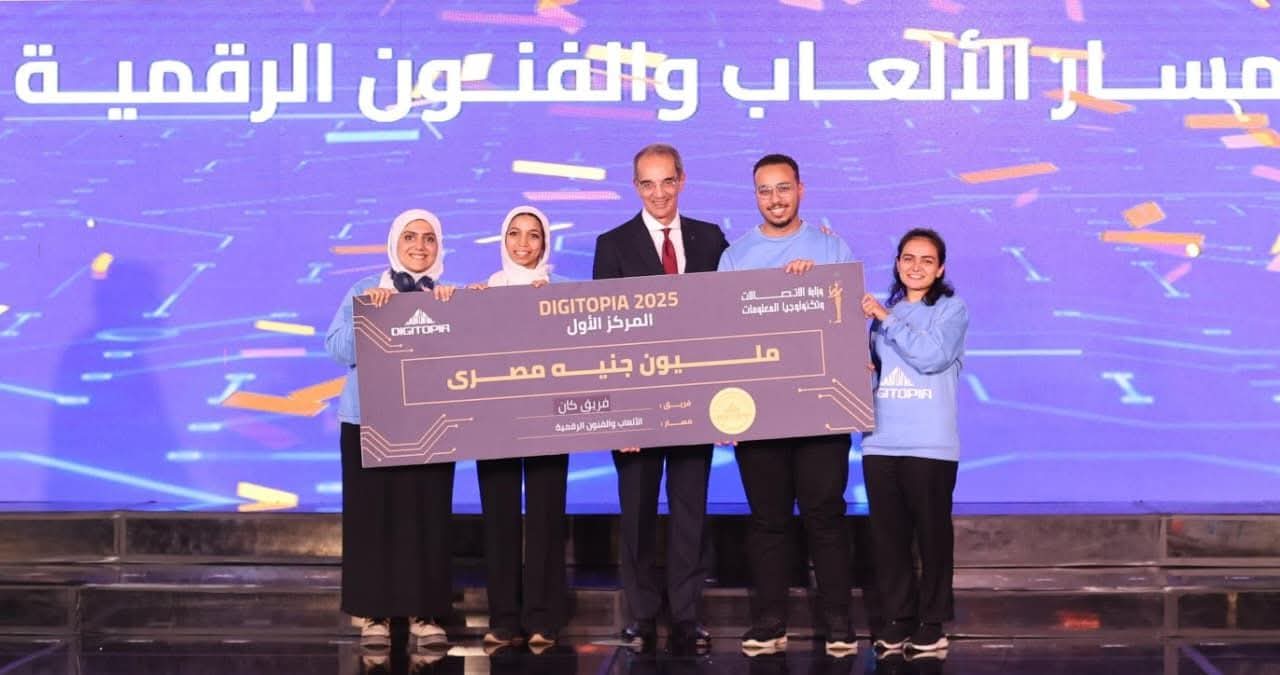
The competition saw contestants innovate digital solutions to address societal challenges across three main tracks: Software Solutions and Artificial Intelligence (AI), Cybersecurity, and Digital Games and Arts.
In his address, Talaat explained the vision behind the name
"DIGITOPIA." He noted the name combines "Digital,"
reflecting Egypt's vision for a society that relies on technology and produces
innovative digital solutions, and the Latin suffix "topia," meaning
ideal city or model. Thus, "Digitopia" expresses the vision for a
better future powered by creative thinking and technology. The Minister
affirmed that the competition will continue to nurture generations of
innovators in all ICT specialties.
Dr. Talaat highlighted that the three chosen tracks
represent the present and future of technology:
AI: Offers capabilities for analysis and solutions in
healthcare, agriculture, energy, and education, which generates vast amounts of
data.
Cybersecurity: Essential for protecting this data, which
represents a wealth for nations and individuals.
Digital Games and Arts: Embodies technology’s ability to
turn ideas into vibrant realities and digital games that reflect creativity and
vitality.
The Minister emphasized that humans remain the true leaders
of technology, as the creative human mind will always be the one that employs
it for the service and welfare of humanity.
The competition, which began in early August, saw massive
participation. Over 25,000 innovators formed more than 6,500 teams from across
all governorates. The competition included multiple elimination rounds,
culminating in the finals with 72 teams (around 300 contestants), with 24 teams
per track. The competition covered four age groups: "Impact
Explorers" (Primary school), "Impact Makers" (Preparatory and
Secondary school), "Impact Innovators" (University students), and
"Impact Leaders" (Graduates and entrepreneurs up to 35 years old).
Minister Talaat honored the top six teams in each category,
awarding prizes exceeding 10 million Egyptian pounds, including a grand prize
of up to one million pounds in each track.
The first-place winners in the competition were announced
across the three tracks:
Software Solutions and Artificial Intelligence Track:
Impact Explorer Stage: "Digital Environment
Champions" team.
Impact Maker Stage: "Mindlink" team.
Impact Innovator Stage: "Capable Ones" team.
Impact Leader Stage: "Challenge of Will" team.)
Cybersecurity Track:
Impact Explorer Stage: "Awareness Champions" team.
Impact Maker Stage: "System Guards" team.
Impact Innovator Stage: "Nazwell" team.
Impact Leader Stage: "White Matter" team.
Digital Games and Arts Track:
Impact Explorer Stage: "Techno Pro" team.
Impact Maker Stage: "The Three Girls" team.
Impact Innovator Stage: "Wingless" team.
Impact Leader Stage: "Kaan" team.
The Minister also honored the "Success Partners" institutions
and organizations recognized for their outstanding contributions to supporting
the "Digitopia" competition.
Dr. Heba Saleh, President of the Information Technology
Institute (ITI), stated that male participants accounted for 65% of the total,
while females represented 35%. She noted that the projects in the Digital Games
and Arts track reflected a strong Egyptian identity, while those in
Cybersecurity and Software/AI presented innovative solutions for information security,
community service, and the national economy.
Chitose Noguchi, UNDP Resident Representative in Egypt,
highlighted the close cooperation between the UN Development Programme and
MCIT, noting the partnership has become the largest digital programme for the
UNDP in the Arab region. She stressed the importance of initiatives like
"Digitopia" in promoting inclusivity, providing equal opportunities
for girls, youth in various governorates, and people of determination.
The event also included a panel discussion titled
"Digital Empowerment Partners," focusing on the criteria for
selecting young talent and mechanisms for enabling Egyptian youth to compete
globally.
The competition was supervised by the Information Technology Industry Development Agency (ITIDA), the National Telecommunication Institute (NTI), the ITI, and the Egypt University of Informatics (EUI), in collaboration with numerous local and international partners including the UNDP, Huawei, Cisco, and Egypt's leading telecommunications companies.