
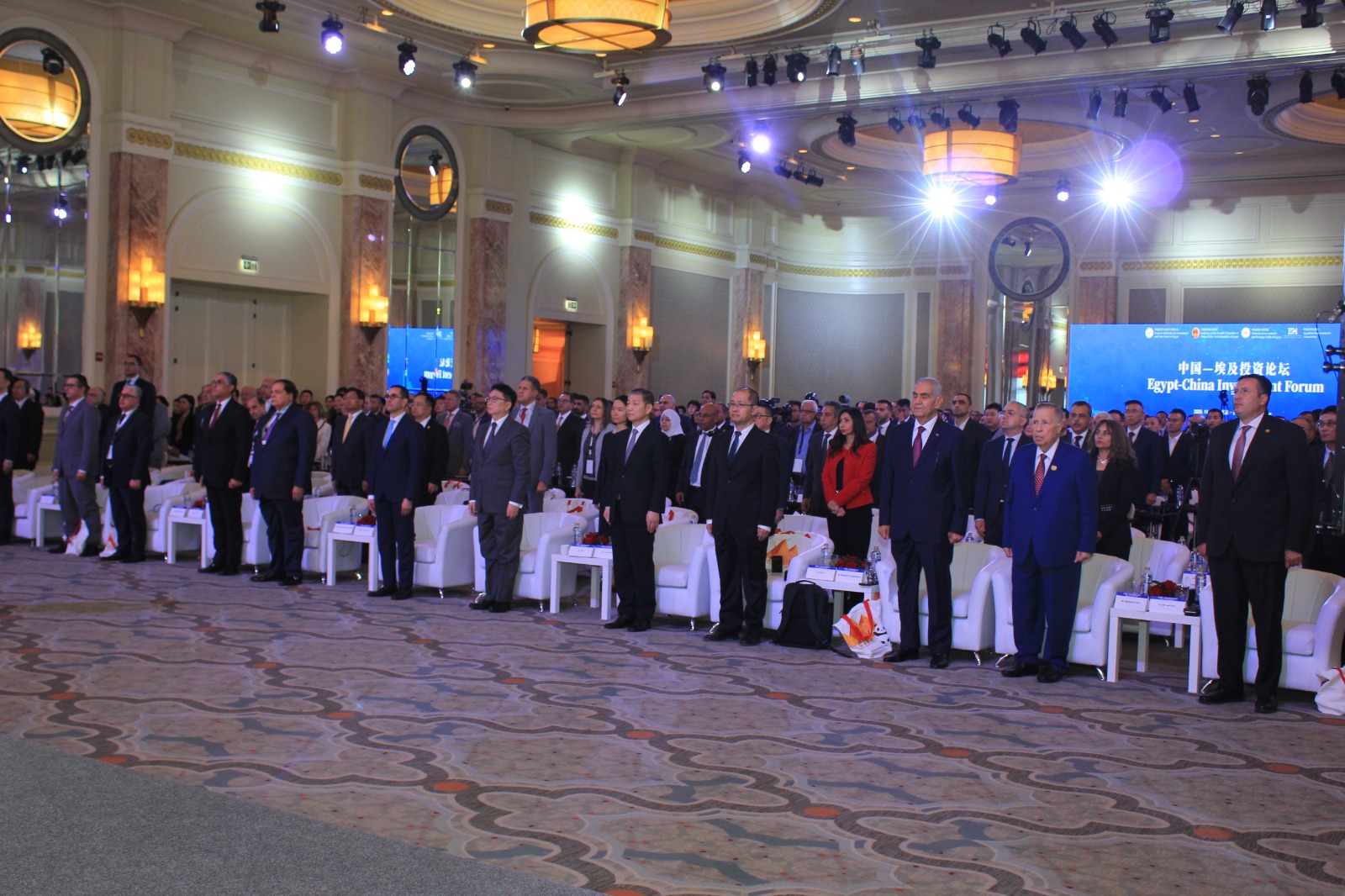
Top officials and business leaders from both Egypt and China attended the opening session. Attendees included Egyptian Minister of Investment and Foreign Trade Engineer Hassan El Khatib, China's Vice Minister of Commerce and Deputy International Trade Representative Ling Ji, EBA Secretary-General Engineer Magd El Din El Manzalawi, Chinese Ambassador to Egypt Liao Liqiang (also China's permanent representative to the Arab League), and Egyptian Parliament Deputy Speaker Mohamed Abou El Enein.
In his opening speech, EBA Secretary-General El Manzalawi
said the forum's organisation fulfilled a long-held EBA aspiration, crowning a
long period of cooperation led by the association’s Committee for Developing
Economic Relations with China, established in 2007 out of a belief that China
is the future of the global economy.
El Manzalawi added that the EBA has engaged with major
initiatives launched by Chinese President Xi Jinping, including the Belt and
Road Initiative (BRI). To activate this initiative, the association joined
major Chinese economic entities to promote it, notably the Belt and Road
Industrial and Commercial Alliance (BRICA), founded by the China Federation of
Industrial Economics (CFIE).
He noted the EBA participated in the alliance's founding
conference in Beijing in 2016 and proposed an annual conference for member
states, with Egypt hosting the first session in 2017. The EBA also attended the
third session in Harbin, China, in 2022.
El Manzalawi stated the EBA is keen to continue its
partnership with China to raise awareness, particularly by boosting Egyptian
participation in the China International Import Expo (CIIE). He highlighted the
expo's global role in promoting trade balance, being the first worldwide fair
to focus on importing both goods and services, and serving as a platform for
high-level openness.
He expressed hope for stronger relations with China, leading
to increased Egyptian exports to the Chinese market and more Chinese investment
in Egypt. He said the EBA seeks to benefit from Chinese expertise in
manufacturing, industrial training, and technology transfer in sectors vital to
the Egyptian economy. This includes developing small and medium-sized
enterprises (SMEs) and creating new jobs for Egyptian youth, leveraging China's
experience in this field.
The forum is a platform for investors, experts, and
policymakers to discuss opportunities, shared challenges, and avenues for
cooperation towards sustainable development, El Manzalawi noted. This year's
forum focuses on three pillars of future development: textiles and ready-made
garments, information and communication technology in the era of artificial
intelligence, and infrastructure and new and renewable energy.
El Manzalawi expressed a desire for the forum to be held
regularly, stressing that the next phase requires enhanced international
cooperation, especially with China, given the strategic relationship between
the two countries.
He suggested potential cooperation areas, including:
Establishing joint technological and research centres in
Egypt to transfer and localise advanced industrial, agricultural, and
technological expertise.
Creating a specialised Egyptian-Chinese industrial zone for
pharmaceuticals, cosmetics, and traditional Chinese medicine to serve African
markets.
Establishing joint investment funds to finance SMEs in
technology, sustainable tourism, vital industries, and agricultural technology,
citing the latter's pivotal role in achieving food security and efficient
production.
Boosting the tourism sector, especially with the opening of
the Grand Egyptian Museum (GEM), which enhances Egypt's position as a global
destination for culture, heritage, and sustainable tourism.
El Manzalawi thanked the Chinese Embassy, the Ministry of
Investment and Foreign Trade, and the General Authority for Investment and Free
Zones (GAFI) for their productive cooperation and efforts in organising the
forum, which contributed to its success and to strengthening economic and
investment cooperation.
He affirmed the EBA looks forward to the forum being a new step towards fruitful cooperation among all participants, and that its outcomes will support development and achieve shared goals.