
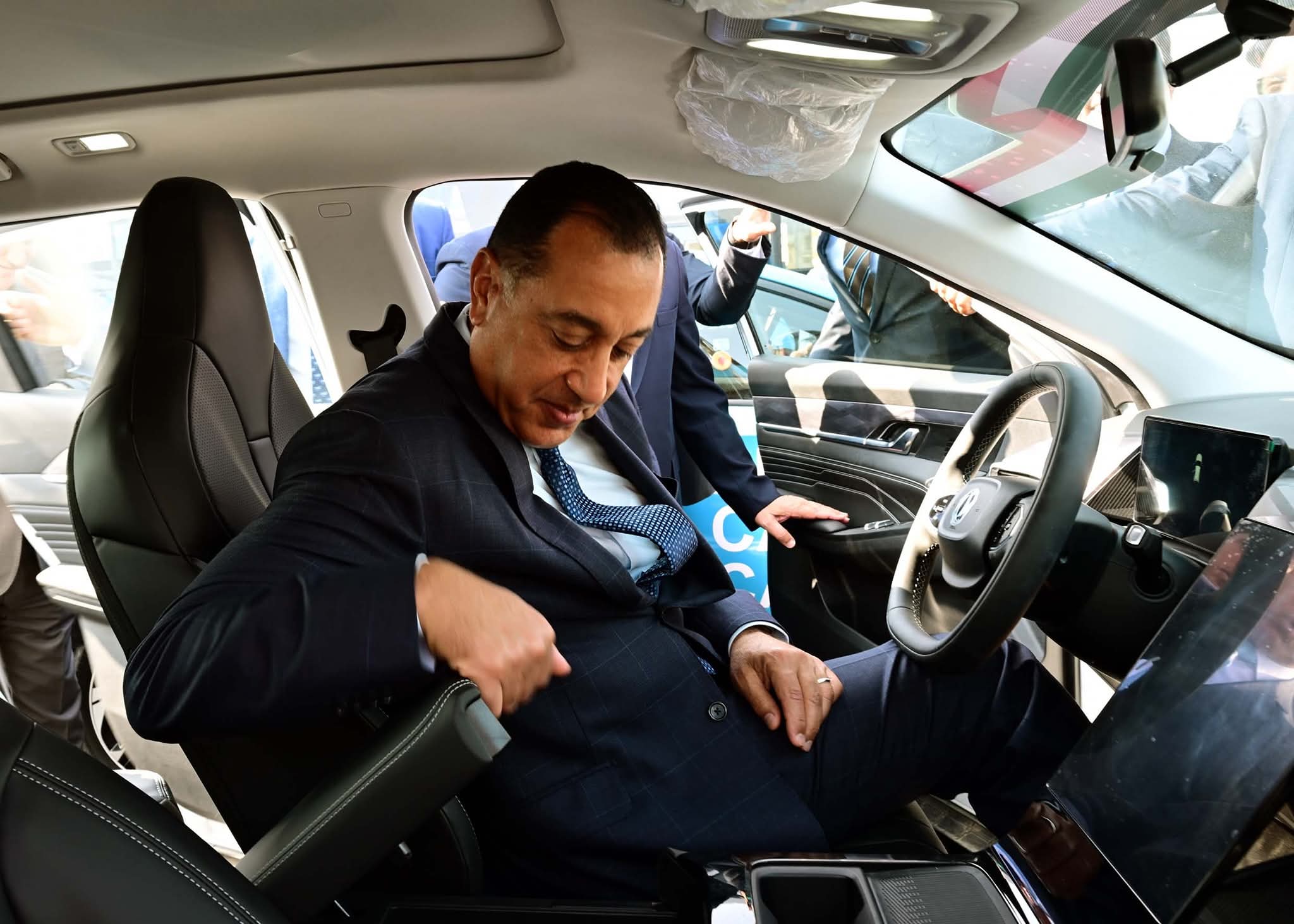
Initially, the Prime Minister and his deputy for industrial
development, the Minister of Industry and Transport, inspected the first
amphibious bus agreed to be manufactured locally in Egypt, which is expected to
contribute to the tourism sector in Egypt.
Madbouly listened to a briefing by Major General Hassan
El-Leithy, Chairman of Super Jet Company, on the buses on display, which
operate with the company and are manufactured locally in Egypt, within the
framework of the plan to localize bus manufacturing in Egypt. The inspection
included buses manufactured by El Nasr Automotive Company, MCV Egypt, MAN Kastour,
and the modern Volvo buses produced in Egypt for export by MCV, which have been
agreed to be contracted locally. The Prime Minister also viewed a model of the
Traffic City, which aims to teach children proper behavior when interacting
with traffic signals and various road types, as part of the Ministry of
Transport’s efforts to raise awareness among different generations about the dangers
of negative behaviors some people display when using the roads.
Following this, the Prime Minister and his deputy for
industrial development, the Minister of Industry and Transport, inspected the
first metro train that arrived in Egypt among the 55 new trains contracted for
Cairo Metro Line 1, designed to provide the highest levels of service for
passengers. These new trains feature a high-capacity air conditioning system
and a safe passageway allowing passengers to move between the carriages for greater
comfort. They are also equipped with CCTV cameras installed at the front for
centralized monitoring of the tracks and LCD screens to provide passengers with
information, which can also be used for commercial activities by displaying
paid advertisements.
It was also noted that above the side doors of these trains
there are screens to inform passengers of the final station before boarding.
Spaces for wheelchairs have been designated and equipped with securing devices
to assist people with disabilities. The carriages are also equipped with
electronic maps above the boarding doors inside, showing the route via
illuminated lights to assist hearing-impaired passengers.
The Prime Minister then inspected buses and vehicles from
"Akta" Company, where he received a briefing from Major General Sabry
Abdel Latif, Chairman of the Board of Directors, about these units, which
include: Higer bus, manufactured in Egypt with 60% local components, 315 kWh
battery, produced by GB Auto, operating within the New Administrative Capital;
GM4 cars, manufactured in China, 50 kWh battery, operating as taxis in the New
Administrative Capital; Yutong bus, manufactured in Egypt with 50% local
components (produced by El Nasr Automotive Company), 350 kWh battery, operating
for internal transport in the New Administrative Capital; and Donglong car,
manufactured in Egypt with 30% local components, 50 kWh battery, produced by El
Nasr Automotive Company, operating as a taxi in the New Administrative Capital.
The Prime Minister, his deputy for industrial development,
the Minister of Industry and Transport, and Ronald Busch, CEO of Siemens
Global, then inspected the first high-speed electric train, "Velaro,"
which arrived as part of the high-speed trains that will operate on the high-speed
electric rail network. Dr. Madbouly listened to a briefing from Major General
Tarek Goweily, Chairman of the National Authority for Tunnels, regarding the
capabilities and features of this train, as well as the number of trains
allocated to the high-speed electric train network across its three lines. He
noted that the train consists of eight connected carriages, 200 meters long,
with a capacity for 479 seated passengers. The carriages are equipped with
family seats, tables, electrical outlets, and USB ports.
Major General Goweily stated that special seats with safety
belts have been provided for people with disabilities. The trains include ten
standard restrooms, one restroom designated for people with disabilities, and
spaces for luggage storage. The trains are also equipped with Wi-Fi, in-car
screens displaying journey information, surveillance cameras, and emergency
equipment to ensure the highest levels of safety and passenger comfort. The
train includes the following carriages: the first carriage, luxury class, with
45 seats, 4 display screens (double display screen in the cabin, display screen
at passenger entrance, 2 external display screens), 5 surveillance cameras
(inside the driver’s cabin, passenger lounge, and carriage entrances); the
second carriage, luxury class, with 54 seats, 4 display screens (2 double
display screens, display screen at passenger entrance, 2 external display
screens), 4 surveillance cameras in the passenger lounge and carriage
entrances, and 2 restrooms.
The third carriage is dedicated to business class, with 34
seats plus 8 seats in the dining area, 7 display screens (double display screen
in the cabin, 2 display screens at passenger entrance, 4 external display
screens), 7 surveillance cameras in the passenger lounge and carriage
entrances, and 2 restrooms. The fourth carriage, also business class, has 58
seats, plus 2 seats for people with disabilities, 4 display screens (double
display screen in the cabin, 1 display screen at passenger entrance, 2 external
display screens), 5 surveillance cameras in the passenger lounge and carriage
entrances, and 1 restroom.