
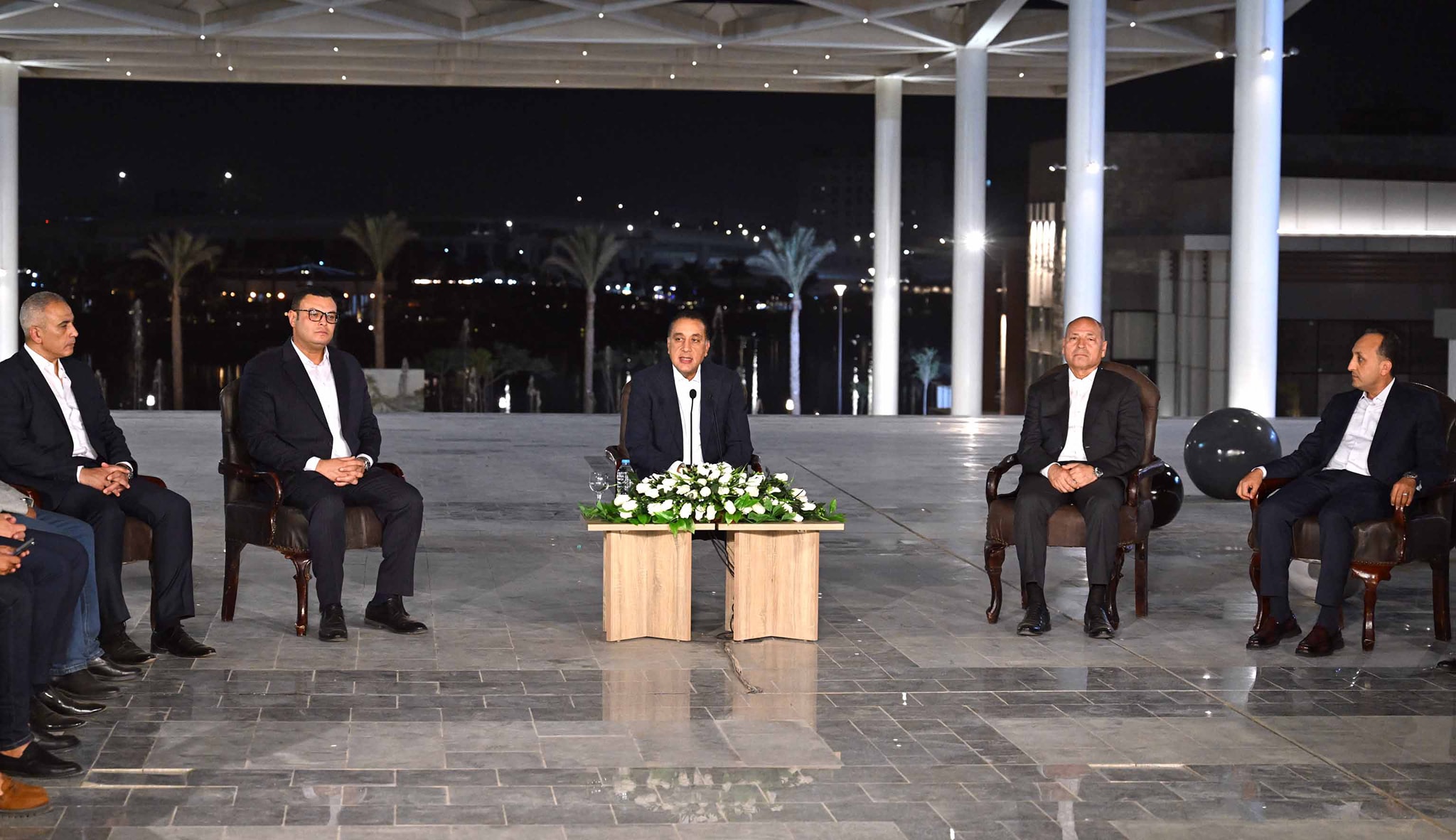
"This is reflected in the exchange rate of the dollar against the pound, which gives very good indicators for stability," Madbouly said during a press conference Tuesday evening from the site of the Telal El Fustat Park after inspecting the location.
Madbouly added that international reports on Egypt's
economic performance, along with statements from heads of global economic
organizations, confirm that the Egyptian economy is moving on its correct
course.
"This week, I was keen to visit and inspect the factory
complex of El-Nasr Pharmaceutical Chemicals Company, one of the subsidiaries of
the Holding Company for Pharmaceuticals," he said. The visit was part of a
plan to maximize state assets by developing existing factories. "Days
before that, we visited the spinning and weaving factories in Shibin El
Kom."
He stressed that these visits show there are strategic
sectors that the Egyptian state has not abandoned. The government's role is to
revive these factories and companies, returning them to productivity after a
long period of being halted or having their production processes deteriorate.
The Prime Minister concluded his remarks by saying that
these steps confirm the state's economic direction, alongside signs of
recovery. He pointed to successive meetings with the economic ministerial group
and the macroeconomic advisory group, in addition to following up on the
government's initial public offering program and monitoring external debt
rates. The goal is to ensure a continued downward trend for the debt until 2030
to reach safe levels in line with various global economies.
Regarding inflation rates, the Central Bank governor
presented data during the economic group meeting showing a continued decline in
inflation and stable conditions, which he said would achieve the figures and
rates announced earlier.
He then shifted his focus to the Telal El-Fustat Park.
"I was keen for us to be here together today in the Telal El-Fustat Park,
which is now in its final touches," he said, calling it a "giant
park" that will truly be the largest public park in the Middle East and
the central park of Cairo, covering an area of more than 500 feddans.
"We started this project some time ago, but the sheer
volume of details, the magnitude, and the complexity of this project were
enormous," Madbouly stated. He paused to reflect on the area before the
project began. "What was the shape of this area about three years ago, or
a little more? This area was essentially a concentration of unsafe areas, areas
that could be described as having a subhuman standard of living."
He noted that the area was home to thousands of families who
have since been successfully relocated to other civilized, high-standard areas.
Additionally, the site was one of the areas where all of Cairo's waste was
dumped. He added that water levels in the nearby lakes, Ain El-Sira and El-Fustat,
had also severely deteriorated.
In this context, the prime minister highlighted other
ongoing projects, including the revival of Khedivial Cairo and the development
of historic and Islamic Cairo, which includes the area around the Saladin
Citadel and the Muhammad Ali Mosque, as well as the area surrounding the Sultan
Hassan Mosque and Sayeda Nafisa, along with other historic mosques like Imam
Shafi'i Mosque. He affirmed that work is underway to revive these places and
their surrounding areas to a level that is worthy of the important heritage of
Cairo and Egypt in general.
Madbouly explained that the Telal El-Fustat Park project is
part of the general plan to revive Greater Cairo. He said the final touches are
being completed, with the project expected to be fully finished in the coming
weeks. He expressed pleasure that the project's completion coincides with the
opening of the Grand Egyptian Museum.
"We also have areas in western Cairo that have seen extensive development work, including the Pyramids area and its surroundings, concurrent with the work on the Grand Egyptian Museum," he said. He added that other areas in the heart of Cairo have also undergone development and efficiency improvements, including the new central park. "This confirms that the Egyptian state is keen on building new cities while, at the same time, preserving and reviving the old heritage and restoring Cairo to its former glory and splendor."