
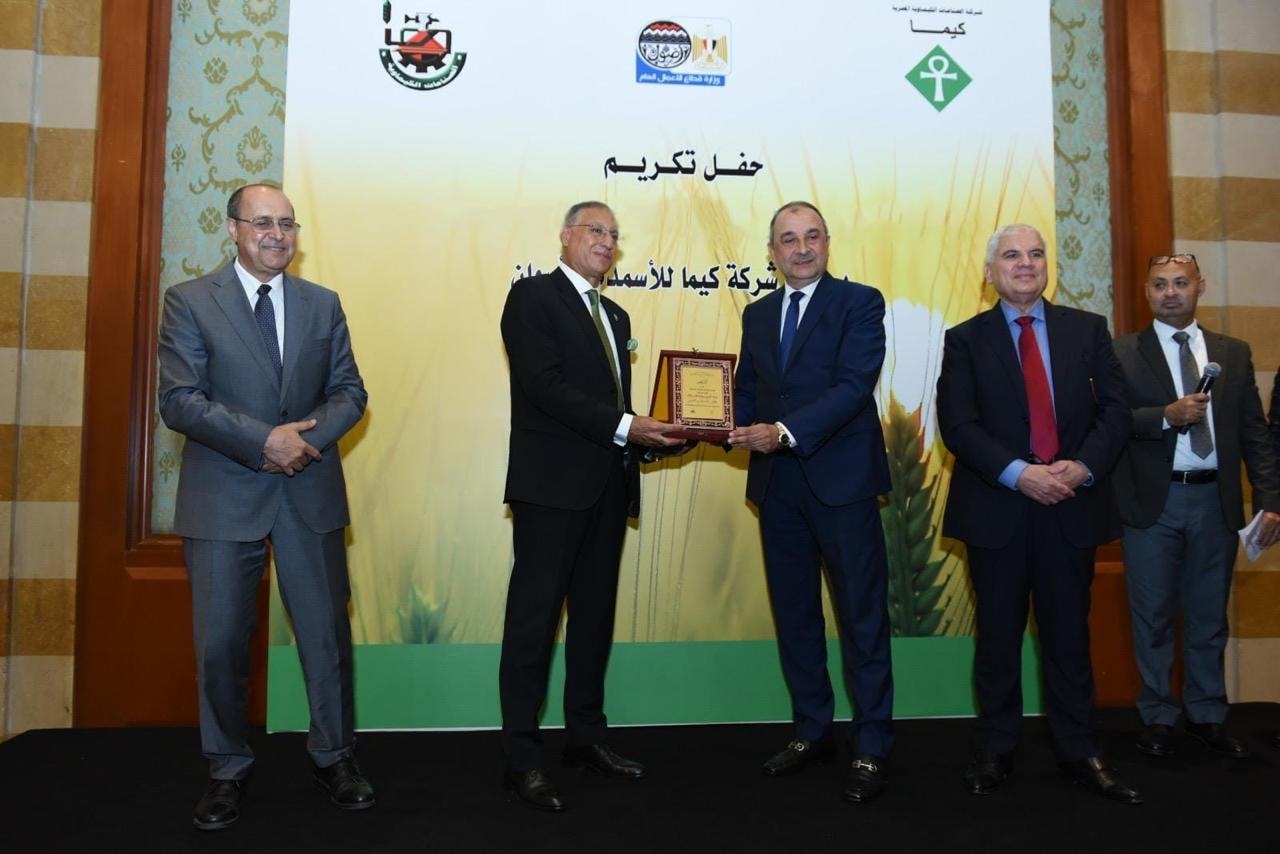
The honoring took place as part of efforts to support
partnerships between national entities and leverage local expertise. Several
companies distinguished in implementing the work were recognized, including the
engine and electronics factories affiliated with the Arab Organization for
Industrialization, as well as the Egyptian Maintenance Company (San Misr) and
Helwan Fertilizers. During his speech, the Minister praised the high efficiency
and capability demonstrated by these companies, emphasizing that national
companies have the expertise and qualified personnel to play pivotal roles in
development and modernization projects.
The ceremony also recognized several industrial leaders,
including Major General Engineer Mokhtar Abdel Latif, Chairman of the Arab
Organization for Industrialization; Engineer Hassan Abdel Alim, Chairman of
Helwan Fertilizers Company; Engineer Mohsen Kotb, Chairman of San Misr Company;
and Engineer Khaled Ibrahim, Chairman of Enppi, for their effective
contributions to maintenance work at KIMA. Emad El-Din Mustafa, former
Executive Managing Director of the Chemical Industries Holding Company, was
also honored for his efforts during his tenure as CEO.
Engineer Mohamed Shimi emphasized the importance of
deepening cooperation with national companies and utilizing their capabilities
to implement major projects. He noted that KIMA’s achievements serve as a model
for integration among Egyptian industrial institutions, reinforcing the trend
toward increased reliance on local expertise and technology localization.
The Minister added that the fertilizer sector is a priority
in the Ministry's plans to develop its subsidiaries, due to its vital role in
supporting the agricultural sector and providing strategic products for the
domestic and export markets. He explained that KIMA is currently implementing
new production projects, including a nitric acid unit with a capacity of 600
tons per day and an ammonium nitrate unit with a capacity of 800 tons per day.
These projects will boost the company’s production capacity while adhering to
the highest technical and environmental standards.
The Minister stressed that maximizing investment returns for
subsidiaries is a top priority for the Ministry. This involves expanding
advanced projects in line with global environmental standards, fully
implementing maintenance programs, applying occupational health and safety
measures, and developing human resources through specialized training programs
aimed at improving efficiency and productivity.
Abdel Latif expressed pride in the recognition, highlighting
the Arab Organization for Industrialization’s commitment to strengthening
cooperation with all governmental and private institutions as the optimal path
to comprehensive development. He emphasized that the recognition reflects the
Organization’s advanced technical and human capabilities, and its ability to
address complex industrial challenges rapidly, supporting Egypt’s efforts to
deepen local manufacturing and reduce dependence on foreign sources.
He also stated that the Arab Organization for
Industrialization aims to meet the needs of Egypt’s industrial sectors, as well
as those in neighboring and friendly countries, for manufacturing equipment and
production lines locally, rather than importing them. He also highlighted the
importance of maintaining investment equipment, considering it a key part of
Egypt’s industrial wealth.
It is worth noting that KIMA, founded in 1956, is one of
Egypt’s major industrial institutions in fertilizer production. Located in the
heart of Upper Egypt, in Aswan Governorate, it represents a critical industrial
and developmental pillar for the region. The company recorded record sales of
EGP 8.6 billion during the 2024/2025 fiscal year, the highest in its history,
reflecting a growth rate of 132% compared to the previous year.
KIMA also successfully rehabilitated its ferrosilicon plant,
inactive since March 2019, converting it to silicomanganese alloy production
and adding an advanced filter unit to ensure compliance with environmental
standards. The plant now has a production capacity of 18,000 tons per year,
enhancing product diversity and supporting export capabilities.