
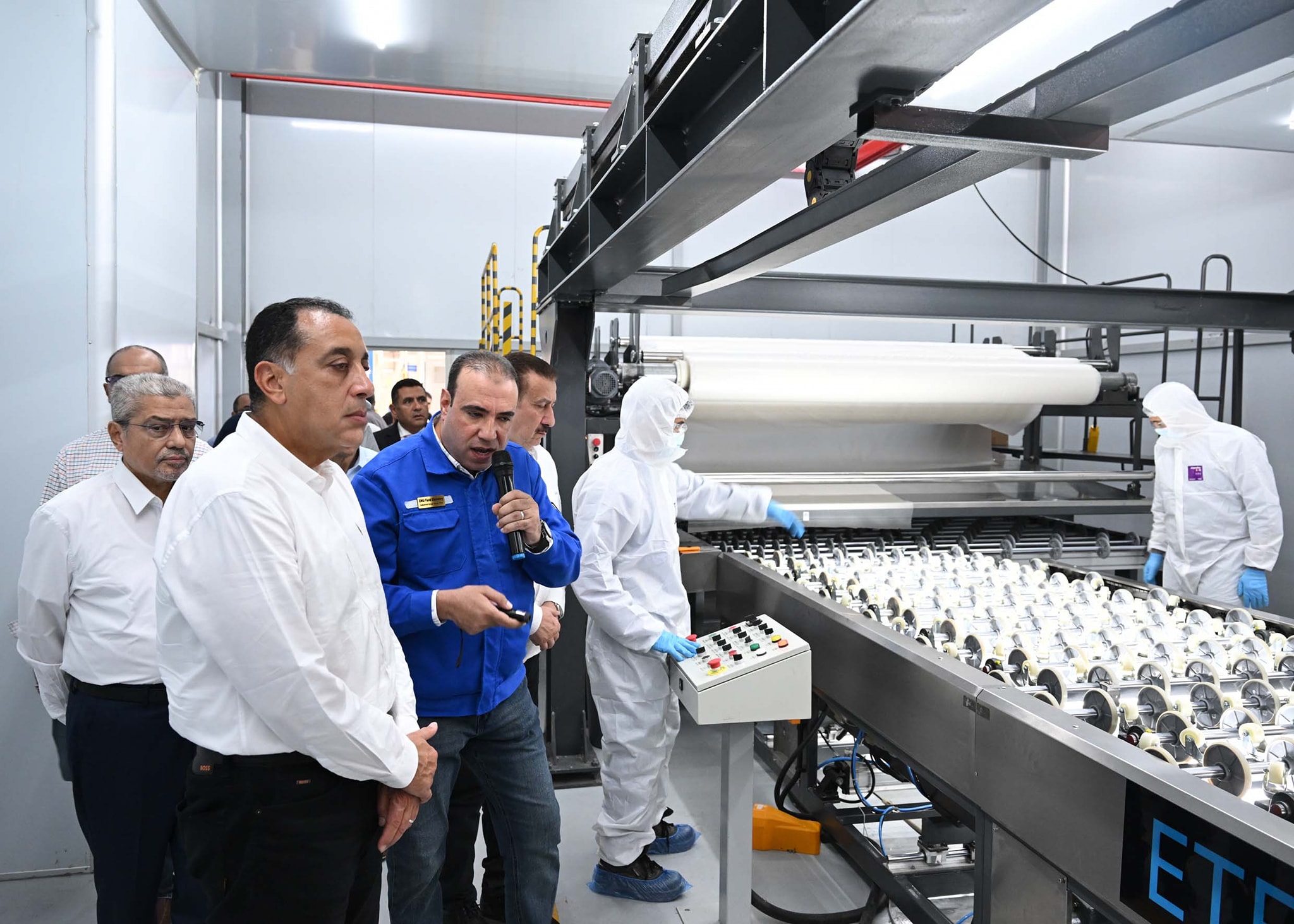
The factory, a partnership with Japan's Toyowachi company, is located in the Quweisna Industrial City in Menoufia Governorate. It is built on an area of 20,000 square metres with a total investment of $25 million.
Madbouly stressed that supporting industry and increasing
its localization in Egypt are "at the forefront of the Egyptian state's
priorities" in the current and upcoming phases. He noted the government is
keen on providing all necessary support for this direction, including equipped
infrastructure, to attract local and foreign investments across various
productive sectors.
Madbouly received a briefing during his tour from Engineer Ibrahim
ElAraby, chairman of the ElAraby Group, who outlined the operations of the new
glass facility.
ElAraby said the factory produces various types of building
façade glass, including double-glazed, thermal, and curved glass, with an
annual capacity of up to two million square metres. The facility relies 100
percent on local components, with plans to export 50 percent of its production
to markets in the Middle East and Africa. It currently provides about 300
direct job opportunities.
The chairman confirmed that the factory has already begun to
replace imports of this product, supplying the local market while also
exporting to foreign markets.
During the inspection, Madbouly toured the facility's raw
material storage area, the glass cutting section—which featured a screen
display to monitor operations—and the preparation stages. The tour also
included rooms for manufacturing train and metro glass, the heat treatment
ovens, and viewing models of manufactured oven glass, along with the drilling
and engraving processes.
Continuing his inspection of the ElAraby Group facilities, the
Prime Minister viewed an exhibition showcasing glass products for home
appliances, architecture, cars, and trains.
He also witnessed a demonstration where a car was driven
over a sheet of glass to test its load-bearing capacity. A miniature model of
the glass used in electronic doors at train and metro stations was also
displayed.
Madbouly then inspected the planned site for a new Refrigerator
Factory, a joint venture with Japan's Sharp company. The new factory is slated
to be built on an area of 107,000 square metres with investments estimated at $108
million. It is expected to have a targeted annual production capacity of up to 900,000
units.
Together, the glass factory and the planned refrigerator
factory are projected to provide more than 4,000 direct job opportunities.
"You have proven that we, as Egyptians, are capable of
producing and manufacturing everything in Egypt," Madbouly said.
For his part, Engineer Ibrahim ElAraby, the chairman of the ElAraby
Group, expressed his pleasure with the important visit by the Prime Minister,
the Minister of Education, and the Governor of Menoufia, calling it a message
of encouragement for national industry. He reiterated that the El-Araby Group's
strategy is to localize industry and increase exports.
El-Araby affirmed that the Egyptian consumer "deserves the best products in terms of quality, technology, and after-sales service." He highlighted the group's partnerships with major global brands that enjoy the trust of Egyptians, including Japan's Sharp, Italy's Hoover, Candy, and La Germania, and Germany's Heller, in addition to local brands Tornado and Kageto.