
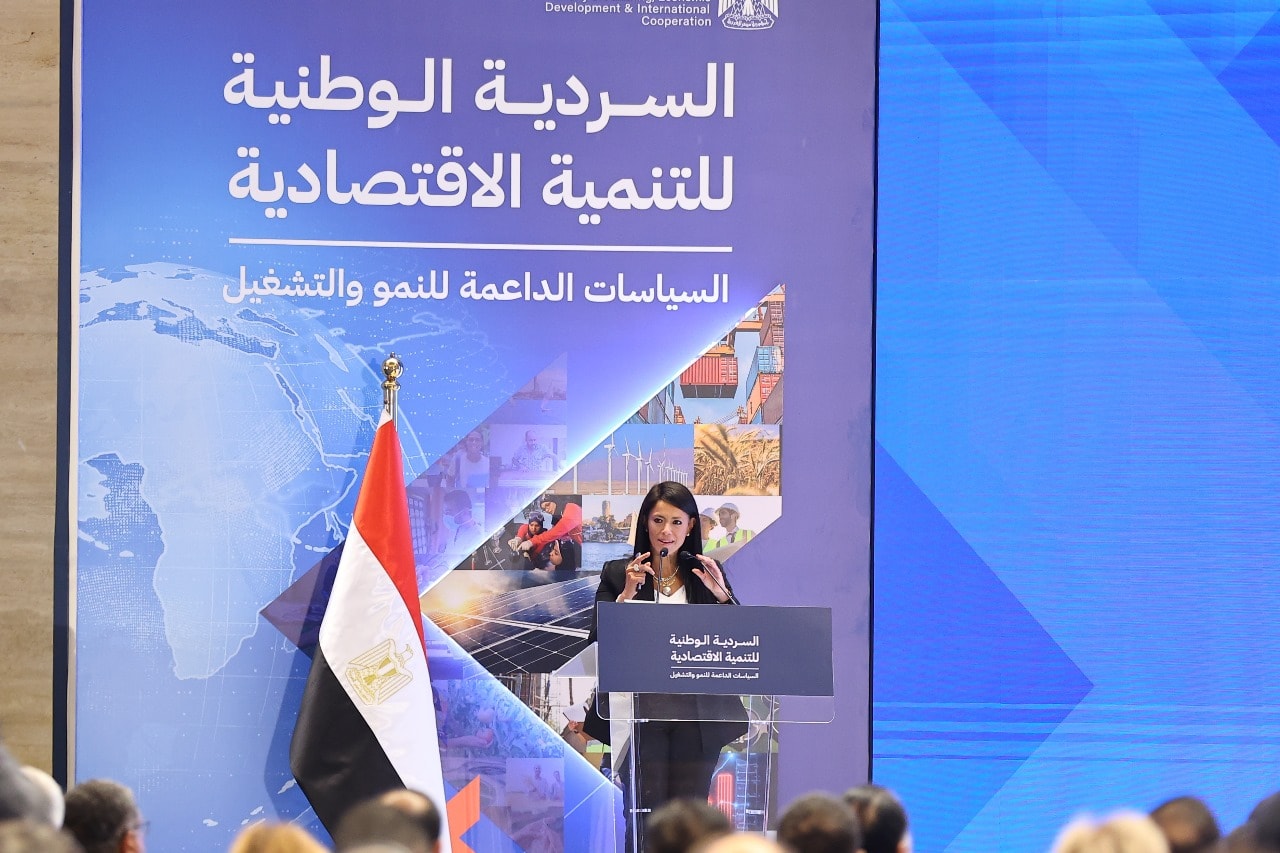
The event brought together Deputy Prime Minister for
Industrial Development Kamel Al Wazir, Deputy Prime Minister for Human
Development and Minister of Health and Population Khaled Abdel Ghaffar,
Minister of Communications and Information Technology Amr Talaat, Minister of
Foreign Affairs, Migration and Egyptian Expatriates Affairs Badr Abdel Aty,
Minister of Finance Ahmed Kouchouk, Minister of Investment and Foreign Trade
Hassan El Khatib, Minister of Education and Technical Education Mohamed Abdel
Latif, Minister of Agriculture and Land Reclamation Alaa Farouk, and Minister
of Petroleum and Mineral Resources Karim Badawi.
Al Mashat explained that the National Economic Development
Narrative provides a comprehensive framework aligning the government’s program
with Egypt Vision 2030. The initiative responds to regional and international
developments and aims to sustain economic reform while focusing on
high-productivity sectors with strong export potential. The strategy builds on
Egypt’s advanced infrastructure to support manufacturing and investment, while
redefining the state’s role in the economy to enhance competitiveness and
encourage private sector participation.
The minister added that the narrative serves as both an
economic reform program and a platform for promoting Egypt’s economic pillars.
The framework highlights structural reforms that support growth, attract
investment, expand private sector participation and showcase promising sectoral
opportunities.
The ministry began preparing the narrative in October 2024
following the new cabinet formation and the merger of the two ministries. The
work was guided by directives from President Abdel Fattah El Sisi to increase
economic growth by prioritizing productive sectors, particularly industry, and
encouraging private sector participation in line with the directives of the
Prime Minister.
The minister noted that the initiative is grounded in the
State General Planning Law No. 18 of 2022 and the Unified Public Finance Law
No. 6 of 2022. These laws require the planning ministry to set strategic
objectives for all sectors within the budget year and medium-term framework,
identify implementation priorities, design an integrated development planning
system and align it with macroeconomic policies. Each ministry and entity must
coordinate with the planning ministry to define performance indicators and
monitor program outcomes.
She emphasized that the narrative is based on the National
Structural Reform Program and its three main pillars: enhancing macroeconomic
stability, increasing economic competitiveness and improving the business
climate, and supporting the green transition. The narrative incorporates
strategies for foreign direct investment, industrial development, foreign trade
and employment, with a focus on manufacturing, tourism, agriculture, energy and
information technology. It also includes fiscal and monetary policies,
governance of public investments and regional planning to localize economic
development.
The minister stressed that international developments
require a flexible planning approach with continuous monitoring and revision of
national strategies in line with changing circumstances. Current efforts
include updating priority strategies for foreign direct investment, industrial
development, foreign trade promotion and employment. This also involves
preparing development plans and the general budget under a medium-term
framework covering the budget year and three subsequent years.
President Abdel Fattah El Sisi has overseen a development
path that invested heavily in infrastructure including roads, energy, ports,
smart transport and industrial and economic zones. These projects provide the
foundation for a more dynamic economy capable of absorbing external shocks,
generating real added value, expanding exports and stimulating productive
sectors to achieve sustainable growth.