
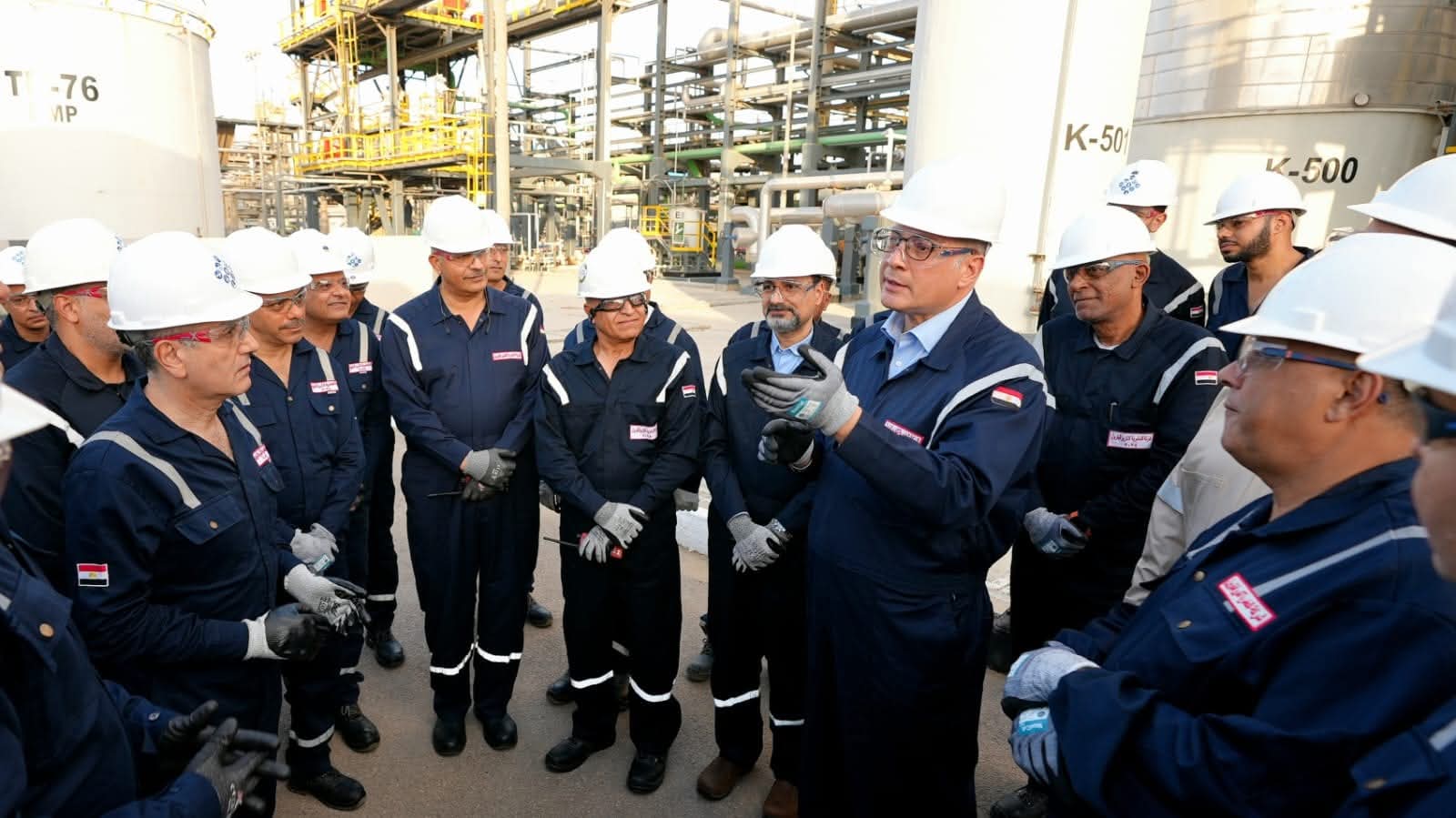
The projects aim to increase the company’s output of high-quality gasoline, butane (liquefied petroleum gas, or LPG), and oils, in addition to its specialized products, which are key inputs for various industries.
During the tour, the minister said the projects being
implemented are a successful model for executing the ministry's strategy. That
strategy focuses on maximizing the economic utilization of the refining
infrastructure to secure local market needs and reduce the import bill for
petroleum products.
Badawi praised the efforts of the company's employees and
stressed the importance of highlighting such successful models to serve as an
example for all workers in the sector.
He directed the company to provide broader opportunities for
women’s participation in various refining facilities and activities, in
appreciation of their effective role and ability to contribute to improving
performance efficiency and supporting the development and modernization
process.
For his part, Mohamed Sobhy, the company's chairman,
reviewed the ongoing projects, which have an investment cost exceeding two
billion Egyptian pounds (EGP) and are designed to increase production and
storage capacity.
The most notable of these projects include:
Re-operation of a hydrogen production unit with a capacity
of 5,000 cubic meters per hour, which had been halted for 13 years. Its return
will support oil production.
Development of the Reforming and Aromatics complex by adding
a new unit. This is expected to boost gasoline production by approximately
100,000 tons annually and also produce benzene, which is used in several
industries.
A project to improve butane (LPG) production that is
expected to achieve significant financial savings.
The construction of a new 12-kilometer cooling water line to
enhance operational sustainability.
The Minister also followed up on the company's energy
rationalization efforts, which have yielded significant results.
These efforts—including the development of the steam network, improved thermal insulation, and maintenance of heat exchangers—have resulted in annual savings of approximately 34 million EGP and an annual reduction in carbon dioxide emissions of about 7,700 tons.