
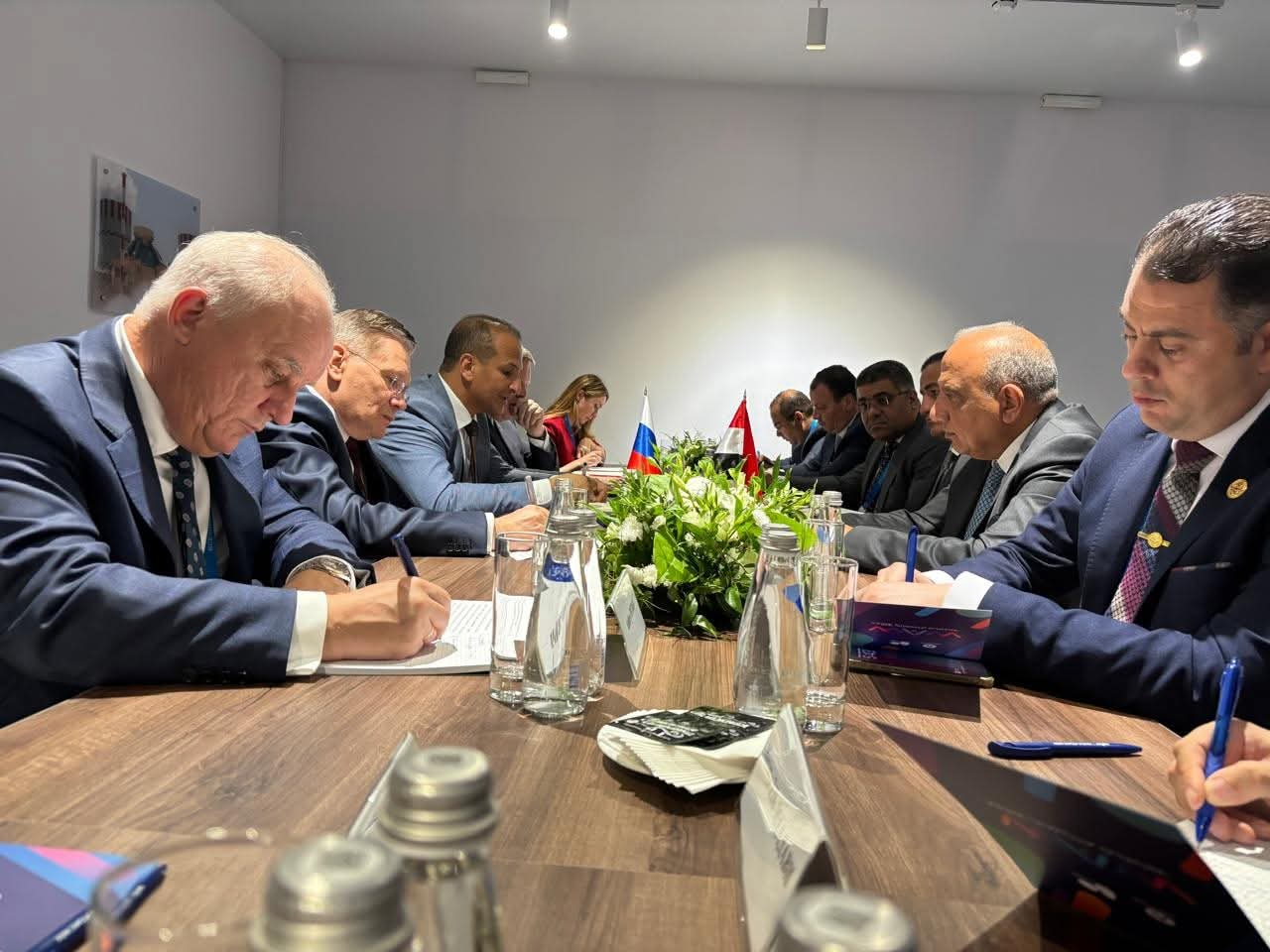
Dr. Essmat held talks with Alexey Likhachev, Director General of Rosatom, and Dr. Andrey Petrov, First Deputy Director General of Rosatom and President of Atomstroyexport (ASE), the company responsible for executing the El Dabaa Nuclear Power Plant project.
The meeting focused on the progress of the El Dabaa Nuclear
Power Plant project, reviewing the implementation of works, and reaffirming
adherence to the scheduled timeline for commissioning the nuclear units and
connecting them to the national grid. They also examined updates on partnership
and cooperation to localize the manufacturing of electrical equipment and
components.
Discussions covered the development of work across all
nuclear units, reviewing execution rates to ensure completion aligns with the
overall plan and specific timelines for each phase. Preparations for receiving
the Reactor Pressure Vessel for the first nuclear unit at the El Dabaa site
were also reviewed.
The talks extended to cooperation in scientific and
technological research, training, capacity building, technology transfer, and
industrial localization. Both sides stressed that continuous coordination,
cooperation, and integration between the Egyptian and Russian teams are crucial
for achieving the project's set goals.
A key point of discussion was the increase in local
manufacturing content. They highlighted the role of the manufacturing sections
at the plant site as a vital facility within the nuclear project, where parts
of the inner containment vessel for the reactor building are being fabricated.
This component is crucial to the national strategic project. Local
manufacturing also includes key elements such as the cooling system connections,
which are being produced entirely in Egypt. Partnerships with several local
institutions to localize the electrical equipment industry were also addressed.
Dr. Essmat stated that localizing the manufacturing of
electrical systems, equipment, and components is a primary focus of Egypt’s
peaceful nuclear energy program. He reiterated the Electricity Ministry's
strategy based on an energy mix, diversifying power generation sources, and
relying on clean energy to reduce fuel consumption and carbon emissions.
The Minister affirmed Egypt's pioneering role in the
peaceful uses of nuclear energy, noting its potential contribution to various
scientific, industrial, and agricultural fields for achieving sustainable
development. He emphasized the importance of the nuclear project in ensuring
the stability and continuity of the unified grid and improving service quality.
Dr. Essmat lauded the historical and close relations between Egypt and Russia, underscoring the significance of internal and external training and rehabilitation programs for preparing human resources within the framework of Egypt's peaceful nuclear program.