
Dr. Talaat provided key statistics demonstrating this growth as outsourcing exports grew by 80% over three years, reaching $4.3 billion in 2024. The number of outsourcing professionals increased by 70% to over 160,000, and the number of companies in this field in Egypt tripled, from 64 to more than 180.
These remarks were made during the annual celebration of the
"Eitesal" Association, held at the Prince Muhammad Ali Palace.
During his speech, Dr. Talaat shared his pleasure in
participating in the Eitesal Association's 21st anniversary celebration, noting
that the event's venue, the Prince Muhammad Ali Palace, shares key
characteristics with the ministry's strategy: clear vision, creative ideas,
mastery, and teamwork.
He detailed the second version of the National AI Strategy,
which sets ambitious goals for 2025-2030, including increasing AI's
contribution to Egypt's GDP to 7.7%. The strategy is based on six main pillars:
Infrastructure: Building computational resources to meet the
ministry's needs and involving 250 AI startups.
Data Governance: Establishing a framework for data exchange
to enrich algorithms and advance Egypt's information society.
Regulatory Framework: Creating a strong regulatory
environment that includes the Personal Data Protection Law, the "Cloud
Computing First" policy, the Egyptian Charter for Responsible AI, and an
Open Data policy.
Development Applications: Launching impactful applications
in sectors like healthcare (e.g., an early breast cancer detection system) and
justice (e.g., a speech-to-text application).
Capacity Building: Expanding the pool of AI specialists. The
goal is to train 30,000 AI professionals by 2030, building on the training of
500,000 specialists in various IT fields last year.
Public Awareness: Increasing societal awareness of AI,
aiming for 25% of government employees to use AI tools to improve their work
and 36% of citizens to be able to use AI applications in their daily lives.
Dr. Talaat also highlighted the ministry's efforts to
develop mobile phone manufacturing in Egypt. There are currently 14 mobile
phone factories in the country, with plans to begin exporting by the end of
this year or early next year. Production reached 3.5 million units last year,
with commitments to produce 9 million units in 2025. The goal is to increase
production capacity and export volume by leveraging free trade agreements.
He also mentioned the graduation of the first class from Egypt
Informatics University, the first specialized IT university in Africa. The
university offers graduates dual degrees through its partnerships with leading
international universities.
Hossam Megahed, Head of the Etisal Association, expressed
his appreciation for Dr. Talaat’s continuous support. He emphasized that the
association's achievements—including launching initiatives for member
companies, expanding local and international partnerships, and supporting
digital transformation—are the result of close cooperation between civil
society, companies, and the government. He added that the association looks
forward to opening new avenues for investment and innovation to support Egypt's
digital vision.
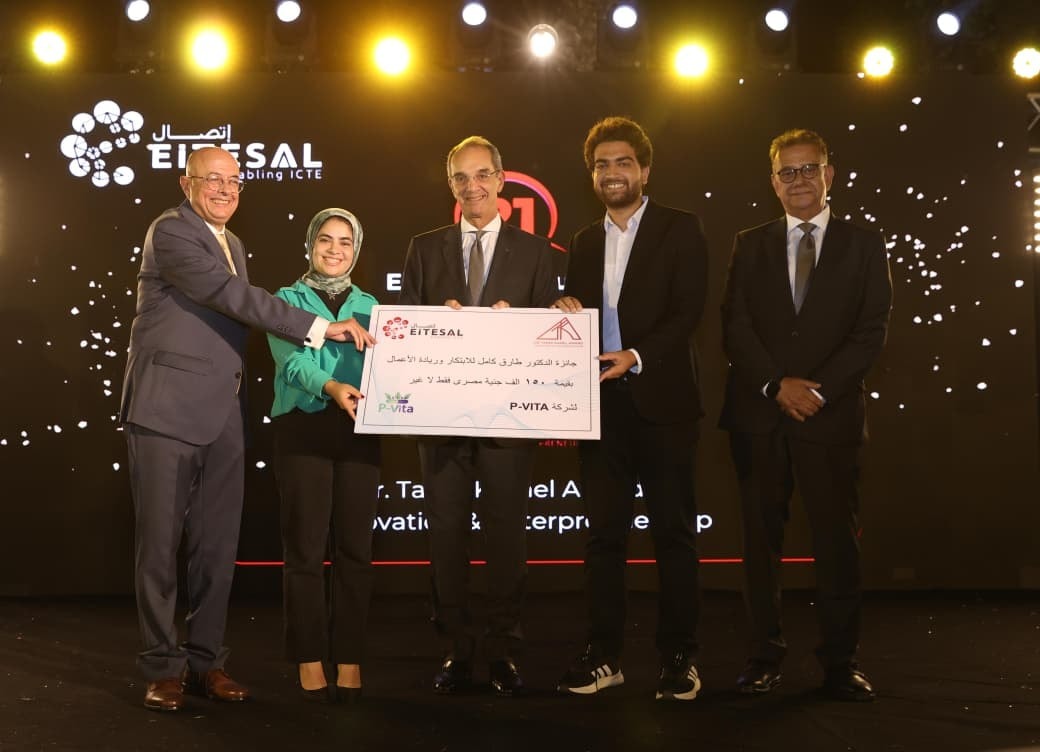
During the event, Dr. Talaat and other leaders presented the Dr. Tarek Kamel Award for Entrepreneurship and Innovation to P Vita, an Egyptian biotech and AI startup. The company was recognized for its innovative work in converting waste into fertilizers.