
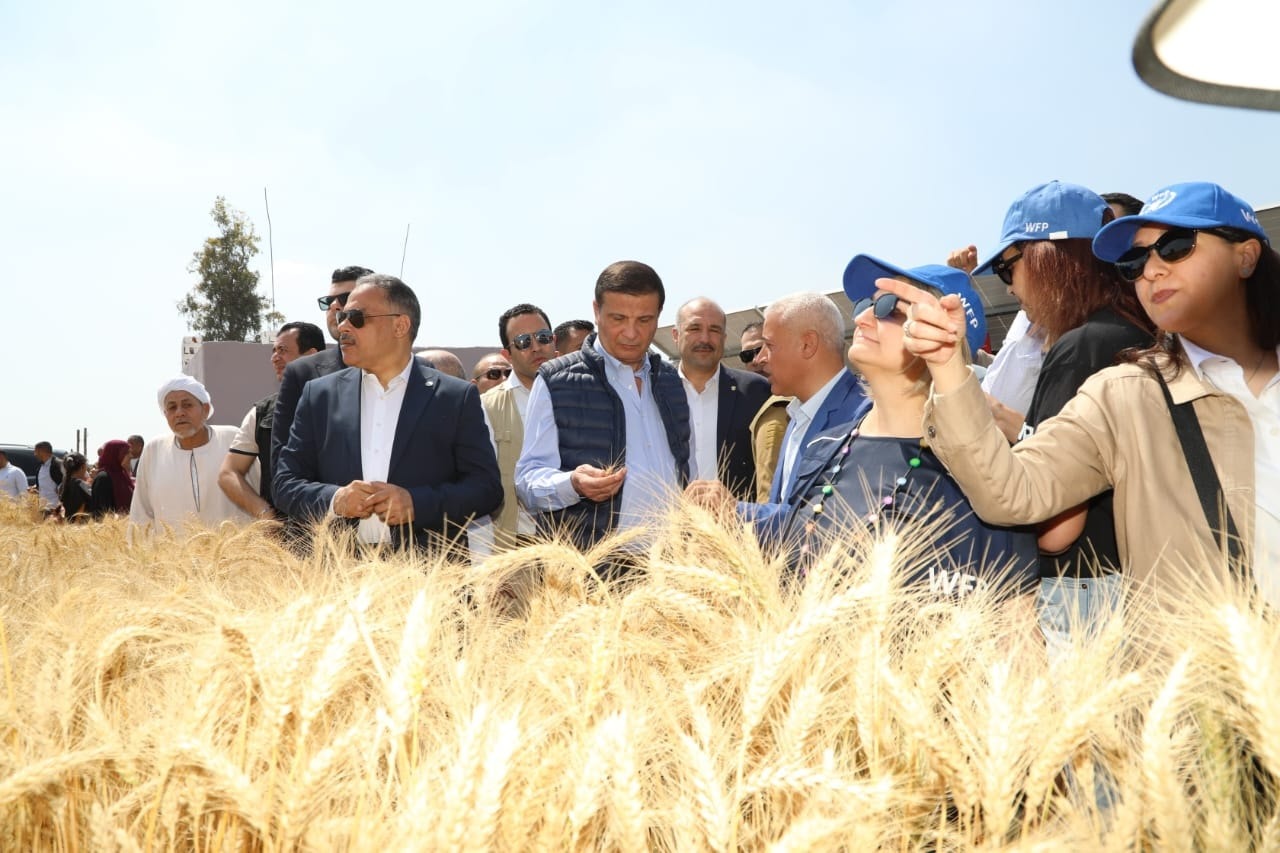
This event is part of a project implemented by the Agriculture Ministry and the WFP, funded by the German government, to enhance food security and resilience for vulnerable rural families in 75 villages across four governorates, supporting over 21,400 families.
During a meeting with farmers, Minister Farouk highlighted
the importance of collaboration between the Egyptian Agriculture Ministry and
the UN's WFP in supporting small farmers, improving livelihoods, especially in
Upper Egypt and rural areas, and enhancing food security through joint
projects.
Farouk emphasized the Agriculture Ministry's comprehensive
support for wheat farmers, considering wheat a crucial strategic crop for
various food industries, particularly bread. He noted continuous communication
with farmers throughout the growing season via agricultural research center
scientists, engineers, extension workers, and pest control officials to provide
technical support and guidance for optimal productivity and crop protection.
The minister also mentioned the development of new
disease-resistant, climate-adaptive, and high-yield wheat varieties.
Furthermore, the provision of quality seeds in agricultural cooperatives and
ministry outlets, and the early dissemination of variety maps indicating
suitable strains for each region to maximize yield, were highlighted.
Additionally, pest control campaigns, demonstration fields, and workshops were
conducted to promote modern agricultural practices.
Farouk projected a wheat production of approximately 10
million tons this year. He added that measures were taken to facilitate the
supply process for farmers at silos and barns, with the state-set price of 2200
EGP per ardeb to encourage cultivation and delivery.
Governor El-Ashmouni welcomed the minister's visit and
commended his continuous monitoring of agricultural activities nationwide, the
provision of support for agricultural sector development, and the ministry's
efforts in resolving farmers' issues, aligning with President Abdel Fattah El-Sisi's
directives and Sharqia's development plans.
Rosala Fanelli of the WFP stated that the visit underscored the impact of partnership in enhancing food security and resilience of rural communities in Egypt. She highlighted the collaboration with the Agriculture Ministry to expand innovative agricultural practices, including land consolidation models, solar-powered irrigation, and improved canal systems, potentially saving up to 30% of water consumption. She also expressed pride in working with partners like the German government, whose support has made these initiatives a reality.