
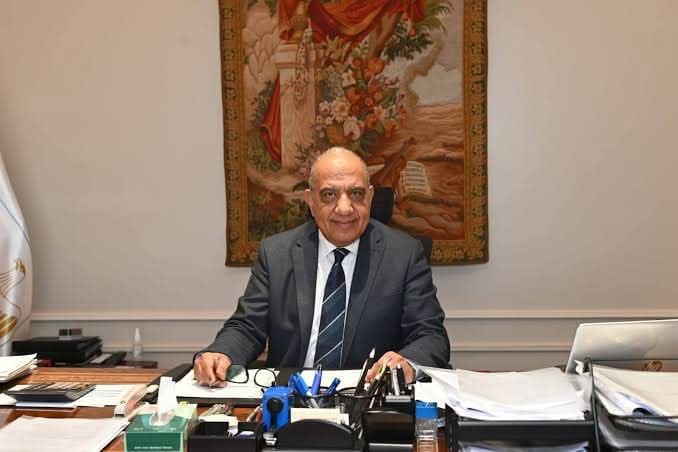
The ministry's strategy focuses on making electric power available as an essential pillar for comprehensive development, including major national agricultural, industrial, and urban projects. Dr. Essmat reviewed the progress of reinforcement projects designed to increase the network's capacity to accommodate new generating capabilities, ensuring a secure, stable, and continuous power supply for all uses in North and South Sinai.
Essmat also reviewed projects that have been completed and
are already operational, including 27 ultra-high- and high-voltage transformer
stations. He checked on the progress of four other ultra-high and high-voltage
stations currently under construction.
Overall, the ministry has completed 3,517 circuit kilometers
of high- and ultra-high-voltage lines with investments totaling 15 billion
Egyptian pounds. These projects provide a total capacity of 8,232
megavolt-amperes (MVA) to transmit power to various activities and strategic
national projects across Sinai. The work ensures stability and continuity by
applying the latest quality standards and modern technological systems to
operate the national electricity grid.
Specific projects reviewed include the construction of three
ultra-high-voltage transformer stations with a total capacity of 1,425 MVA and one
high-voltage transformer station with a total capacity of 120 MVA. These
include the Rawafaa Sinai 1 transformer station (220/66/22 kilovolt [kV] with a
capacity of 3×175 MVA plus 6×40 MVA) and the Rawafaa Sinai 3 transformer
station (66/11 kV with a capacity of 3×40 MVA). These stations are vital for
supplying the power needed for agricultural development projects under the
"Future of Egypt for Sustainable Development" agency.
Dr. Essmat affirmed the continued focus on energy security
and sustainability as the foundation of the national sustainable development
plan, which includes massive urban, industrial, and agricultural projects
across all governorates, especially Sinai. He noted the increasing reliance on renewable
energy sources as part of the energy mix to meet rising demand.
He highlighted the plan to provide necessary electricity for
all new projects, particularly those related to land reclamation, agricultural
industrialization, and greenhouses overseen by the "Future of Egypt for
Sustainable Development" agency. Essmat emphasized the goal of improving
the quality of supply and the efficiency of traditional fuel use, adding that
providing energy for all purposes is a top priority for attracting investments.
He concluded that the electricity sector possesses large generation capacities
capable of meeting all demands, backed by giant infrastructure across its
various sectors.
Dr. Essmat stressed the importance of developing the grid and transitioning from a conventional network to a smart grid capable of integrating large generating capacities, especially from renewables, and transmitting power with the highest efficiency and lowest losses. He pointed to ongoing efforts to improve grid efficiency and transmit sustainable electric power from all production sources in line with international standards. He confirmed that the electricity transmission network reinforcement projects—including building new lines, supporting existing ones, and constructing or expanding transformer stations—will continue, with a special focus on Sinai. He also affirmed the ministry's commitment to raising the competency of human resources and providing training on the latest technologies in electricity and energy transmission.