
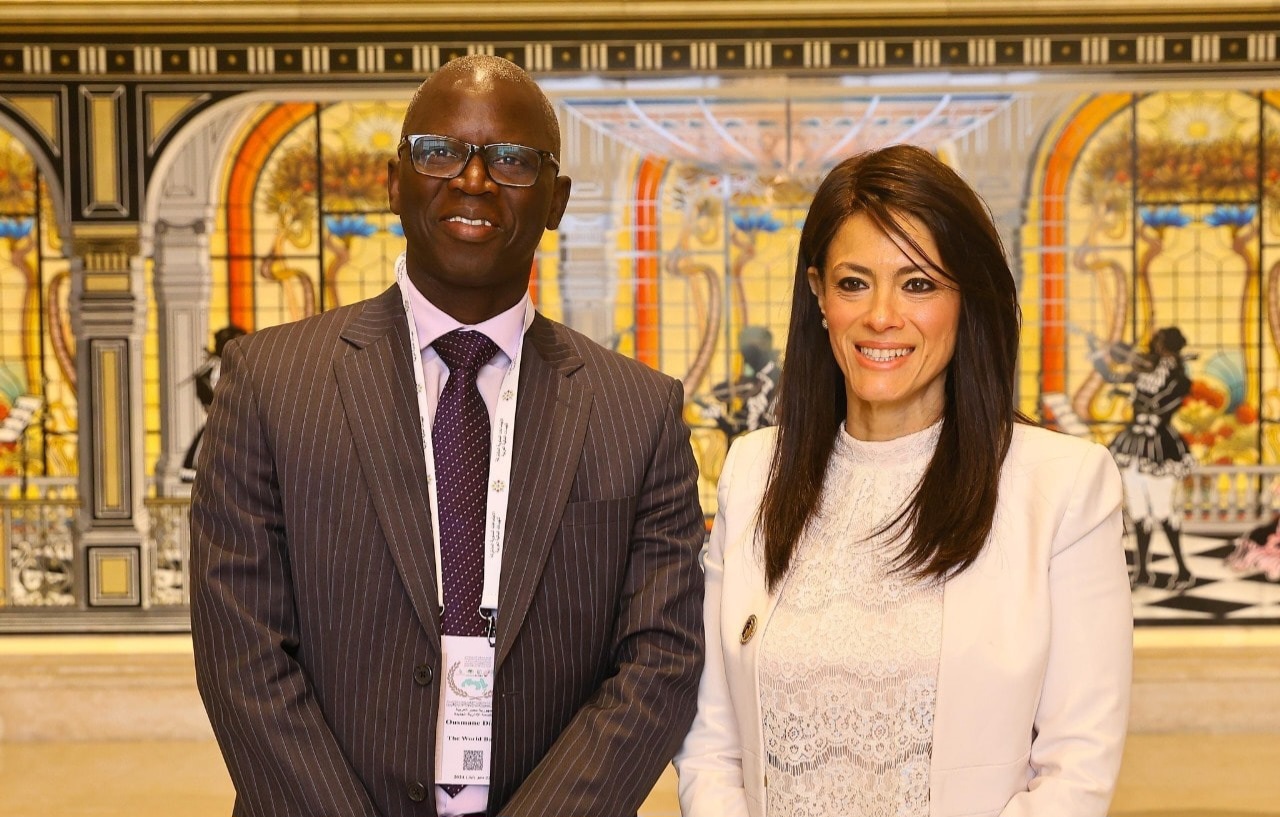
The meeting was also attended by Cheick-Oumar Sylla, Regional Director for North Africa and the Horn of Africa at the International Finance Corporation (IFC), Stéphane Guimbert, World Bank Country Director for Egypt, Yemen, and Djibouti, and Sandeep Mahajan, World Bank Regional Director for the Middle East and North Africa.
The officials discussed ways to enhance cooperation and
several joint files between Egypt and the World Bank.
Mashat stressed the depth of relations between Egypt and the
World Bank Group and its institutions, highlighting the government's efforts to
support and strengthen partnerships with international development partners.
She noted that Egypt holds one of the World Bank Group's largest portfolios in
the Middle East and North Africa region.
The discussion covered joint efforts to boost economic development
by leveraging the World Bank's international capabilities and expertise. Future
projects with the bank and preparations for the World Bank's annual meetings
this October were also addressed.
The minister spoke about the "National Narrative for
Economic Development," describing it as a comprehensive framework that
integrates the government's work program and Vision 2030 in light of
accelerating regional and global changes. Its goal is to transition to an
economic model centered on higher-productivity sectors with greater access to
export markets, thereby enhancing the Egyptian economy's competitiveness and
stimulating private sector participation, in continuation of the economic
reform path.
She clarified that the "National Narrative" serves
as an economic reform program with clear executive mechanisms through the
National Structural Reforms Program, translating structural reform priorities
into a consistent set of quantitative targets by 2030.
Mashat also pointed to the economic growth indicators for the
current fiscal year 2024/2025, which showed a structural shift in growth, now
led by non-petroleum manufacturing and real economy sectors. This confirms the
government's core objective through the "National Narrative" to shift
toward an economic model focused on productive sectors.
She added that the economy achieved a 4.4% growth rate,
surpassing expected levels, which coincided with an increase in private sector
investments and a decline in public investments, signaling the state's move to
create space for the private sector.
The meeting also discussed the latest developments regarding the World Bank's portfolio in Egypt, including the Universal Health Insurance Project, the Sustainable Sanitation Services in Rural Areas Project, and the Takaful and Karama (Social Safety Net) project. Updates on the Upper Egypt Local Development Program and the Cairo-Alexandria Trade Logistics Project, being implemented in cooperation with the National Railways Authority, were also reviewed.