
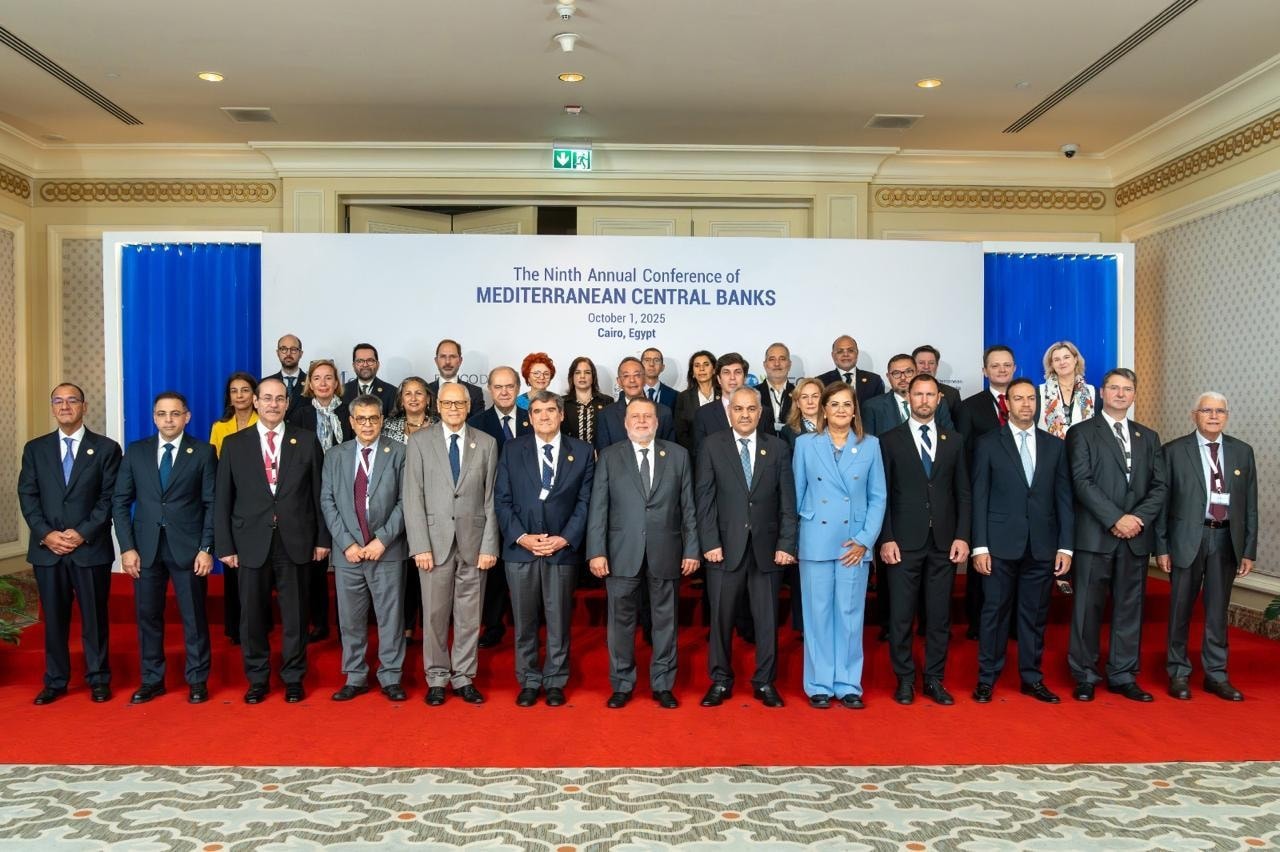
The high-level conference, held in light of Egypt's commitment to strengthening ties with key development partners, saw the participation of numerous governors of Euro-Mediterranean central banks, policymakers, economic experts, academics, and representatives from international financial institutions.
The event was co-organised with the Bank of Spain (BdE), the
Organisation for Economic Co-operation and Development (OECD), the European
Institute of the Mediterranean (IEMed), and the Union for the Mediterranean
(UfM). It serves as a vital platform for dialogue and cooperation among
Euro-Mediterranean central banks on economic and financial issues of global and
regional concern.
In his opening address, CBE Governor Hassan Abdalla welcomed
the participants, emphasizing that hosting the conference reflects Egypt's firm
commitment to strengthening cooperation and exchanging expertise to support
regional stability and prosperity.
Abdalla underscored the conference's value as an opportunity
to deepen cooperation among Mediterranean nations, particularly given current
challenges that necessitate joint action. He praised the agenda for tackling
issues aimed at building a more resilient and prosperous economic future.
The Governor stressed that the Mediterranean, historically a
bridge connecting peoples, cultures, and continents, must now transform into a
bridge for innovation and resilience. He affirmed that joint efforts can turn
current challenges into opportunities for building a more stable, inclusive,
and sustainable financial system.
For his part, José Luis Escrivá, Governor of the Bank of
Spain, called for enhanced cooperation among participating central banks,
stressing the importance of continuing to build flexible financial systems that
meet the needs of all segments of society.
He added that "in times of uncertainty and division,
the importance and value of the multilateral system become clearer. It is not
enough to maintain it; we must work to develop and strengthen it to keep pace
with rapid global changes."
Luiz de Mello, Director of the Country Studies Branch in the
OECD Economics Department, affirmed the crucial role of central banks in
tackling current challenges. He noted their function has expanded beyond
ensuring monetary and financial stability to becoming a pillar for supporting innovation,
financing the green transition, and promoting inclusive growth.
He stressed that dialogue is now more essential than ever to
foster cooperation, build trust, and support sustainable growth amidst global
economic uncertainty and rapid technological change.
Senén Florensa, Executive President of the IEMed,
highlighted that the region faces intertwined pressures from conflicts, global
trade wars, debt crises, and climate change risks, alongside the challenge of
achieving more inclusive and sustainable growth. He noted these issues test
financial resilience and underline the importance of strong central banks as
essential anchors of stability.
Meltem Büyükkarakaş, Assistant Secretary General of the UfM,
pointed to the region's challenges, including "geopolitical tensions,
development gaps, social inequalities, and the digital divide." She
asserted that unlocking the region's potential requires enhanced integration
"based on green and digital transitions," and affirmed the UfM's
determination to translate this vision into "concrete, impactful actions
for the benefit of the region's peoples."
The conference included four main sessions:
The first, titled "Artificial Intelligence and Central
Banks and the Financial Sector," discussed the growing role of AI
technologies in reshaping the banking and financial sectors and how to use them
efficiently while managing associated risks.
The second, "Financing for Sustainable
Development," focused on the role of central banks in supporting the shift
towards a green economy and directing finance to serve sustainable development
goals in the face of climate and environmental challenges.
The third, "Financial Inclusion for All," reviewed
various initiatives to expand financial services and promote economic
empowerment and social justice through innovative and comprehensive solutions.
The fourth, "Financial Integration," debated the
OECD report on ways to enhance regional cooperation, develop digital
infrastructure, and achieve greater coordination between fiscal and monetary
policies in the region.
In his closing remarks, the CBE Governor thanked all
participants, praising the rich discussions and constructive ideas. He affirmed
that the conference outcomes represent an important step towards supporting financial
stability and fostering sustainable and inclusive development for the
Euro-Mediterranean peoples.
It was announced that the Bank of Spain will host the next edition of the conference. A technical preparatory meeting at the expert level will also be held approximately four months beforehand to ensure adequate preparation, coordination, and the exchange of expertise among the relevant institutions.