
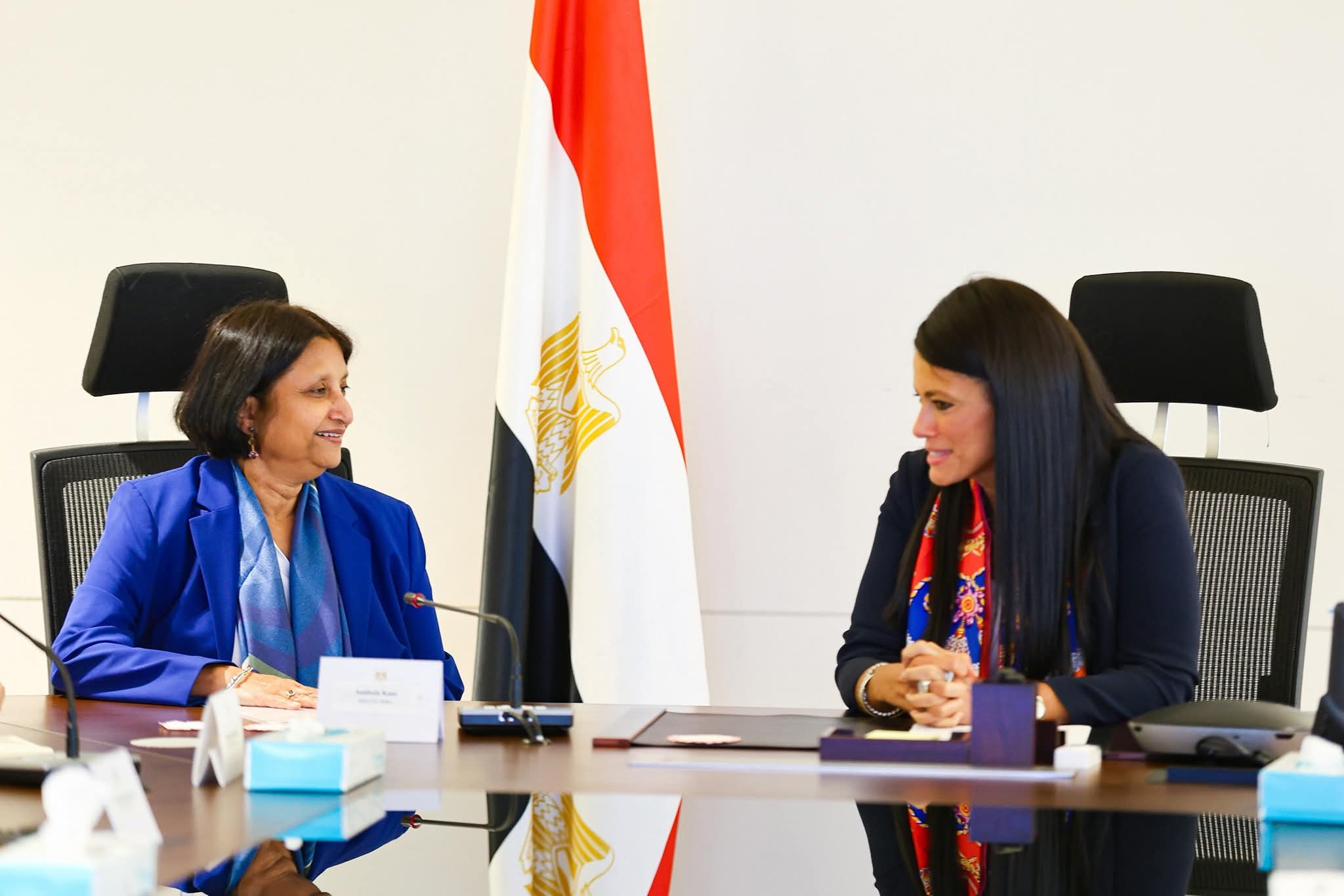
Attending the meeting were Stephane Guimbert, World Bank Country Director for Egypt, Yemen, and Djibouti, and Cheick-Oumar Sylla, Regional Director for North Africa and the Horn of Africa at the International Finance Corporation (IFC), along with members of the World Bank team.
During the discussion, Al-Mashat stressed the Egyptian
government’s commitment to enhancing its strategic partnership with the World
Bank Group to support economic and social development priorities. This includes
advancing financial and structural reforms, boosting private sector
participation, and expanding green transition investments, all within the
framework of the state's vision and priorities.
Dr. Al-Mashat highlighted the government’s launch of the "National
Economic Development Narrative," a comprehensive framework that integrates
the Egypt Vision 2030 and the government's action program, in light of regional
and international developments. She explained that the government is
implementing an economic model based on this narrative, focusing on
higher-productivity sectors and the real economy to increase the Egyptian
economy's self-reliance and its capacity for sustainable growth.
She noted that the launch of the National Economic
Development Narrative represents an advanced stage in a development path that
began more than a decade ago, during which the state injected massive
investments into infrastructure, including road networks, energy, ports, and
smart transportation. These investments were aimed at creating a favorable
environment for economic activity, increasing productivity and attracting
investments, establishing the necessary foundation for a more dynamic economy
capable of absorbing external shocks and generating real added value.
Al-Mashat also pointed out that the government, through the
National Economic Development Narrative, aims to diversify the production
structure, increase exports, rationalize imports, improve private sector participation
in line with the State Ownership Policy Document, enforce the Competition Law
and protect low-income groups.
The Minister elaborated on the targets of the current fiscal
year's economic and social development plan and the government's efforts to
enhance fiscal discipline to reduce the overall budget deficit. She affirmed
that the government is continuing to govern public investments and has set an expenditure
ceiling of about 1.16 trillion Egyptian pounds (EGP) in the current fiscal
year's plan to control spending, maintain a downward trajectory for public
debt, and enhance macroeconomic stability. The government is also working to
increase private sector participation, utilizing returns from the state asset
sale program.
Al-Mashat revealed that Egypt has one of the World Bank's
largest portfolios in the Middle East and North Africa region. This portfolio
includes commitments from the International Bank for Reconstruction and
Development (IBRD) exceeding $6 billion across 13 projects, an IFC portfolio
valued over $2 billion, and guarantees from the Multilateral Investment
Guarantee Agency (MIGA) of approximately $700 million to support vital
investments in energy and logistics.
For her part, Kant affirmed the World Bank Group's support
for these efforts through the Financial Incentives Framework (FFI), launched in
2025, and debt-for-development swaps initiatives, which contribute to directing
additional resources toward education, health, and environmental preservation.
They also discussed the outcomes of recent meetings with the
Ministry of Finance, which emphasized the continuation of financial and
structural reforms aimed at sustainable growth and reducing public debt. This
includes a focus on launching a Green Tax Strategy by December 2025 and enhancing
the role of public-private partnerships.
Al-Mashat concluded the meeting by reiterating that cooperation with the World Bank Group is a cornerstone for supporting Egypt's development priorities, underscoring the importance of bolstering international partnerships to increase investments directed towards productive sectors and the green transition, thereby contributing to inclusive and sustainable growth and supporting Egypt Vision 2030 and Africa Agenda 2063.