
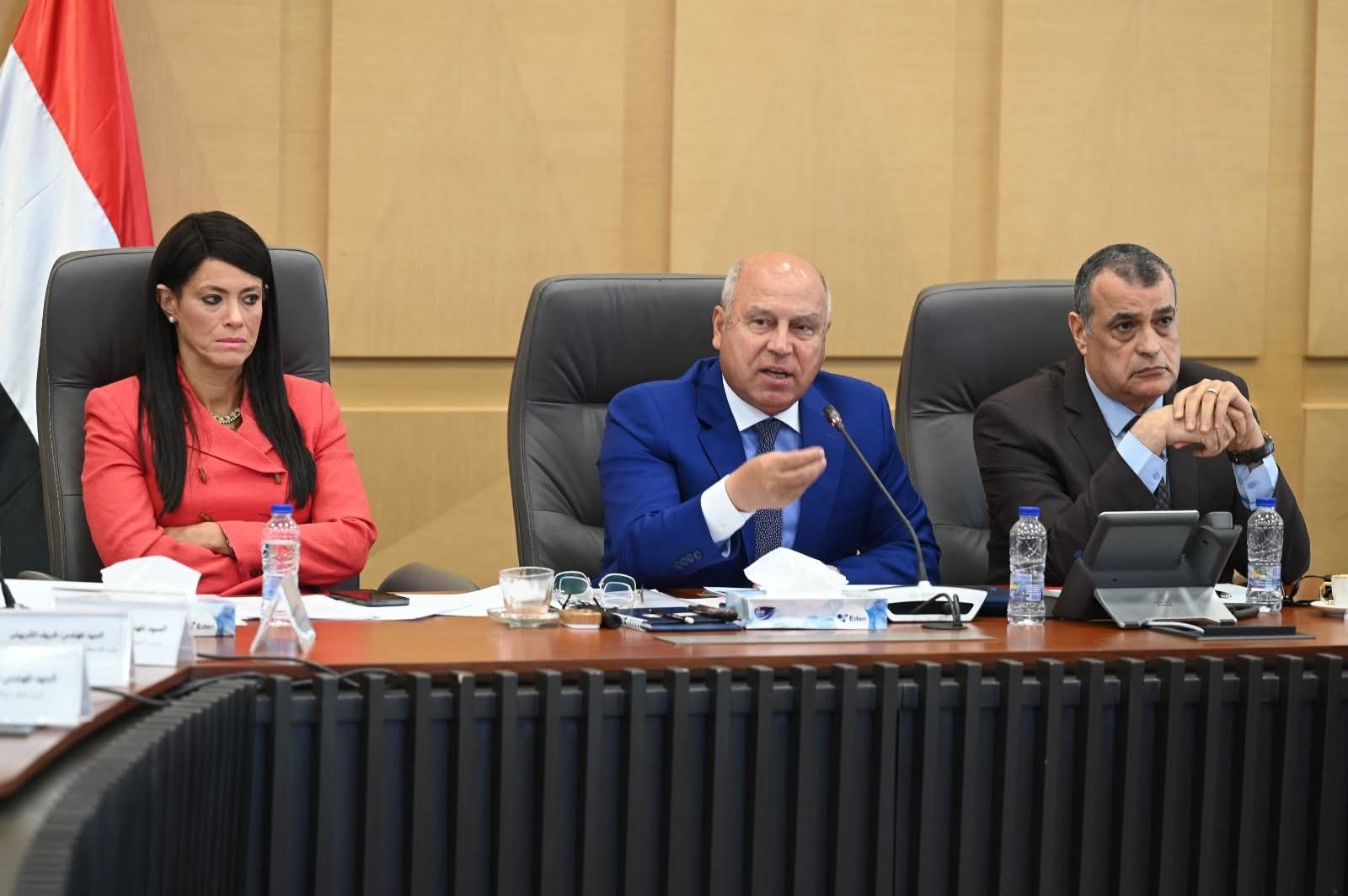
The meeting was attended by a host of ministers and officials, including Minister of Planning, Economic Development and International Cooperation Dr. Rania Al-Mashat, Minister of State for Military Production Engineer Mohamed Salah El-Din, Minister of Electricity and Renewable Energy Dr. Mahmoud Esmat, and Minister of Public Business Sector Engineer Mohamed Shimi.
Minister of Investment and Foreign Trade Engineer Hassan
El-Khatib joined via videoconference. Other attendees included Minister of
Housing, Utilities and Urban Communities Engineer Sherif El-Sherbiny, Minister
of Petroleum and Mineral Resources Engineer Karim Badawy, and Minister of
Agriculture and Land Reclamation Alaa Farouk.
Also present were Chairman of the Arab Organization for
Industrialization Mokhtar Abdel Latif, Chairman of the Suez Canal Economic Zone
General Authority Walid Gamal El-Din, and head of the Federation of Egyptian
Industries Engineer Mohamed ElSewedy.
During the meeting, El-Wazir addressed the recent increase
in gas supply prices for factories, effective September 15, 2025. He directed
all fertilizer producers to sign a protocol that clearly outlines three main
quotas: supplies to the Ministry of Agriculture and Land Reclamation, quantities
for the local market through auctions, and quantities for export.
Al-Wazir stressed that adherence to these quotas would
balance the interests of companies with local market stability. He added that
the state is committed to providing the necessary gas for fertilizer factories
and has tasked regulatory bodies, including the Competition Protection and
Anti-Monopoly Agency and the Consumer Protection Agency, with monitoring
markets to prevent unjustified price increases.
The group also discussed the import of tourist buses. Al-Wazir
noted that while imported electric buses are fully exempt from customs duties,
imported components for local assembly are subject to tariffs, creating an
imbalance for domestic industry.
He highlighted Egypt's recent strides in bus production,
mentioning that companies like El-Nasr Automotive and MCV are now capable of
meeting domestic demand and exporting luxury buses to European markets. Al-Wazir
instructed officials to prepare a study on mechanisms to protect locally
manufactured buses for submission to the Cabinet.
The meeting also addressed challenges facing industries like
porcelain tableware and watches, which are struggling with smuggling at some
ports. Al-Wazir called on the Ministry of Investment and Foreign Trade and the
Customs Authority to implement stricter controls and inspection procedures to
curb smuggling.
He underscored the crucial role of the Egyptian Organization
for Standardization and Quality, the Industrial Control Authority, and the
General Organization for Export and Import Control in ensuring that imported
goods meet Egyptian standards, which protects consumers and boosts the
competitiveness of local products.
Al-Wazir concluded by stating that the Ministerial Group for Industrial Development will continue to monitor these issues to support national industry and enhance its local and international competitiveness.