
The opening ceremony was attended by Anna Westerberg, President of Volvo Buses, Swedish Ambassador to Egypt Dag Juhlin-Dannfelt, and MCV Chairman Karim Ghabbour, along with senior executives from both companies and officials from various ministries.
During his address, Al-Wazir said the new production line is
a significant addition to Egypt's industrial development. He described it as a
strong message of confidence from major global companies in the Egyptian
economy and a testament to the country's successful policies under President
Abdel Fattah El-Sisi to enhance the investment environment and localize
advanced industries.
Al-Wazir noted that the new line, built with an investment
of 3 billion Egyptian pounds, has an annual production capacity of about 1,200
electric buses, all designated for export to European markets. He added that
the project will create more than 2,000 new jobs, providing real added value to
the economic and social development of Sharqiya and Egypt.
The Minister described the project as an integrated model
that combines modern technology with environmental commitment. He explained
that the production lines operate on automated systems according to the latest
global standards, and the project is committed to a significant reduction in
carbon emissions, aligning with Egypt's vision for a green economy and its
international climate change commitments. He pointed out that this
collaboration's initial phase targets exporting all production to European
markets, which have some of the strictest quality and environmental standards.
This, he said, serves as a major vote of confidence in the quality of national
industry and proves that Egypt can be a manufacturing and export hub for the
world's most advanced markets.
Engineer Al-Wazir emphasized that the Egyptian government
recognizes electric vehicle manufacturing as the future of the global transport
sector. He said the government supports this trend by offering incentives and
facilities to investors, encouraging feeding industries, investing in
sustainable transport infrastructure and charging stations, and enhancing
training programs to build technical and engineering capabilities for youth.
The project is the result of state efforts to localize
advanced industries, transferring global expertise to Egyptian talent and
expanding the industrial knowledge base to localize electric vehicle
technology. He added that such projects are a crucial step toward the
government's strategic goal of doubling Egyptian industrial exports to more
than $170 billion by 2030, and will add high-tech, competitive products to
Egypt's exports.
Al-Wazir said the Ministry of Industry will continue to
gradually increase the local component ratio in the projects to deepen national
industry and raise added value. He said the new production line reflects a
"true partnership" between Egypt and Volvo and marks the start of other
projects the state aims to implement in sustainable transport and green
industry.
In his closing remarks, Al-Wazir thanked Volvo for its
confidence in the Egyptian market and everyone who worked to achieve this
milestone. He said he looked forward to more investments and partnerships that
support Egypt's industrial development. He stressed that the project is new
proof that Egypt manufactures, exports, and can compete in the heart of Europe
and the world. He affirmed that Egypt "is not waiting for the future but
building it with the hands of its people and its international partnerships."
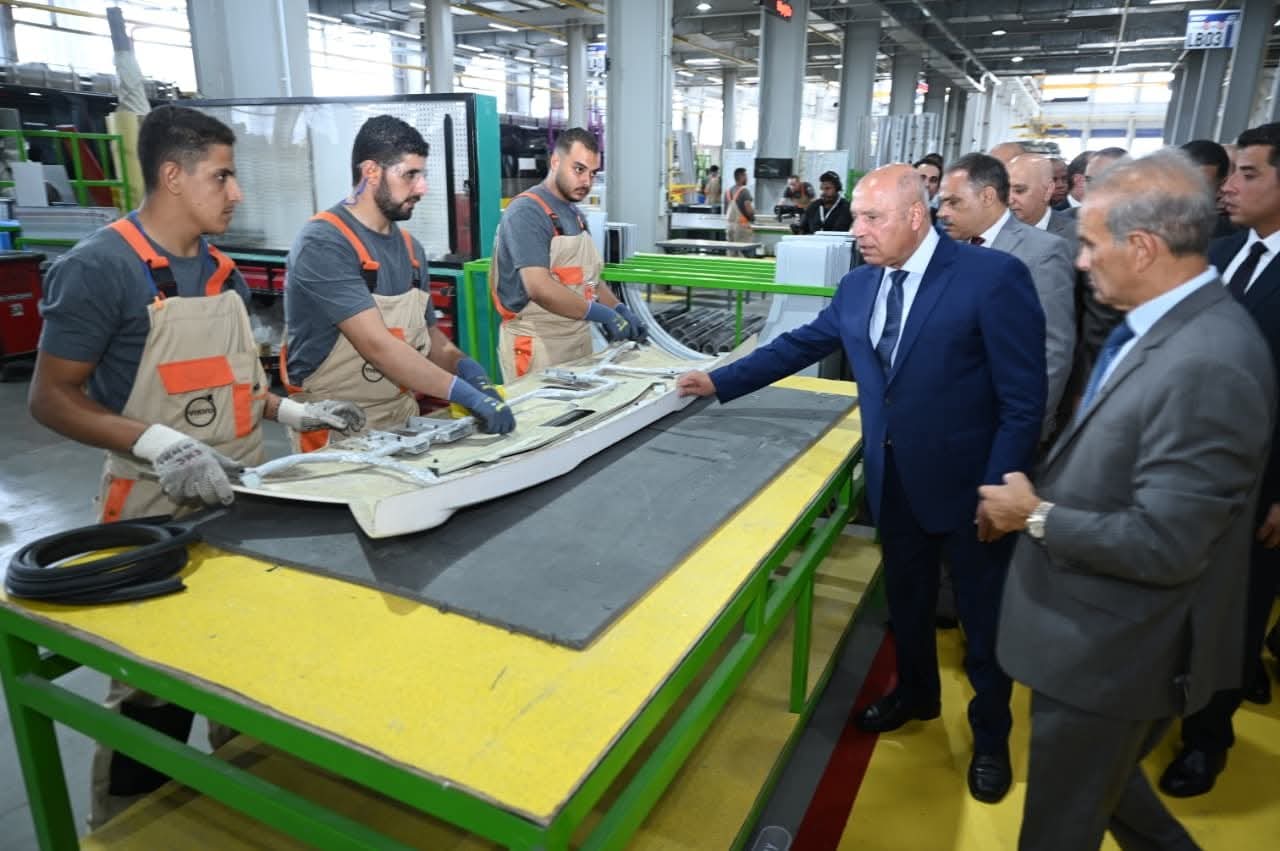
During an inspection tour of the production lines, the Minister
reviewed the different manufacturing stages, including the bus body assembly
and internal component installation. He also saw the finished models — the new
line's first production batch — designated for export to Britain and other
European markets.
During the tour, Al-Wazir directed Ministry of Industry
representatives to study ways to expand the number of car glass factories to
meet local market needs and enhance export opportunities. He underscored the
importance of supporting this vital sector as part of the strategy to localize
automotive feeder industries. He also stressed the need for the Egyptian
General Organization for Standardization and Quality to coordinate directly
with car manufacturers to overcome obstacles related to minibus licensing and
speed up their market launch in accordance with approved standards. He said the
ministry will continue to provide a supportive climate for investors and
resolve challenges facing local industry, considering it the engine of economic
development and export growth.
In a press conference, Minister Al-Wazir outlined Egypt's
strategy to support the electric vehicle industry, emphasizing that the project
is part of a broader vision to boost industrial competitiveness and exports. He
stressed the government's commitment to removing obstacles for investors and
accelerating industrial development.
He detailed a comprehensive strategy for localizing industry
with a focus on meeting domestic needs and expanding exports to solidify
Egypt's position as a regional industrial hub. He highlighted the
transportation manufacturing sector as a key area of this expansion, noting
that Egypt can now produce 2,000-2,500 buses annually, eliminating the need for
imports. He added that the country has more than five private-sector car
companies and one government-owned company, with ongoing efforts to increase
local components in final products to achieve self-sufficiency in both
traditional and electric vehicles.
When asked about factories in urban areas, Al-Wazir
explained that all countries regulate industrial activities to benefit citizens
and protect the environment. He noted that factories in residential blocks
cause traffic jams, noise, and environmental burdens.
He stressed that existing factories will not be closed but
will have their licenses renewed after implementing a corrective plan to comply
with environmental and traffic requirements. However, no new licenses will be
granted for any factory within residential blocks, urban areas, or on
agricultural lands, in line with the state's urban and industrial planning
direction.
Al-Wazir affirmed that the state adopts a transparent
approach based on equal opportunities when dealing with investors. He stressed
that no request from a serious investor for industrial land of any size is
rejected as long as they adhere to the rules and regulations, have financial solvency,
and a technical feasibility study that reflects the seriousness of the project
and its ability to add value to the national economy.
A survey by the Ministry of Industry revealed approximately
11,000 struggling factories, said Al-Wazir. Technical issues have been resolved
for many, but 6,000 still face financial difficulties and will be addressed by
a new fund.
The government aims to find a permanent solution for
struggling and closed factories. Over the years, it has launched several
initiatives, including the "productive sectors working capital support
initiative," which provided more than EGP 150 billion in financing at a
subsidized 15% interest rate. Another initiative offered EGP 30 billion in
subsidized financing for production lines and equipment.
Currently, the ministry is coordinating with the Central
Bank on a new initiative to restructure and restart these factories. The new
fund, "the initiative to establish a fund to finance struggling factories
and increase exports," is a crucial step toward reviving their role in
production and exports, boosting the national economy, and creating jobs.
Responding to a question on promising industries, Minister Al-Wazir
said the Ministry of Industry has identified 28 sectors for investment to
deepen local manufacturing, meet market needs, and reduce import costs.
He called on serious investors to expand into these targeted industries, in line with President Abdel Fattah El-Sisi's directives to offer specific, limited-time incentives for investors entering these sectors. The selection of these industries was based on key factors, including local market needs, available energy, trained labor, local resources, and existing production technology and factories.