
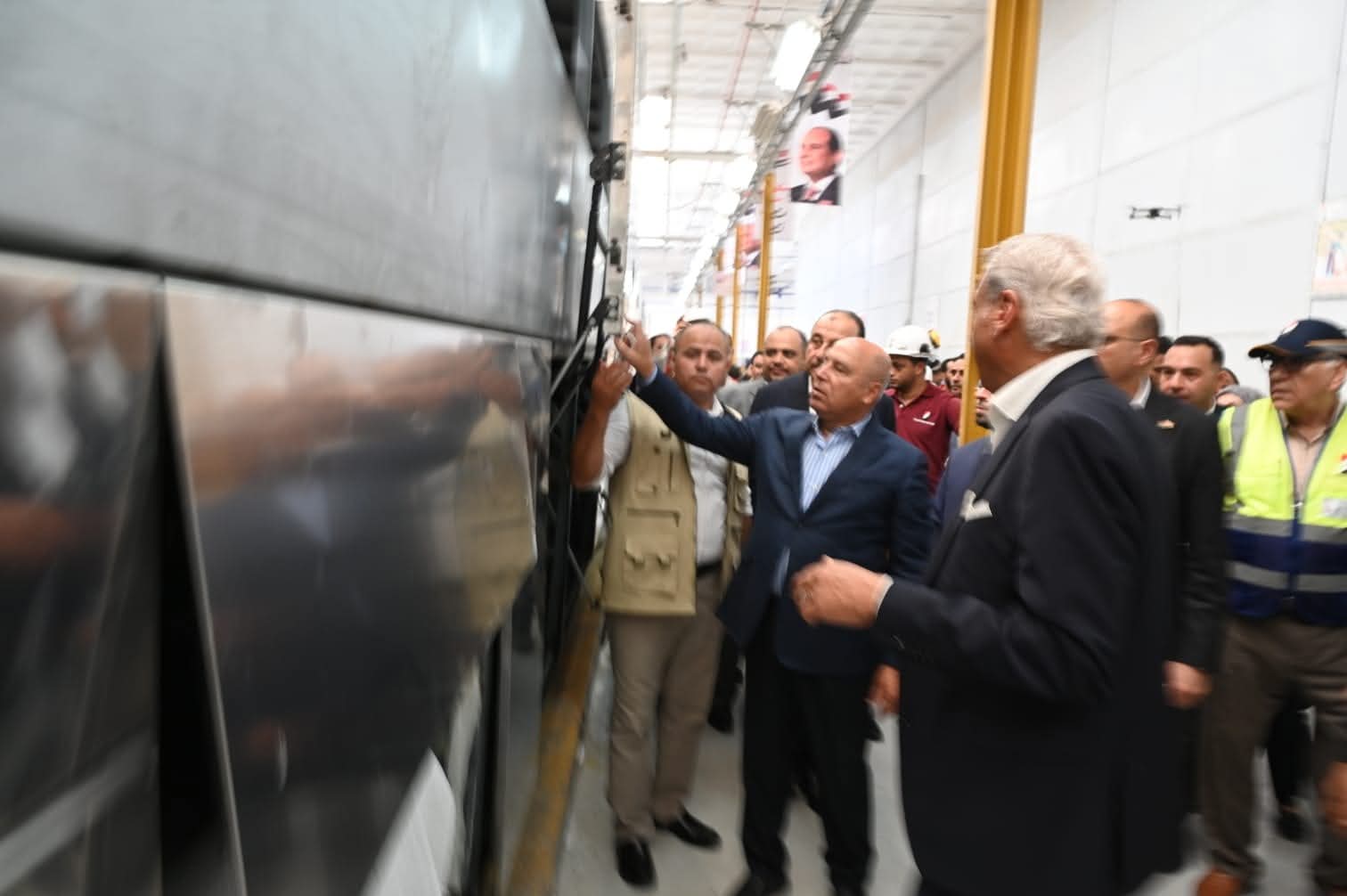
The delegation included Engineer Mohamed Shimi, Minister of Public Enterprise Sector, Mohamed Gobran, Minister of Labor, and Dr. Osama El-Azhary, Minister of Endowments.
The tour was also attended by Dr. Nahed Youssef, Head of the
Industrial Development Authority, Engineer Mohamed El-Saadawy, Managing
Director of the Metallurgical Industries Holding Company, Dr. Khaled Shedid,
Managing Director of El Nasr Automotive, and a number of leaders from the
Ministries of Industry and Public Enterprise Sector.
Al-Wazir began his inspection tour at El Nasr Automotive
Manufacturing Company, founded in 1960. The company’s sprawling 900,000-square-meter
facility houses nine factories ranging in size from 18,000 to 40,000 square
meters.
His first stop was Factory 4, the passenger car plant. He
observed initial operational trials and final preparations following a
comprehensive upgrade. The modernization included the installation of new
production lines for assembly, painting, and ovens, as well as an advanced
E-coat line for rust protection. At 44,000 square meters, the factory is now
home to one of the largest painting lines in the country, designed to meet the
latest global standards. All construction, mechanical, and electrical work has
been completed, with the entire operating system brought into full compliance
with safety and environmental regulations.
The officials toured the bus factory, which was re-commissioned
late last year and now produces several modern bus models. The factory
manufactures the Nasr Sky, a 12-meter tourist bus built to the latest global
standards, and the Nasr Star, an 8-meter minibus.
Covering an area of 40,000 square meters, the factory
features dedicated lines for frames, assembly, sheeting, and finishing. It's
equipped with advanced manufacturing technology, including laser and plasma
machines for producing the entire bus body. The tourist bus currently has a local
component percentage of 63%.
In addition to the existing models, the factory plans to
produce new eco-friendly buses that run on electricity or natural gas, known as
the Nasr Green series. The tour highlighted the importance of increasing local
manufacturing for components, such as the bus's metal sides, to further boost
the local content percentage.
Following the factory tour, they held an educational seminar
and a large meeting with the factory workers to encourage them to improve the
company. In his opening remarks, Al-Wazir expressed his pleasure in meeting the
workers of El Nasr Automotive, which he called a "cornerstone of Egyptian
industry."
He explained that the urgent plan for industrial
development, approved by President Abdel Fattah El-Sisi, is built on seven key
pillars. The most crucial of these is restarting closed and struggling
factories, which serves two main goals: Economic revitalization: The first goal
is to get industry back on track, restart the production cycle, and save the
foreign currency currently being spent on imports. El Nasr Automotive is a
prime example of this effort; Social responsibility: The second, and more
important, goal is to protect the workers and engineers, along with their
families, and to preserve Egypt's real estate and industrial assets.
Engineer Al-Wazir highlighted that reopening a closed or
struggling factory is far more efficient than building a new one from scratch,
which requires significant time for construction and labor training. He noted
that President El-Sisi's directives are to preserve Egypt's industrial and real
estate assets while rehabilitating the workforce and promoting a spirit of
activity, seriousness, and discipline. This is all backed by a strong political
commitment to get these factories running again.
The Minister praised the Egyptian workforce, describing them
as skilled, active, intelligent, and patriotic. He affirmed that the government
is dedicated to creating a supportive and motivating environment for loyal
workers to help El Nasr Automotive regain its prominence. This will be achieved
through the company's own efforts or through partnerships with local, Arab, and
foreign private sectors to secure necessary funding, knowledge, and technology.
Al-Wazir concluded by expressing his hope to see the factory in a phase of full
production during his next visit.
Minister of Public Enterprise Sector, Engineer Mohamed Shimi,
welcomed his fellow ministers and greeted the employees of El Nasr Automotive.
He expressed his pride in being among the staff of this "historic
industrial institution," which he called a "golden name in the memory
of Egyptians."
He emphasized that the name "Nasr" is more than
just a brand; it's a symbol of Egyptian will—a testament to the ability to
build, challenge, and overcome difficulties. Thanks to the support of President
Abdel Fattah El-Sisi and the dedication of the workers, this historic company
is being revived after years of stagnation.
The Minister confirmed that the production lines are already
active, producing buses with a high local component, including the "Nasr
Sky" and the "Nasr Star" minibus. Work is also underway to
produce eco-friendly buses that run on natural gas and electricity, as well as
to add new vehicle models and sizes to meet market demands.
Minister Shimi explained that this success is a result of integrated
efforts with the Ministry of Transport, which is supplying new "Nasr"
buses to its transport and tourism companies. This partnership ensures that
"Nasr" products directly serve the Egyptian public.
He also highlighted the significant developments at the passenger
car factory, which has been equipped with modern production lines for assembly,
painting, and E-coat. These upgrades prepare the factory for a new
manufacturing phase that honors its history while meeting global standards.
Addressing the workers directly, the Minister said, "To
the Nasr workers... you are the foundation, the heart, and the pulsating spirit
of this institution. Success is built by your effort and sustained by your
dedication." He stressed that the ministry is committed to improving the
work environment, ensuring quality, safety, and environmental protection, and
providing continuous training.
In his conclusion, the Minister reiterated that "Nasr"
is more than a name; it is a clear message that Egyptians are capable of
challenge and building a better future. He affirmed that the Ministry of Public
Enterprise Sector will continue to provide strong support to restore El Nasr
Automotive to its position as a symbol of national industry and a respectable
front for Egypt in the automotive field.
Minister of Labor, Mohamed Gobran, praised the national
industrial revival plan, crediting Eng. Kamel El-Wazir and other relevant
ministries for their efforts in expanding factories and developing strategic
industries. He celebrated the return of production at El Nasr Automotive,
calling it a major industrial stronghold.
Gobran stated that the plan to revive and develop industry
will create thousands of job opportunities and contribute directly and
indirectly to the development process, aligning with President El-Sisi's directives
and Egypt's 2030 Vision.
He also highlighted the new Labor Law No. 14 of 2025, set to
take effect next September, as a gift from the state to both workers and
employers. The law was designed to meet international labor standards, ensure
fairness and balance, and encourage investment. It also includes modern
mechanisms for managing future professions and new work patterns, with
amendments aimed at regulating the labor market, improving the work
environment, and strengthening workers' rights.
Minister of Endowments, Dr. Osama El-Azhary, expressed his
great pleasure in joining his colleagues and the employees of El Nasr
Automotive. He affirmed that building civilization is an Islamic duty.
He noted that the current generation has received a great
institution from a previous one, and it is now their responsibility to develop
and add to it. He sees this as a way to fulfill a trust, strengthen the nation,
and serve as a beacon for future generations.
Dr. El-Azhary expressed his anticipation for celebrating the
company's expanded production in the near future. He concluded by citing
historical figures who, through their sincerity and creativity, found great
happiness and left an immortal legacy.
On the sidelines of their visit to El Nasr Automotive,
Minister Kamel Al-Wazir and Minister Mohamed Shimi conducted an inspection of
the Egyptian Iron and Steel Company in Helwan. The purpose of the visit was to
study the optimal use of the company's assets for industrial purposes,
potentially in partnership with the private sector.
The Iron and Steel Company was founded in 1954, and a decision to liquidate it was made by the company's general assembly in 2021.