
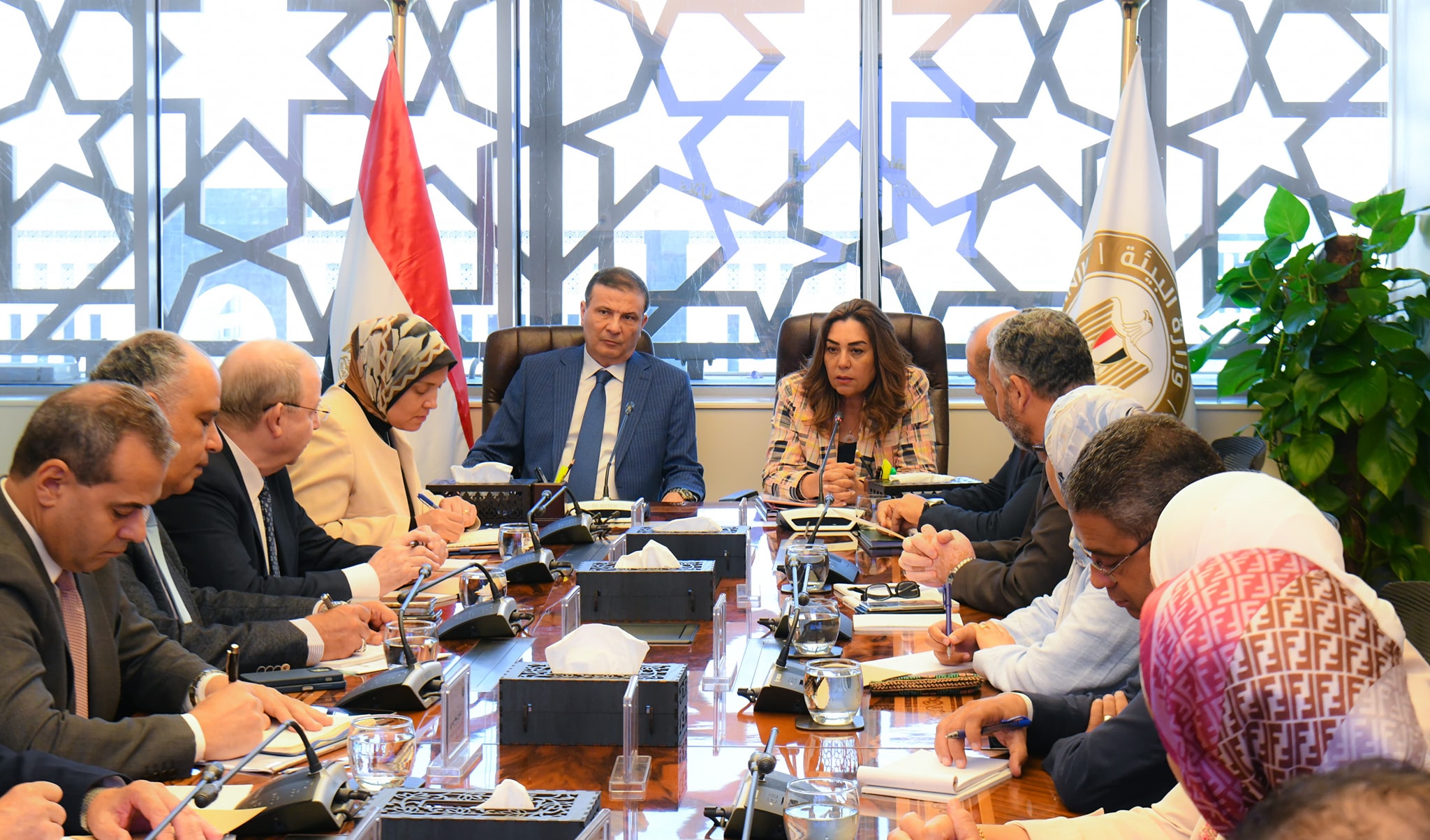
Awad emphasized the government's commitment to capitalizing on agricultural and animal waste. She highlighted the Ministry of Environment's efforts to increase the number of biogas units, aligning with Egypt's goal to boost exports and transition to organic fertilizers to enhance the competitiveness of Egyptian agricultural products in global markets.
Awad pointed out the government's focus on maximizing the
use of animal waste, including from slaughterhouses, and utilizing animal
manure to produce fertilizer and gas. She noted that a pilot biogas unit is
currently under construction at the Kafr Shukr slaughterhouse in Qalyubia,
which will serve as a model for future slaughterhouse designs.
The Minister stressed the need to expand the implementation
of medium and large-scale biogas units for agricultural and animal waste,
especially from large farms, slaughterhouses, and hotels. She highlighted the
success of the Ministry of Environment's Bioenergy Foundation in disseminating
biogas technology.
For his part, Farouk underscored the strategic importance of
expanding biogas units and recycling agricultural, animal, and poultry waste.
He described the initiative as a "qualitative leap" in resource
management, turning environmental challenges into economic opportunities.
Farouk said that agricultural and animal waste are valuable
resources that can be exploited through biogas units to produce organic
fertilizers and biogas. He added that the Ministry of Agriculture has previous
experience and specialized technical staff in this field, having implemented
biogas units and operating a training center for this purpose.
The Minister stressed the importance of raising awareness
among producers and encouraging them to reuse waste to produce organic
fertilizers that improve soil fertility and increase productivity. He also
highlighted the need for continuous coordination with all relevant entities,
especially the Ministry of Environment, to ensure the successful implementation
of the project.
Zaghloul Khedr, advisor to the Minister of Local
Development, presented a report emphasizing the benefits of using agricultural
and animal waste for organic fertilizer and biogas production. He noted that
agricultural exports reached 6.5 million tonnes and that Egypt ranks seventh
globally in chemical fertilizer production.
Khedr reviewed feasibility studies for constructing biogas
units with daily production capacities of 600 and 1,200 cubic meters of gas,
detailing their electricity and fertilizer output and estimated costs.
The meeting also reviewed the work of the Bioenergy for
Sustainable Development Foundation, which has established 2,000 biogas units
across 19 governorates. These units produce 2.152 million cubic meters of gas
annually, equivalent to 86,000 butane cylinders, and process 53,800 tonnes of
animal waste to produce 50,000 tonnes of organic fertilizer.
The foundation has recently expanded its efforts to include
medium and large-scale biogas units, such as a new unit at the Giza Zoo. A
project to utilize agricultural and animal waste is also underway in Beni Suef
Governorate, in cooperation with the United Nations Industrial Development
Organization (UNIDO). A partnership with Eni is being prepared to build a plant
with a capacity of 5,000 cubic meters per day, along with a system to collect
the 134 tonnes of animal waste needed for its operation.
The ministers concluded the meeting by forming a committee to develop an integrated plan to expand bioenergy projects, build biogas units, and maximize the use of agricultural, slaughterhouse, animal, and hotel waste. They called for accelerating the pace of work to align with the country's green transition and environmental sustainability goals.