
The NFSA's 28th weekly report for 2025, covering August 2-8, detailed the authority's efforts to enhance oversight of the food processing sector and international trade. The General Administration for Factory Control, in collaboration with the Industrial Control Authority, conducted 110 inspection missions to assess food facilities' compliance with quality and safety standards. Five new facilities were registered nationwide during the week.
In its oversight capacity, the NFSA's Control Department for
Packing Stations and Centers conducted 50 inspection and accreditation visits,
resulting in the registration of three new packing facilities. The department
also issued 444 export permits for agricultural products on behalf of 393
companies.
According to the General Administration of Exports and
Imports, a total of 3,470 food shipments, weighing approximately 170,000
tonnes, were exported by 1,200 companies. The shipments included about 650
varieties of products, such as vegetables, fruits, flour, and processed foods.
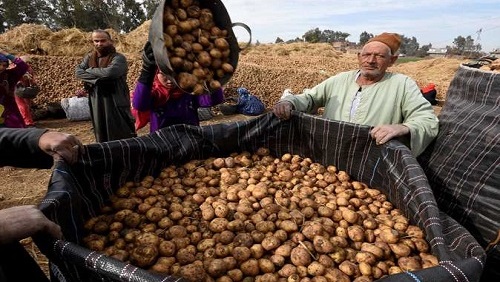
Sweet potatoes led vegetable exports with 7,000 tonnes,
followed by potatoes and beans at 6,000 tonnes each. In total, 47 types of
vegetables were exported, amounting to 33,000 tonnes.
Strawberries topped fruit exports with 10,000 tonnes,
followed by mangoes at 7,000 tonnes and fresh grapes at 3,000 tonnes. In total,
28 types of fruits were exported, totaling 30,000 tonnes.
These exports were distributed to 166 countries, with the
United States, Saudi Arabia, Sudan, and Somalia being among the main importers
of Egyptian products during the week.
The port of Safaga was the busiest export point, handling
580 food shipments. It was followed by the port of Alexandria with 560
shipments and Cairo International Airport with 410.
In support of food exports, the NFSA issued 715 health
certificates during the week to ensure products met safety requirements,
thereby boosting international confidence in Egyptian goods.
On the import side, Egypt received 1,810 food shipments,
totaling 245,000 tonnes, from 830 companies. The imports included wheat,
soybeans, various oils, and fava beans. Ukraine was the top exporter to Egypt,
followed by the United States, Russia, and Malaysia.
The port of Alexandria was the primary entry point for food
imports, receiving 572 shipments, followed by Cairo International Airport with
365 and Port Said with 265.
Regarding customs clearance, 1,031 food shipments were
temporarily released. A further 400 shipments were released through the
expedited clearance system.
In compliance with the Grievances Committee, official reports were filed for 80 shipments. Additionally, import licenses were issued to 65 importers during the same period.