
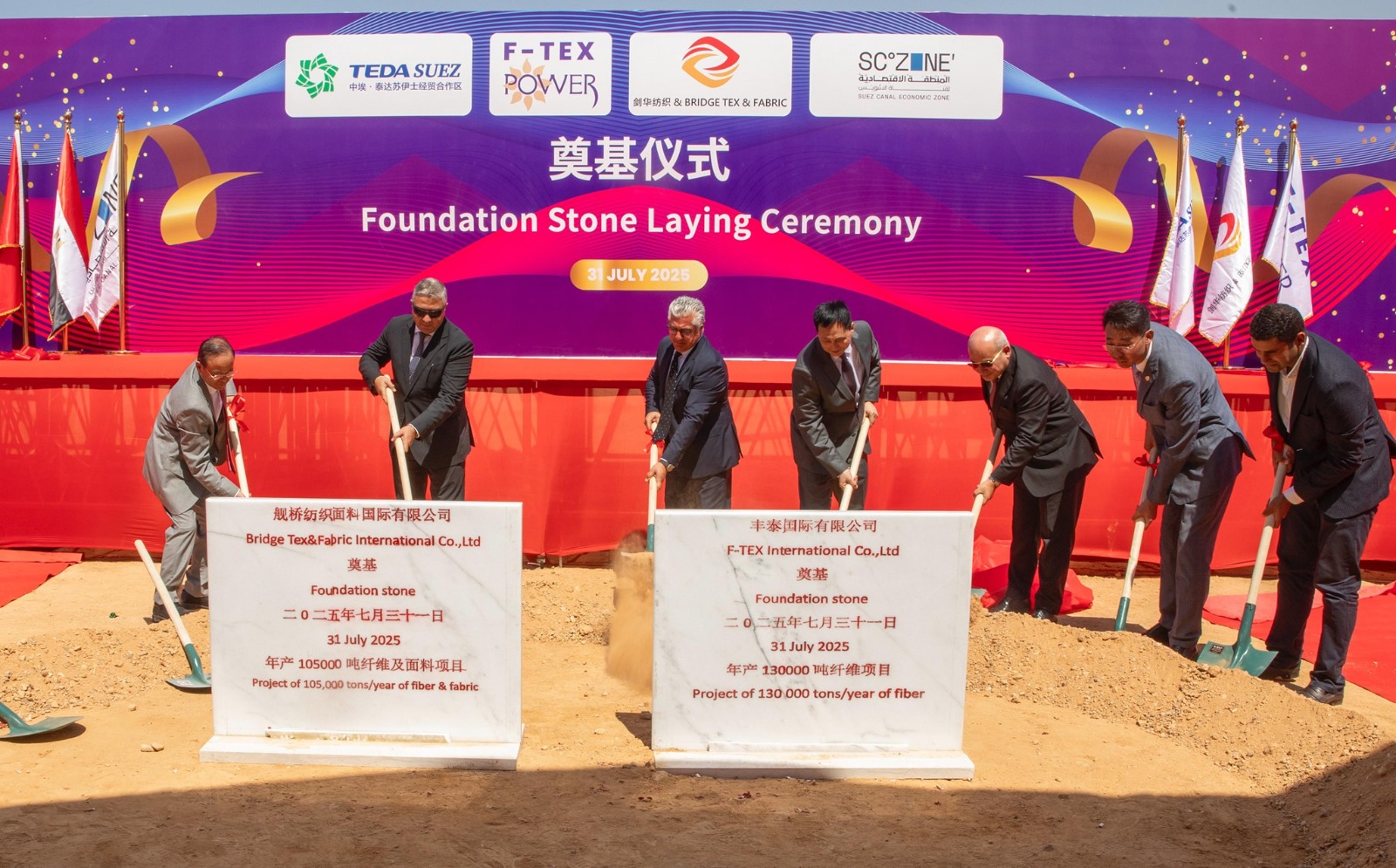
The projects, located within the TEDA-Egypt industrial developer's area, were launched in the presence of Cao Hui, CEO of TEDA-Egypt, Zhang Li Hua, director of Bridge-Tex, and Lu Xin Rang, director of F-Tex, alongside other officials from SCZONE.
The first project, undertaken by Bridge Textile
International Egypt, involves building an integrated industrial complex across
40,000 square metres with investments exceeding $25 million. It will feature
administrative and residential buildings, 18 spinning lines, over 100 fabric
production lines, and six printing and dyeing lines for finished fabrics,
forming a complete industrial chain. The complex aims for an annual production
capacity of 25 million metres of high-quality fabrics and 105,000 tonnes of
fibres, creating around 500 direct and 1,000 indirect jobs.
The second project, by F-TEX INTERNATIONAL, will span 55,000
square metres and house 60 production lines for DTY polyester fibres, with an
investment of approximately $30 million. Expected to be fully operational by
the end of 2027, it targets an annual production of 130,000 tonnes, providing
around 400 direct jobs and generating up to $150 million in annual export
revenues.
Gamal El-Din stated that these projects mark a significant
addition to SCZONE, reflecting international investors' confidence, particularly
from China, in the region's investment climate. He lauded the successful
partnership with TEDA-Egypt, an industrial developer known for attracting
quality investments. Discussions during his recent visit to China included
allocating an additional 10 square kilometres to TEDA, reflecting SCZONE's
commitment to supporting industrial expansion.
Gamal El-Din affirmed SCZONE's dedication to providing
necessary support for the timely execution of these projects. He noted that
they enhance added value, create jobs, foster industrial integration, and boost
Egypt's competitiveness in global supply chains. He highlighted SCZONE's
success in attracting $8.6 billion in investments across 297 projects over the
past three years, with $4.4 billion from 121 projects in the last fiscal year
alone.
Zhang Li Hua of Bridge-Tex said their project anticipates
$120 million in annual sales, including $100 million in foreign currency
revenues, with 80 percent of production destined for European and American
markets. This strategy, leveraging Egypt's competitive edge, Chinese
technology, and global markets, aims to help Egypt's textile exports surpass
$10 billion annually.
Lu Xin Rang of F-Tex described their project as a new link
between two great textile civilisations, emphasising that true cooperation
involves integrating Chinese standards with Egyptian wisdom and labour for
sustainable development. He commended the support from the Egyptian government
and SCZONE in creating a favourable investment environment, expecting factory
construction to conclude and trial operations to begin within a year.
These initiatives are part of SCZONE's broader efforts to localise strategic industries, deepen domestic manufacturing, and expand exports. The zone's unique geographical location and integrated port infrastructure enable new projects to quickly access regional and global markets.