
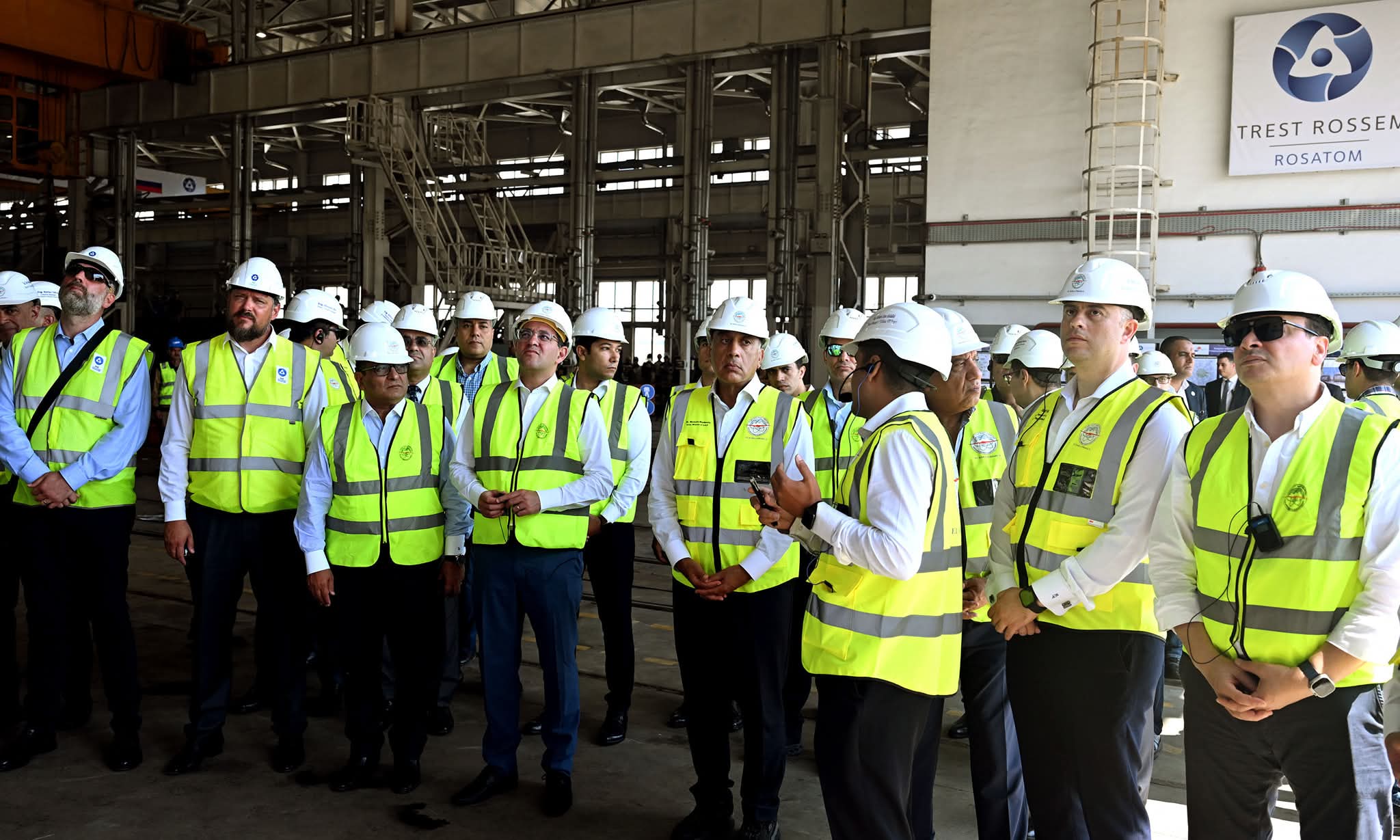
Madbouly was received by Engineer Mahmoud Esmat, Minister of
Electricity and Renewable Energy, Ahmed Kouchouk, Minister of Finance, Dr.
Sherif Helmy, Chairman of the Nuclear Power Plants Authority for Electricity
Generation, and several leaders from the Ministry and the Authority.
Also present were Karen Vasilyan, Russia's Consul General in
Alexandria, and Alexey Kononenko, vice president of Atomstroyexport, the
Russian general contractor for the project.
At the beginning of the visit, the prime minister
underscored the "continuous support of the political leadership for
various projects being implemented in the energy sector." He said this
support aims to strengthen Egypt's efforts to diversify electricity generation
sources, reduce reliance on fossil fuels, and expand the use of renewable and
clean energy.
The Prime Minister pointed out that the Dabaa Nuclear Power
Plant project represents the realization of a national dream that the Egyptian
people have harbored since the mid-last century. Today, it has become a
tangible reality embodying the national will and firm determination to possess
advanced, safe, and sustainable sources of electricity generation. He added
that this project reflects the deep and strong relations between the two
friendly countries, Egypt and Russia, and underscores the insightful vision of
the leaderships of both countries in enhancing further aspects of cooperation
and coordination in many fields and sectors, especially concerning the
promising energy sector, through the establishment of the first nuclear power
plant for peaceful uses on Egyptian soil.
At the beginning of the visit, the Prime Minister watched an
explanatory video titled "Features of the Dabaa Project," which
showcased the project's development stages and achievements to date. This was
followed by a presentation covering the vision and efforts of the Nuclear Power
Plants Authority for Electricity Generation regarding this colossal national project,
highlighting accomplishments on the ground and future aspirations.
Madbouly emphasized that the Dabaa project embodies Egypt's
"national will and firm determination to possess advanced, safe, and
sustainable sources of electricity generation." He added that the plant
reflects the "deep and strong relations between the two friendly
countries, Egypt and Russia."
The prime minister watched an explanatory video detailing
the project's development and achievements before receiving a presentation on
the NPPA's vision and efforts.
He then toured the construction and installation base,
including manufacturing workshops where parts of the internal containment
vessel for the reactor building are produced.
Electricity Minister Mohamed Shaker affirmed that the Dabaa
plant "is one of the most prominent strategic national projects receiving
special care and significant attention from the political leadership." He
added it is crucial for diversifying Egypt's energy mix, meeting increasing
electricity demand, and contributing to sustainable development in line with
Egypt's Vision 2030.
After inspecting the construction area, Madbouly observed
all components of the plant, which includes four nuclear units. Helmy provided
a detailed explanation of the project's progress, emphasizing that all work is
on schedule with "no obstacles or delays." He also noted that all
work adheres to the highest quality and nuclear safety standards.
Helmy highlighted the project's commitment to local participation, stating that Egyptian labor constitutes up to 80% of the workforce. He added that the plant utilizes the latest technology and will be operated by "purely Egyptian hands" from its first day of operation.