
Accompanying the Minister were Dr. Nahed Youssef, Head of
the Industrial Development Authority, and several key officials from the
Ministry of Industry.
The tour commenced at the Obour Land Food Industries Company
complex, a sprawling 35,000-square-meter facility. This major player boasts an
impressive annual production capacity of 170,000 tons of cheese, 70,000 tons of
sterilized milk, and 50 million liters of juice. Obour Land employs over 2,500
individuals and exports its diverse products to more than 33 countries,
including the US, Russia, and the Arabian Gulf. Notably, in 2024, the company's
exports reached a significant $20 million.
Engineer Mohamed Hamed El-Sherif, Chairman of Obour Land
Food Industries Company, along with Ashraf Hamed, Vice Chairman, and Mohamed
Ashraf Hamed, Head of Development, welcomed the Minister.
During his visit, Al-Wazir meticulously inspected the
sterilized milk and juice factory, reviewing reception tanks and filling
machines. He also explored a mini-exhibition showcasing the factory's extensive
product range. The tour continued to the white cheese factory, where he
examined the packaging hall with its four production lines, the cheese factory
laboratory, Tetrapak lines, and the final assembly line.
The Minister urged the ministry's affiliated bodies to
conduct regular inspections of laboratories to ensure the safety of raw
materials and equipment. He also emphasized the critical need to double the
company's production of various types of white cheese to adequately meet local
market demands.
Next on the agenda was the Ceramica Royal Company factory, a
leader in ceramic and porcelain tile production. Spanning 70,000 square meters,
the factory has an annual production volume of 15 million square meters and
exports to European, Middle Eastern, and American markets, employing 1,665
individuals.
Engineer Hossam El-Sallab, Chairman of Ceramica Royal
Company, and Engineer Mohamed El-Sallab, Head of the Industry Committee in the
House of Representatives, welcomed the Minister at the factory.
Al-Wazir's inspection included an exhibition of the
company's products, the raw material preparation area for glaze and colours,
and the drying, pressing, glazing, sorting, and kiln areas.
The Minister lauded the factory's exceptional product
quality, highlighting its unique position as the only factory in Egypt and the
Middle East to produce 2 cm and 3 cm thick porcelain tiles for maximum
load-bearing capacity, ideal for use in ports, airports, and roads. He also
commended its pioneering efforts in producing glazed porcelain with sizes up to
60x120 cm. Furthermore, El-Wazir praised the factory's sustainable production
processes, which eliminate water and raw material waste through comprehensive
recycling, significantly reducing production costs and optimizing resource
utilization.
In a move to bolster local manufacturing, the Minister
directed that all tiles used in subway stations be supplied by local
manufacturers.
Al-Wazir reaffirmed the government's unwavering commitment
to safeguarding national industry from dumping practices, in accordance with
World Trade Organization laws. This measure, he stated, will help rationalize
import bills and increase reliance on local products. He also expressed the ministry's
ambition for Ceramica Royal Company's factory to achieve self-sufficiency for
the local porcelain market.
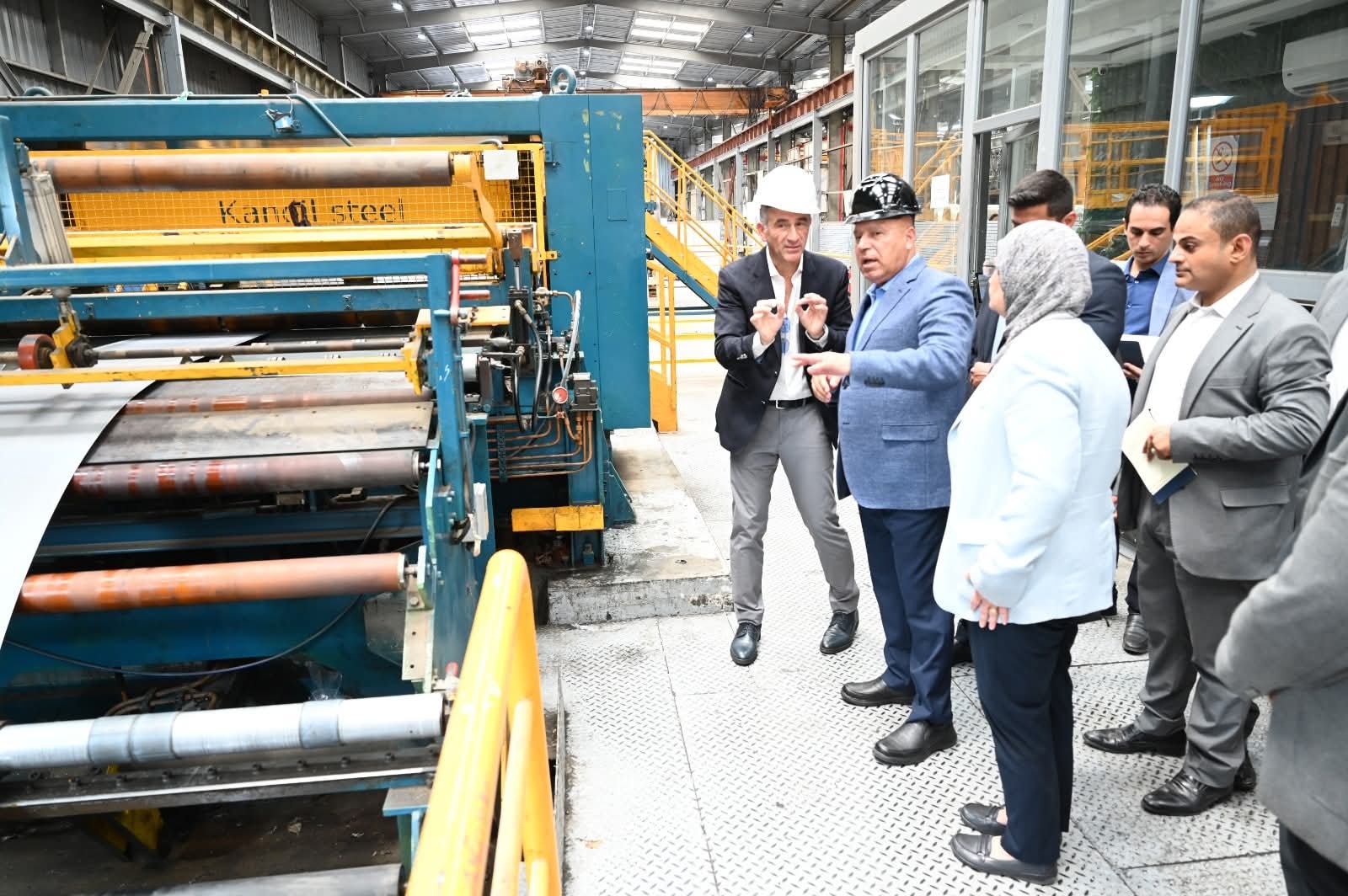
The Minister then proceeded to the Qandil Steel Group
factory, where he was welcomed by Engineer Amr Qandil, Chairman of Qandil Steel
Group. The visit included a miniature exhibition of the final products, as well
as inspections of the pickling and rolling production line, the grinding and
furnaces line, the galvanizing line, and the zinc bath.
A highlight of the visit was the inspection of two multi-slice
cutting lines, the first of their kind in Egypt, the Middle East, and Africa.
These cutting-edge lines specialize in precisely cutting and slitting steel
sheets of all sizes, particularly for the home appliance sector, which demands
high quality and precision. Investments in these two advanced lines reached 6
million Euros in 2024.
Al-Wazir underscored the vital importance of cultivating a second generation of qualified factory workers to ensure the seamless transfer of skills and continuity of production. He also emphasized the strategic benefit of exporting trained technical labor abroad and enhancing worker training through the Productive Efficiency and Vocational Training Authority, an entity affiliated with the Ministry of Industry. The Minister concluded with a reassuring message to Egyptian workers, asserting that true industry fundamentally relies on skilled, trained, and dedicated individuals, and that labor remains indispensable for any industry, regardless of the increasing adoption of modern technologies.