
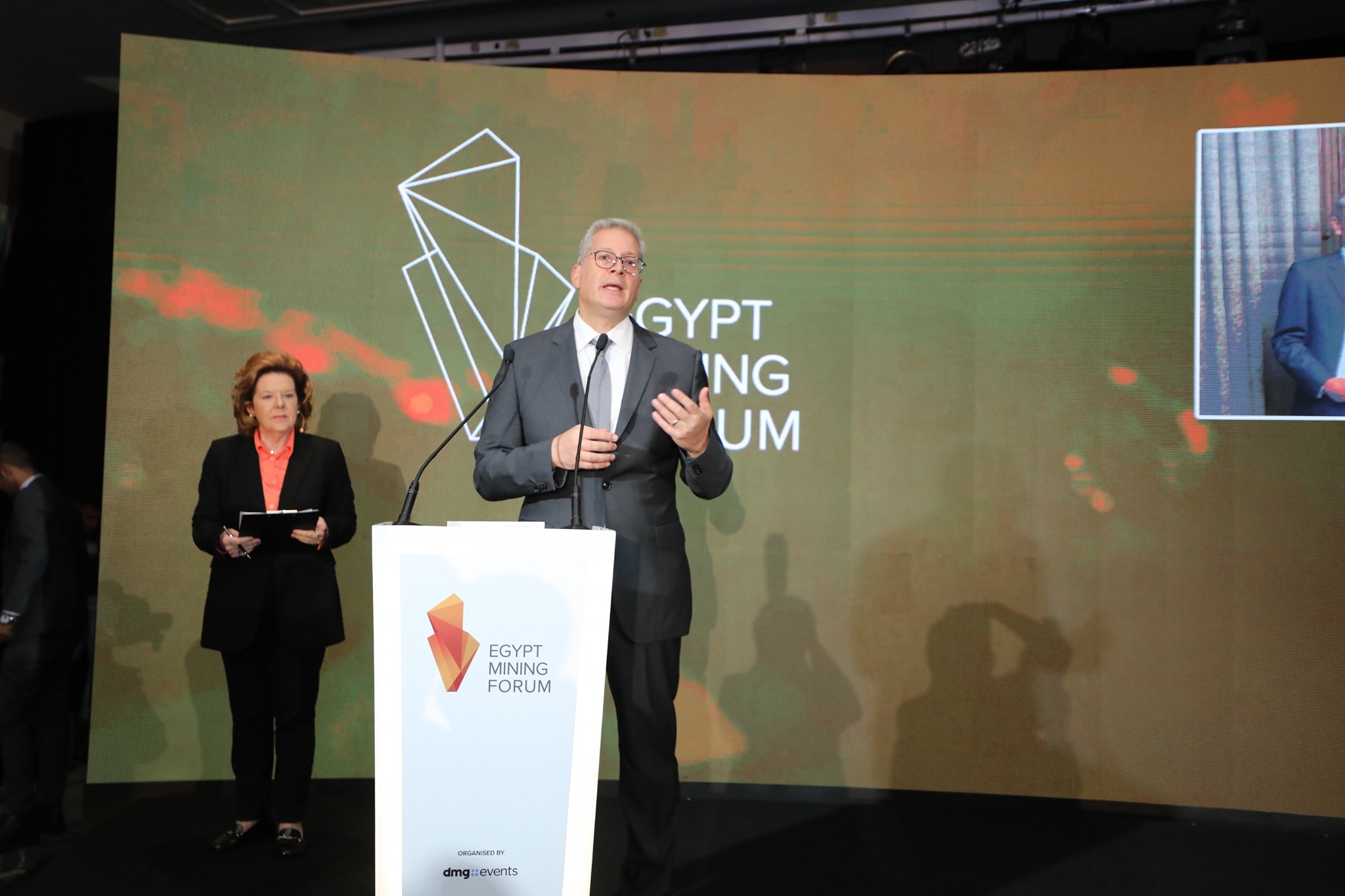
The opening session saw high-level attendance, including
Parliamentary and Legal Affairs Minister Mahmoud Fawzi, Jordanian Minister of
Energy and Mineral Resources Saleh Al-Kharabsheh, Saudi Vice Minister for
Mining Affairs Khaled Al-Mudaifer, and Equatorial Guinea's Minister of Mines
and Hydrocarbons Antonio Oburu.
Also present were several members of parliament and
governors, including Qena Governor Khaled Abdel Halim, First Undersecretary of
the House of Representatives Ahmed Saad Eddin, head of parliament's industry
committee Mohamed El-Sallab, head of the energy and environment committee
Talaat El-Sewedy, deputy head of the industry committee Shehata Abouzid, and
Mohamed Ismail, a member of the constitutional affairs committee and introducer
of the Mineral Resources Law. Deputy governors from New Valley, Red Sea, and
Aswan governorates also attended.
Ambassadors from various Arab and foreign countries, along
with senior officials from mining sectors in Arab and African nations, and CEOs
and directors of major international and local mining companies, were also in
attendance.
In his opening speech, Minister Badawi welcomed attendees to
Egypt, stating, "We gather to inaugurate the fourth session of the Egypt
Mining Forum (EMF), taking a new step forward in our journey towards exploring
more opportunities and unleashing the full potential of Egypt's mining
sector."
He added that in a short period, the forum has
"witnessed remarkable development to become a high-level platform bringing
together industry experts and decision-makers to exchange innovative ideas on
achieving optimal utilization of our mineral wealth, contributing to the
aspirations and ambitions of our peoples towards maximizing the benefit from
these resources."

This year's Egypt Mining Forum (EMF), held under the slogan
"Accelerating Commercial Exploration and Mineral Discoveries," aims
to drive discussions on investment, policies, licensing, exploration,
exploitation, and technology localization. It also seeks to build resilient and
responsible mineral value and supply chains through strategic alliances and
partnerships.
"God has endowed Egypt with vast mineral resources, an
unparalleled strategic location, and advanced transport and energy
infrastructure," the minister stated. He added that Egypt's inclusion of a
significant part of the Arabian-Nubian Shield makes it a "land of golden
opportunities."
He highlighted Egypt's substantial reserves of mineral
wealth, including gold, copper, silver, zinc, platinum, and numerous other
precious and essential minerals, positioning it as one of the most important
global mining destinations. This immense potential is supported by the Egyptian
government's economic reform program, which aims to achieve economic stability,
attract investments, and enhance market attractiveness. This will bolster
Egypt's standing as a distinct and exceptional destination for international
investors and place it on the global mining investment map, consistent with the
sustainable development strategy (Egypt Vision 2030).
He noted that, in line with presidential directives to transform
the Mineral Resources Authority from a service body into an economic entity
with legal personality, under the name "Mineral Resources and Mining
Industries Authority," and to restructure it to prepare an integrated
strategy for maximizing the utilization of Egypt's mineral wealth and achieving
a qualitative leap in the Egyptian mining sector, coordination has been carried
out in a spirit of cooperation and integrated work among various ministries,
bodies, and legislative and executive authorities to implement an appropriate
regulatory framework aimed at providing an attractive investment climate in the
mining sector.
The law transforming the Mineral Resources Authority from a
service body into an economic body under the name "Mineral Resources and
Mining Industries Authority" has been successfully issued, allowing for
its restructuring and the preparation of an integrated strategy to maximize the
benefit from Egypt's mineral wealth. The new law grants the authority financial
and administrative independence, supporting development operations and mining
process management by establishing the necessary institutional framework to
achieve strategic objectives. This is achieved through a detailed framework for
the new organizational structure and key positions, with clear definitions of
regulatory roles and responsibilities, enabling the authority to perform its
assigned role to the fullest without any obstacles or difficulties, and
increasing its contribution to supporting the national economy.
Transforming the Mineral Resources Authority from a service
to an economic entity also aims to support and develop the mineral resources
sector and implement mining sector plans and projects. This includes developing
an integrated strategy for organizing geological and mining survey,
exploration, discovery, and evaluation work, preparing associated laboratory
studies and geological and mining maps, and establishing a national strategy
for localizing mining industries in coordination with relevant authorities by
implementing projects based on the exploitation of local mineral raw materials
to maximize their added value. The ultimate goal is to achieve the greatest
possible benefit from mineral resources, contributing to a breakthrough in the
mining sector and making Egypt a regional hub for mining industries.
He added that following discussions and negotiations with
major mining companies for nearly a year to finalize the terms and conditions
of an exploitation agreement model for awarded exploration areas, an agreement
model has been reached that rivals international agreements in leading mining
countries.
A draft exploitation agreement model was agreed upon on
December 4, 2024, during a meeting with Barrick Gold and AngloGold Ashanti on
the sidelines of the Egyptian-British Business Association mission in London.
Initialing of the agreement took place on April 20, 2025.
He further stated that the Ministry of Petroleum and Mineral
Resources is working to develop and optimally utilize petroleum and mineral
wealth according to six main axes, the third of which focuses on achieving a
breakthrough in the mining sector and maximizing its added value to increase
its contribution to the GDP to reach 5-6%.

Minister of Petroleum and Mineral Resources highlighted
significant positive indicators in the mining sector during the 2024/2025
fiscal year.
Key achievements include:
Gold and Silver Production: Output reached 640,000 ounces, a
14% increase from the previous year. Total sales hit $1.5 billion, marking a 57%
rise.
Mineral Ore and Product Output: 26 million tons were
produced, up 39% from the prior year.
Mineral Exports: 1.4 million tons of mineral ores and
products, excluding phosphate rock, were exported, valued at $52.5 million.
Mining Revenues: Mineral resource development revenues
reached $446 million, a significant 131% increase over the previous year,
including gold revenues.
Successful Bid Round: The first public bid round of 2024 for
kaolin sands/glass sand and associated minerals in the Eastern Desert,
announced by the Egyptian General Authority for Mineral Resources in December
2024, saw considerable interest. Twenty companies participated, 19 of which
were from the private sector, reflecting confidence in the investment climate
fostered by the ministry's transparent and equitable policies.
"Egypt Mining Portal" Progress: The first and
second phases of the "Egypt Mining Portal," designed to enhance the
authority's efficiency and support investors, have been completed. This digital
investment platform aims to boost transparency, data accessibility, and promote
investment opportunities. The final phase is underway, with an official launch
expected soon.
Phosphoric Acid Complex Deal: Final agreements and contracts
for the industrial complex to produce phosphoric acid in the Abu Tartour
plateau were signed, with the New Valley Governor in attendance. The framework
agreement was signed between project shareholders, and a general contractor
agreement was inked with the Chinese consortium CSCEC/ECEC. This project
represents a qualitative leap to maximize value-added and economic returns from
Egyptian phosphate rock by channeling it into high-yield industries instead of
exporting it as raw material. The project, with an investment cost of $658
million, aims to produce 250,000 tons annually of high-concentration commercial
phosphoric acid (P₂O₅ 100%) in its first phase, using phosphate from Abu
Tartour mines and leveraging the latest global technology.
Strategic Phosphate Partnership: A Memorandum of
Understanding was signed with Elsewedy Capital Investments in early July to
explore, evaluate, exploit, and produce phosphate rock in the Nile Valley
(Sebaiya mines) and enhance its concentration. If the commercial feasibility
study proves viable, the target is an annual production of at least 1 million
tons with a P2O5 concentration of no less than 25%.
Promising Gold Discoveries: Field visits by Barrick Gold to
the Wadi Al-Allaqi area in April yielded encouraging results for gold
occurrences. Barrick Gold's report indicated promising samples from both veins
and alteration zones across a wide area.
High-Grade Mineral Intersections: Aton Resources announced
the completion of its diamond drilling program in the Abu Marawat concession
area in the Eastern Desert, a key technical evaluation stage that began in June
2024. Recent drilling results confirmed high-value mineral intersections,
including 33.86 grams/ton of gold and 419 grams/ton of silver, and another
intersection recording 44.59 grams/ton of gold and 103 grams/ton of silver,
indicating rich concentrations and promising mineral extensions at depth. These
results reinforce the rich geological potential of the Eastern Desert, a
prominent promising mineral area within the Arabian-Nubian Shield.
New Gold Exploration Agreements: A licensing agreement for
gold and associated minerals exploration will be signed today between the
Ministry of Petroleum and Mineral Resources, the Mineral Resources and Mining
Industries Authority, and Centamin Central, owned by AngloGold Ashanti.
Additionally, a framework agreement will be initialed between the Ministry, the
Authority, and Barrick Gold. These agreements signify international companies'
strong desire to expand investments in Egypt's mining sector, reflecting global
confidence in Egypt's investment climate and the success of the state's policy
in attracting foreign investments.
The conference is set to feature crucial discussions in both
strategic and technical sessions, involving a host of prominent speakers. These
include a ministerial session on attracting strategic partners, a governors'
session on their role in fostering an attractive investment climate in their
governorates, and an ambassadors' session on their perspectives on Egypt's
mining investment climate. A session for major global mining investors will
also explore ways for Egypt to enhance its global competitiveness in mining.
The second day of the strategic conference will include several important
sessions, notably one on the new Mineral Resources Law.
Furthermore, several technical sessions will focus on reviewing the latest developments in project implementation, sustainable best practices, and innovative technologies and solutions applied across various areas of the mining industry.