
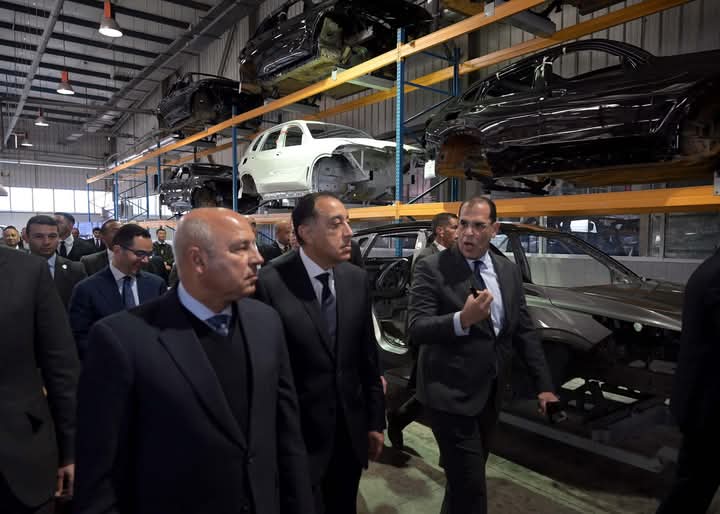
The initiative seeks to deepen local manufacturing, reduce reliance on imports, open new export markets for Egyptian products, enhance the international perception of Egypt's investment climate, and support national goals for industrial development and comprehensive economic growth.
International institutions are
optimistic about Egypt's automotive sector. Fitch Solutions forecasts further
improvement in vehicle production by 2025, citing anticipated stable exchange
rates and relaxed import restrictions. The firm noted that improved local
dollar liquidity could foster a conducive environment for production growth.
Fitch also highlighted that
strategic government initiatives will be crucial in propelling the growth of
the electric vehicle (EV) sector, positioning it as a key area of expansion
within the Egyptian automotive industry. The International Energy Agency
further affirmed that Egyptian car manufacturers' efforts to expand battery and
EV production lines and facilitate exports to the European Union have
contributed to their increased adoption locally.
The government's support includes
the National Strategy for Localizing the Automotive Industry, launched in 2022
with EGP 1.5 billion allocation in the 2024/2025 budget. Seven companies have registered
for this initiative, with three already submitting invoices. An updated version
of the strategy was approved in May 2025 and is set to take effect in July
2025.
Additional measures include
activating the Automotive Industry Development Program (AIDP) to localize
manufacturing and offer incentives for increased added value. The Supreme
Council for the Automotive Industry and the Green Vehicle Financing Fund were
established under Law No. 162 of 2022. Furthermore, the first graduates of the
"Android Automotive" software development program for vehicles
completed their training in December 2024.
In the electric vehicle sector, a
contract has been signed to establish a joint-stock company for manufacturing
Egypt's first electric mini-bus, designed to carry 24 passengers with a
production capacity of up to 300 buses. An electric battery production line
with a capacity of 600 batteries is also slated for establishment in 2026.
Development efforts also include
the "Egypt Sat Auto" project, with an investment of approximately EGP
300 million, focusing on manufacturing electric passenger cars, buses, EV
charging stations, electric scooters, and EV components and spare parts.
Key automotive manufacturing and
assembly projects highlighted include the Geely car assembly plant, featuring
two production lines with an annual capacity of up to 10,000 cars and a local
manufacturing content of up to 45% in assembly lines.
El Nasr Automotive Company boasts
over 50% local content and an annual production capacity of 300 buses. The Egyptian
German Automotive (EGA) factory has an annual production capacity of 1,200
Mercedes cars and 3,000 Exeed cars.
In the automotive feeder
industries, the Prometeon Tyres Egypt factory produces approximately 1.1
million heavy-duty vehicle tires annually, with about 70% exported, creating
around 2,000 jobs. The Sumitomo global factory in 10th of Ramadan City, the
company's largest worldwide for automotive wiring harnesses, is expected to
create 10,000 job opportunities and targets exports to major European car
manufacturers.
The Mansour Vehicle Filters factory was also noted, with investments exceeding $10 million and an annual production capacity of over 10 million filters.