
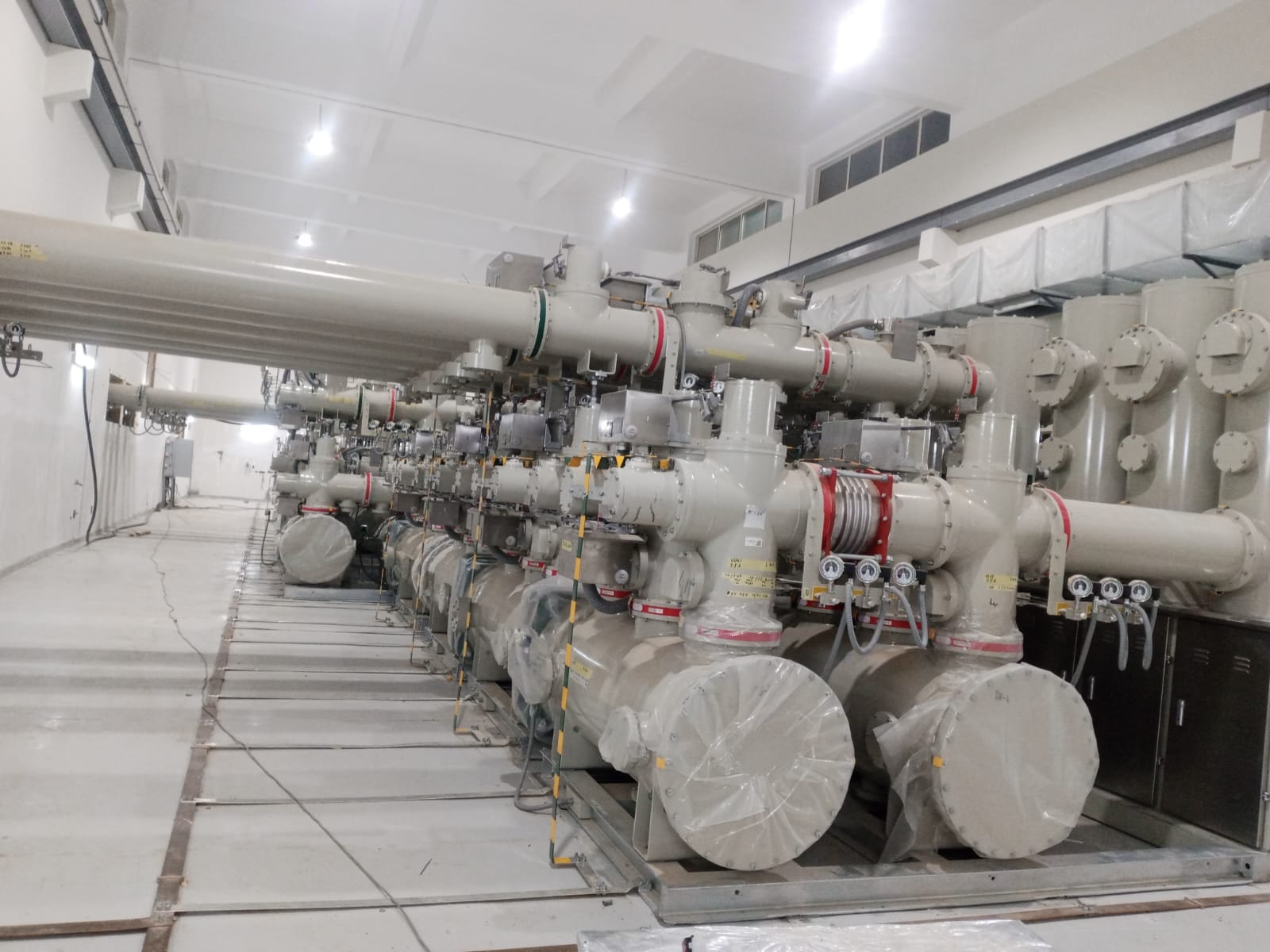
The Minister verified that the distribution networks and transmission lines were fully operational across various voltages, including those supplying power to the lifting pump distributors. The station's activation is a critical move, ensuring electricity reaches the agricultural development projects managed by Egypt's Future for Sustainable Development Agency.
The project was completed in record time and to the highest
technical standards, thanks to its crucial connection with the summer planting
season. Dr. Esmat's personal, on-site supervision over the past two months,
combined with seamless coordination between the South Cairo Electricity
Distribution Company and the Egyptian Electricity Transmission Company, ensured
its early and timely completion. This remarkable efficiency and discipline
meant the agricultural season wasn't missed.
The Rawafaa Rashid 2 station boasts a modern, compact
design, incorporating two 220 kV transformers and six 66 kV transformers. Its
operational capacity effectively matches that of two independent stations. This
technical feat significantly boosts the national grid's flexibility and its
ability to support future developmental expansions. Critically, it will serve
as a primary power source for agricultural reclamation and urban expansion
projects, aligning perfectly with the broader vision for desert development and
maximizing the use of natural resources.
Dr. Esmat underscored the substantial government support for
the electricity sector, recognizing its pivotal role as a fundamental pillar
for comprehensive and sustainable development. He emphasized the integrated
plan to ensure electricity availability for all uses, particularly for
agricultural development and land reclamation, which are vital for achieving
energy self-sufficiency.
Commending the project's implementation team for their dedication and timely grid integration, Dr. Esmat highlighted the strategy to improve energy system efficiency and implement immediate, sustainable solutions for grid stability and service quality. This strategy prioritizes renewable energy sources and optimizes the performance of generation plants. He reaffirmed the commitment to providing the necessary electrical supply for all new projects, especially those related to agricultural reclamation, manufacturing, and greenhouses, under the purview of Egypt's Future for Sustainable Development Agency.