
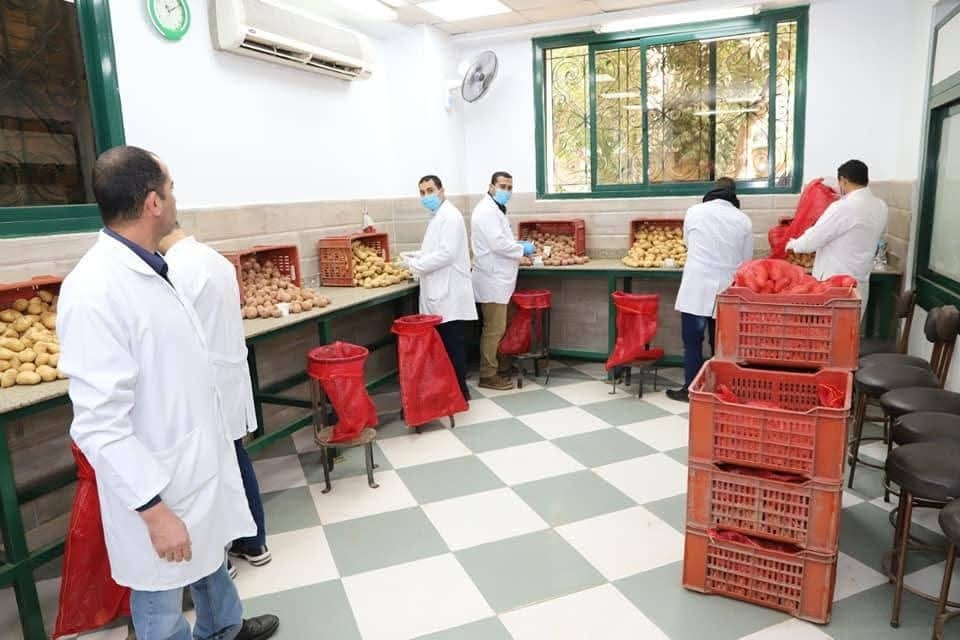
The figures were detailed in an official report received by Minister of Agriculture and Land Reclamation Alaa Farouk from Dr. Naglaa Balabel, Director of the Potato Brown Rot Survey and Control Project, outlining the project's activities and efforts during May.
Dr. Balabel highlighted an unprecedented intensity of
project activities in May, particularly concerning the volume of table potatoes
inspected for export to various countries. This aligns with the minister's
directives for continuous monitoring and sustained efforts to enhance
efficiency and improve performance, under the supervision of Dr. Ahmed Adham,
Head of the Agricultural Services and Follow-up Sector.
The project director stated that from the beginning of the
season until the end of May, 1,356,067 tons of table potatoes were inspected
for export, representing approximately 52,500 samples. Of this, 319,589 tons
(12,036 samples) were examined in May alone. She noted a substantial 34% surge
in potatoes prepared for export this year compared to the same time last year,
when roughly 1 million tons were inspected.
Regarding visual inspection samples of potatoes at 75 days
post-planting for the 2024-2025 season, Dr. Balabel reported that the total
number of winter cultivation samples reached approximately 8,168, and summer
cultivation samples totaled 4,354 by the end of May. This included 99 winter
cultivation samples and 670 summer cultivation samples during May. For local
break seeds (refrigerated) in the first phase of the 2025-2026 season, 23,141 tons,
representing 1,167 samples, were examined by the end of May, with 14,000 tons
(700 samples) processed in May.
Dr. Balabel affirmed the ongoing work of the project's monitoring
and follow-up unit. This includes reviewing data from forms submitted by engineers
in brown rot-free zones via tablets to the data preparation and reception
platform, as well as issuing reports and indicators on the performance of these
engineers. Approximately 835 satellite images have been uploaded to monitor
both winter and summer potato cultivations. Four new areas, totaling 375
feddans, have been established within the brown rot-free zones, bringing the
total number of pivots to 4,147 and farm units to 268 within the geographic
database. The total area of brown rot-free zones is approximately 622,000
feddans. Additionally, routine maintenance was conducted on 120,000 feddans of
cultivated brown rot-free zones this season.
She also indicated that data for the 2024/2025 summer
cultivation has been entered into the geographic database for brown rot-free
zones, covering 544 devices over an area of 40,000 feddans, compared to 36,000
feddans in the previous season. Soil salinity, chlorophyll, and vegetative
water content analyses are being conducted for summer cultivations using remote
sensing technology. Data from field withdrawals for the 2024-2025 summer
season, comprising 4,354 samples, has also been entered into the brown rot-free
zone geographic database.
Dr. Balabel added that the harvesting of the 2024-2025 summer cultivation is being continuously monitored daily, with a review of harvesting quantities for each company against the inspected quantities received by the project to ensure that inspection volumes do not exceed harvested volumes. Furthermore, data for three cold storage facilities holding certified potato seeds, comprising 1,167 samples and 23,141 tons for the first phase, have been entered to confirm their freedom from brown rot disease.