
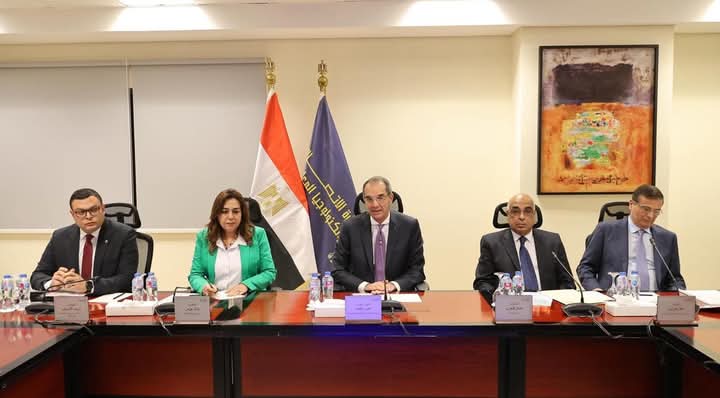
The primary focus of the meeting was to follow up on the system's current status and to coordinate efforts for drafting the executive regulations of the law, which was recently approved by the House of Representatives.
The meeting focused on the latest developments in
preparing the digital system that will manage the issuance of real estate
national ID numbers for units across all governorates. This system is nearing
its launch, marking a crucial step in regulating Egypt's real estate wealth.
Dr. Amr Talaat emphasized that the Real Estate National
ID system aims to assign a unique identifier to each property, much like the
national ID for citizens. This unique number will be the sole identifier for
all government transactions related to that property.
He highlighted the significant efforts involved in
preparing the Real Estate ID Law, noting the successful linking of all relevant
databases with the Real Estate National ID system. So far, approximately 19
million real estate national ID numbers have been issued across several
governorates, a collaborative effort with the Real Estate Wealth Operation
Center at the Administrative Control Authority. Dr. Talaat underscored the
system's crucial role in providing accurate data for every property,
encompassing both residential units and agricultural land.
Dr. Manal Awad affirmed the Ministry of Local
Development's commitment to collaborating with the Ministry of Communications
to facilitate the Real Estate National ID system's implementation. This
partnership aims to unify and link databases, ultimately improving data quality
for the system's benefit.
She added that the Ministry will provide essential data
from local administrations concerning citizen services in various governorates
and technological centers. This contribution is crucial for the successful
on-the-ground implementation of the system.
Counselor Adnan Fangary underscored the critical nature
of the first and second phases in implementing the Real Estate National ID Law
and its numbering regulations. He further emphasized the necessity for all
property units in each governorate to be affiliated with the Real Estate
National ID system to ensure its effective operation.
Engineer Sherif El-Sherbiny stressed the importance of unifying efforts within the Real Estate National ID system to create a comprehensive database of all Egyptian properties, both existing and future. This database will be linked with the "Egypt Real Estate" platform, already launched in cooperation with the Ministry of Communications and Information Technology.
He reiterated that the recently approved Real Estate National ID Law aims to assign a national ID number to every property nationwide. This project, he affirmed, opens new horizons for a complete digital transformation in real estate transactions. Furthermore, he highlighted the Ministry of Housing's proactive steps towards institutional activation by establishing two new units:
The Egyptian Real Estate Export Unit: This unit aims to
create a national platform for global marketing of Egyptian real estate,
connecting foreign investors with available opportunities in a transparent and
organized manner.
The Real Estate Market Regulation Unit: This unit is
responsible for setting controls and rules to regulate the real estate market
and monitoring the relationship between developers and buyers.
El-Sherbiny concluded by stating that this meeting
underscores the state's confident strides towards building a unified digital
system for managing its real estate assets.
Alaa Farouk emphasized the crucial role of the Ministry
of Communications and Information Technology in implementing this project as
part of its efforts to develop the digital system. This is being done in
coordination and joint cooperation with relevant ministries and government entities
to facilitate citizens' transactions with various government bodies.
He also highlighted the importance of linking the Real
Estate National ID not only to residential units (whether owned or rented) and
inherited properties, but also to agricultural lands, especially considering
issues of land fragmentation and successive inheritances.
Engineer Mahmoud Badawi, Assistant Minister of
Communications and Information Technology for Digital Transformation Affairs,
outlined the Ministry's approach to preparing the Real Estate National ID
system. He explained that the mechanism follows international coding standards,
starting with the land, then the building, followed by the individual unit, and
finally the street. He also mentioned the plan to print the Real Estate
National ID on electricity bills.
Once implemented, citizens will be able to easily identify the real estate national ID of their units through electricity bills. The system is also expected to significantly contribute to improving transparency and regulating the real estate market in Egypt, further supporting the nation's digital transformation plans.